







Question: competing on productivity ARTICLE ANALYSIS For each article in the text that is assigned, you are to prepare an outline of the key concepts of
competing on productivity
ARTICLE ANALYSIS
For each article in the text that is assigned, you are to prepare an outline of the key concepts of the article. This can be in outline format, but should be typed and look professional. Each is worth a maximum of 50 points.
read the artical and pull out the key concepts.
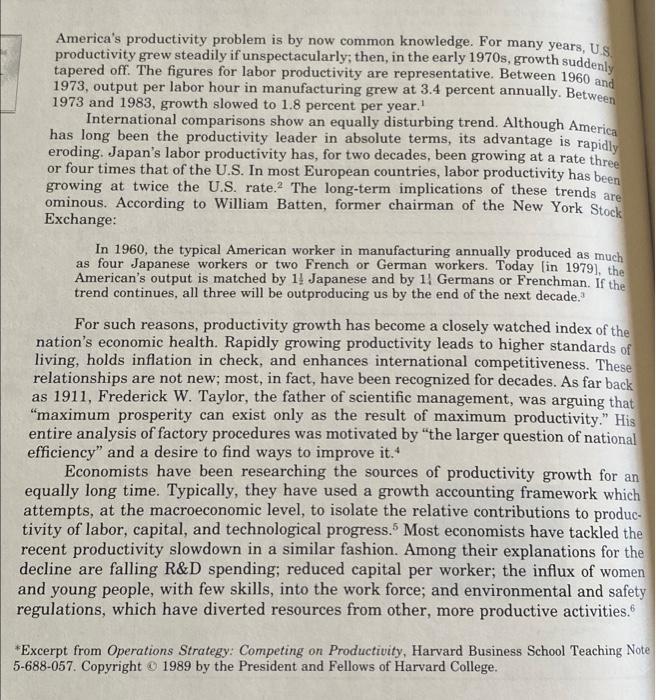
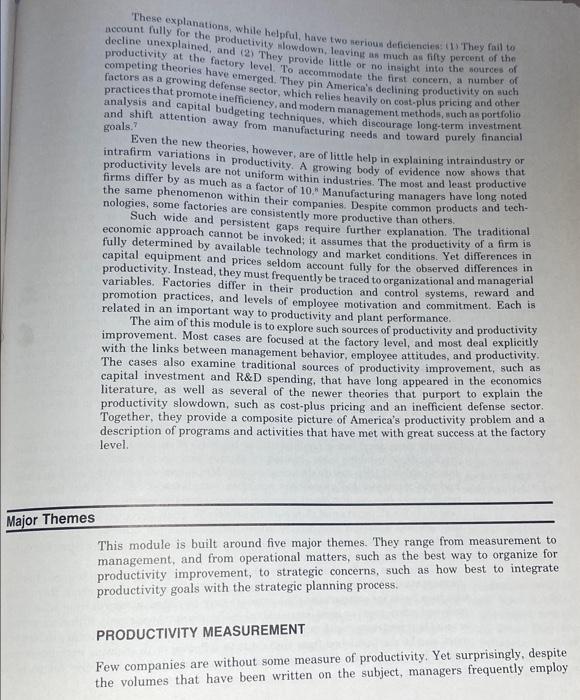
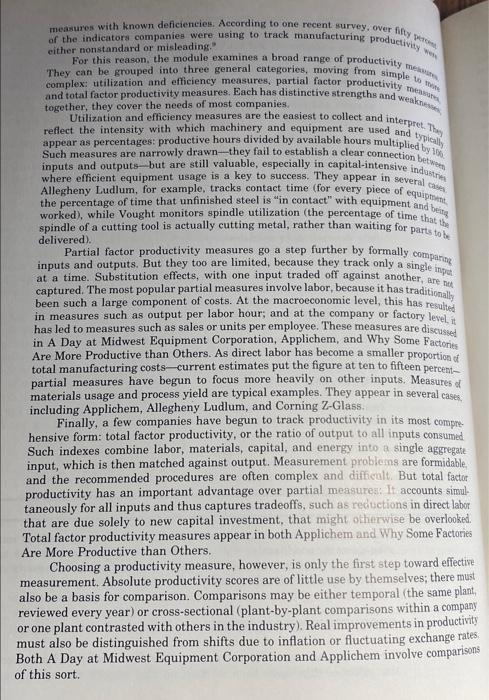
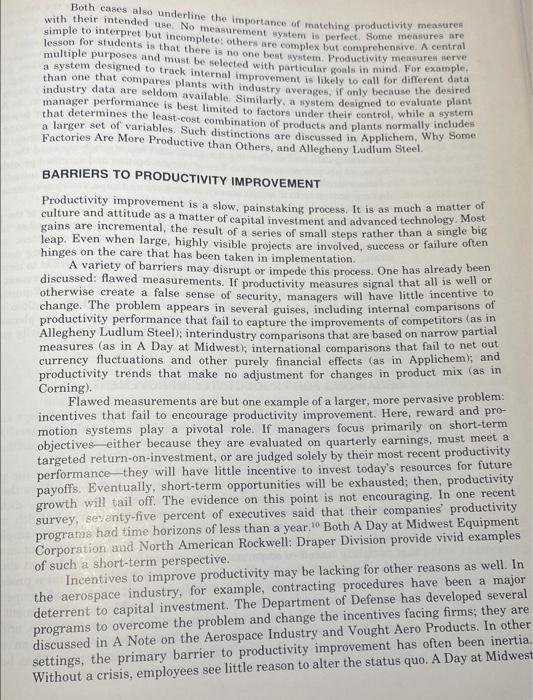
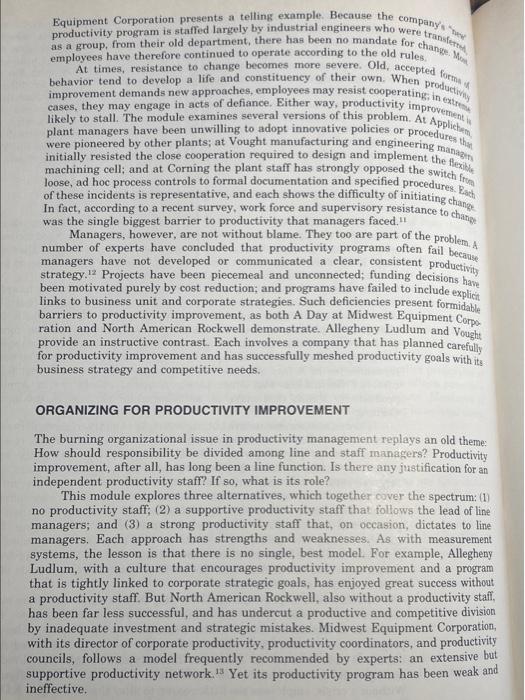
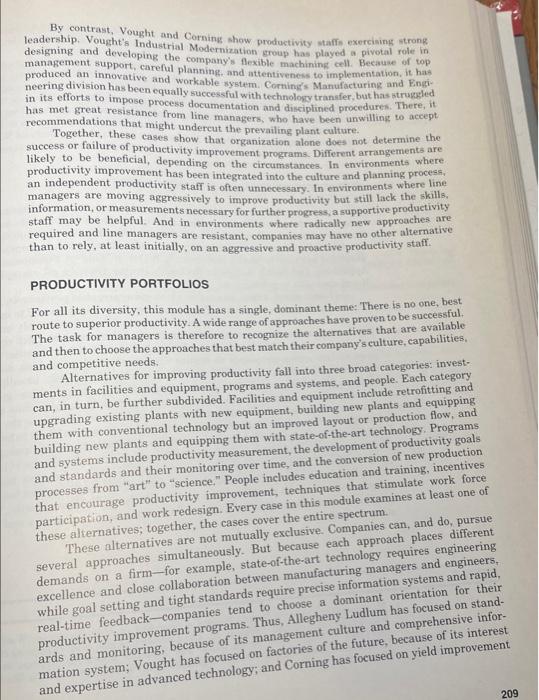
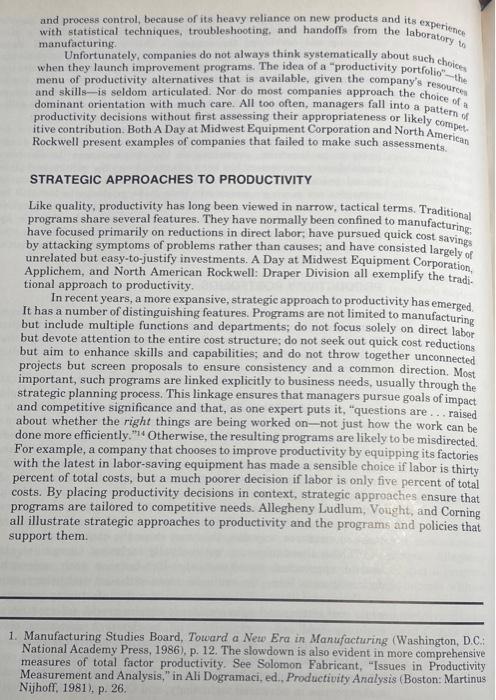
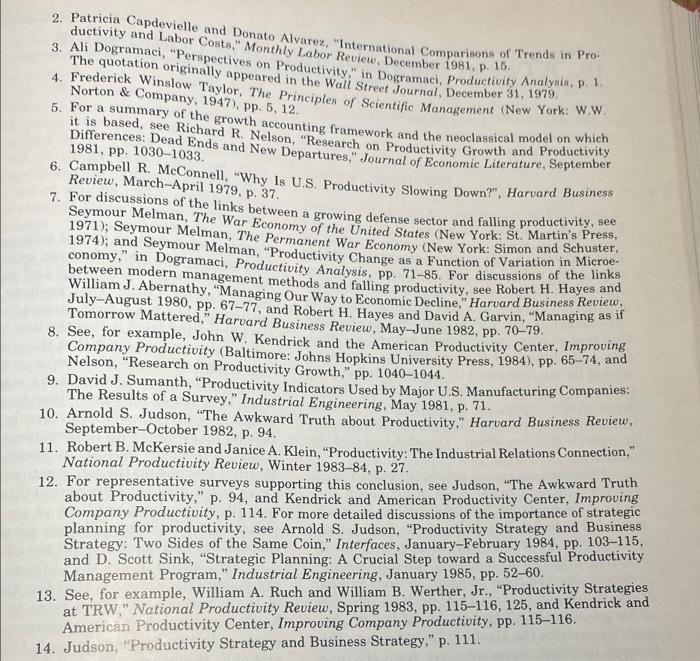
America's productivity problem is by now common knowledge. For many years, US productivity grew steadily if unspectacularly; then, in the early 1970s, growth suddenly tapered off. The figures for labor productivity are representative. Between 1960 and 1973, output per labor hour in manufacturing grew at 3.4 percent annually. Between 1973 and 1983, growth slowed to 1.8 percent per year.! International comparisons show an equally disturbing trend. Although America has long been the productivity leader in absolute terms, its advantage is rapidly eroding. Japan's labor productivity has, for two decades, been growing at a rate three or four times that of the U.S. In most European countries, labor productivity has been growing at twice the U.S. rate. The long-term implications of these trends are ominous. According to William Batten, former chairman of the New York Stock Exchange: In 1960, the typical American worker in manufacturing annually produced as much as four Japanese workers or two French or German workers. Today (in 1979), the American's output is matched by 11 Japanese and by 1: Germans or Frenchman. If the trend continues, all three will be outproducing us by the end of the next decade. For such reasons, productivity growth has become a closely watched index of the nation's economic health. Rapidly growing productivity leads to higher standards of living, holds inflation in check, and enhances international competitiveness. These relationships are not new, most, in fact, have been recognized for decades. As far back as 1911, Frederick W. Taylor, the father of scientific management, was arguing that "maximum prosperity can exist only as the result of maximum productivity." His entire analysis of factory procedures was motivated by the larger question of national efficiency" and a desire to find ways to improve it. Economists have been researching the sources of productivity growth for an equally long time. Typically, they have used a growth accounting framework which attempts, at the macroeconomic level, to isolate the relative contributions to produc- tivity of labor, capital, and technological progress. Most economists have tackled the recent productivity slowdown in a similar fashion. Among their explanations for the decline are falling R&D spending; reduced capital per worker; the influx of women and young people, with few skills, into the work force; and environmental and safety regulations, which have diverted resources from other, more productive activities. * a *Excerpt from Operations Strategy: Competing on Productivity, Harvard Business School Teaching Note 5-688-057. Copyright 1989 by the President and Fellows of Harvard College. goals. These explanations, while helpful. have two serious deficiencies: 1. They follo account fully for the productivity Nowdown, leaving as much as tiny percent of the decline unexplained, and (2) They provide little or no insight into the sources of productivity at the factory level. To accommodate the first concern, a number of competing theories have emerged. They pin America's declining productivity on sich factors as a growing defense sector, which relies beavily on cont plus pricing and other practices that promote inefficiency, and modem management methods, vachan portfolio analysis and capital budgeting techniques, which discourage long-term investment and shift attention away from manufacturing needs and toward purely financial Even the new theories, however, are of little help in explaining intraindustry for intrafirm variations in productivity. A growing body of evidence now shows that productivity levels are not uniform within industries. The most and least productive firms differ by as much as a factor of 10. Manufacturing managers have long noted the same phenomenon within their companies. Despite common products and tech- nologies, some factories are consistently more productive than others. Such wide and persistent gaps require further explanation. The traditional economic approach cannot be invoked; it assumes that the productivity of a firm is fully determined by available technology and market conditions. Yet differences in capital equipment and prices seldom account fully for the observed differences in productivity. Instead, they must frequently be traced to organizational and managerial variables. Factories differ in their production and control systems, reward and promotion practices, and levels of employee motivation and commitment. Each is related in an important way to productivity and plant performance. The aim of this module is to explore such sources of productivity and productivity improvement. Most cases are focused at the factory level, and most deal explicitly with the links between management behavior, employee attitudes, and productivity. The cases also examine traditional sources of productivity improvement, such as capital investment and R&D spending that have long appeared in the economics literature, as well as several of the newer theories that purport to explain the productivity slowdown, such as cost-plus pricing and an inefficient defense sector. Together, they provide a composite picture of America's productivity problem and a description of programs and activities that have met with great success at the factory level Major Themes This module is built around five major themes. They range from measurement to management, and from operational matters, such as the best way to organize for productivity improvement, to strategic concerns, such as how best to integrate productivity goals with the strategic planning process, PRODUCTIVITY MEASUREMENT Few companies are without some measure of productivity. Yet surprisingly, despite the volumes that have been written on the subject, managers frequently employ measures with known deficiencies. According to one recent survey. Over Wy perce of the indicators companies were using to track manufacturing productivity w either nonstandard or misleading." They can be grouped into three general categories, moving from simple to w For this reason, the module examines a broad range of productivity the and total factor productivity measures. Each has distinctive strengths and weak, complex: utilization and efficiency measures, partial factor productivity together, they cover the needs of most companies, Utilization and efficiency measures are the easiest to collect and interpret thay appear as percentages: productive hours divided by available hours multiplied by V reflect the intensity with which machinery and equipment are used and typically Such measures are narrowly drawn they fail to establish a clear connection betwem inputs and outputs but are still valuable, especially in capital-intensive indust where efficient equipment usage is a key to success. They appear in several Allegheny Ludlum, for example, tracks contact time (for every piece of equip worked), while Vought monitors spindle utilization (the percentage of time that the the percentage of time that unfinished steel is "in contact with equipment and . Partial factor productivity measures go a step further by formally comparint inputs and outputs. But they too are limited, because they track only a single captured. The most popular partial measures involve labor, because it has traditionally spindle of a cutting tool is actually cutting metal, rather than waiting for parts to been such a large component of costs. At the macroeconomic level, this has resulted in measures such as output per labor hour, and at the company or factory level in has led to measures such as sales or units per employee. These measures are discussed in A Day at Midwest Equipment Corporation, Applichem, and Why Some Factories Are More Productive than others. As direct labor has become a smaller proportion of total manufacturing costs-current estimates put the figure at ten to fifteen percent partial measures have begun to focus more heavily on other inputs. Measures materials usage and process yield are typical examples. They appear in several cases including Applichem, Allegheny Ludlum, and Corning Z-Glass. Finally, a few companies have begun to track productivity in its most compre hensive form: total factor productivity, or the ratio of output to all inputs consumed Such indexes combine labor, materials, capital, and energy into a single aggregate input, which is then matched against output. Measurement problems are formidable . and the recommended procedures are often complex and difficult. But total factor productivity has an important advantage over partial measures: li accounts simul- taneously for all inputs and thus captures tradeoffs, such as reductions in direct labor that are due solely to new capital investment, that might otherwise be overlooked. Total factor productivity measures appear in both Applichem and Why Some Factories Are More Productive than Others, Choosing a productivity measure, however, is only the first step toward effective measurement. Absolute productivity scores are of little use by themselves, there must also be a basis for comparison. Comparisons may be either temporal (the same plant, reviewed every year) or cross-sectional (plant-by-plant comparisons within a company or one plant contrasted with others in the industry). Real improvements in productivity must also be distinguished from shifts due to inflation or fluctuating exchange rates, Both A Day at Midwest Equipment Corporation and Applichem involve comparisons of this sort Both cases also underline the importance of matching productivity measure with their intended use. No measurement system is perfect. Some measures simple to interpret but incomplete: others are complex but comprehensive. A centrul lesson for students is that there is no one beat system. Productivity measures were multiple purposes and must be selected with particular wouls in mind. For examples a system designed to track internal improvement is likely to call for different data than one that compares plants with industry averagen, if only beenuse the desired industry data are seldom available. Similarly, a system designed to evaluate plant manager performance is best limited to factors under their control, while a system that determines the least-cost combination of products and plants normally includes a larger set of variables. Such distinctions are discussed in Applichem, Why Some Factories Are More Productive than others, and Allegheny Laadlum Steel a BARRIERS TO PRODUCTIVITY IMPROVEMENT Productivity improvement is a slow, painstaking process. It is as much a matter of culture and attitude as a matter of capital investment and advanced technology. Most gains are incremental, the result of a series of small steps rather than a single big leap. Even when large, highly visible projects are involved, success or failure often hinges on the care that has been taken in implementation A variety of barriers may disrupt or impede this process. One has already been discussed: flawed measurements. If productivity measures signal that all is well or otherwise create a false sense of security, managers will have little incentive to change. The problem appears in several guises, including internal comparisons of productivity performance that fail to capture the improvements of competitors (as in Allegheny Ludlum Steel); interindustry comparisons that are based on narrow partial measures (as in A Day at Midwest); international comparisons that fail to net out currency fluctuations and other purely financial effects (as in Applichem); and productivity trends that make no adjustment for changes in product mix (as in Corning) Flawed measurements are but one example of a larger, more pervasive problem: incentives that fail to encourage productivity improvement. Here, reward and pro- motion systems play a pivotal role. If managers focus primarily on short-term objectiveseither because they are evaluated on quarterly earnings, must meet a targeted return-on-investment, or are judged solely by their most recent productivity performance-they will have little incentive to invest today's resources for future payoffs. Eventually, short-term opportunities will be exhausted; then, productivity growth will tail off. The evidence on this point is not encouraging. In one recent survey, seventy-five percent of executives said that their companies' productivity programs had time horizons of less than a year 10 Both A Day at Midwest Equipment Corporation and North American Rockwell: Draper Division provide vivid examples of such a short-term perspective. Incentives to improve productivity may be lacking for other reasons as well. In the aerospace industry, for example, contracting procedures have been a major deterrent to capital investment. The Department of Defense has developed several programs to overcome the problem and change the incentives facing firms, they are discussed in A Note on the Aerospace Industry and Vought Aero Products. In other settings, the primary barrier to productivity improvement has often been inertia. Without a crisis, employees see little reason to alter the status quo. A Day at Midwest productivity program is staffed largely by industrial engineers who were trade Equipment Corporation presents a telling example. Because the company's as a group, from their old department, there has been no mandate for chanse employees have therefore continued to operate according to the old rules At times, resistance to change becomes more severe. Old, accepted for improvement demands new approaches, employees may resist cooperating in et behavior tend to develop a life and constituency of their own. When produce cases, they may engage in acts of defiance. Either way, productivity improve likely to stall. The module examines several versions of this problem. At Applica plant managers have been unwilling to adopt innovative policies or procedures than were pioneered by other plants; at Vought manufacturing and engineering Man machining cell; and at Corning the plant staff has strongly opposed the switch from initially resisted the close cooperation required to design and implement the Bible loose, ad hoc process controls to formal documentation and specified procedures. Each of these incidents is representative, and each shows the difficulty of initiating ang In fact, according to a recent survey, work force and supervisory resistance to change was the single biggest barrier to productivity that managers faced." Managers, however, are not without blame. They too are part of the problem, number of experts have concluded that productivity programs often fail because managers have not developed or communicated a clear, consistent productivity strategy. Projects have been piecemeal and unconnected funding decisions haw been motivated purely by cost reduction and programs have failed to include explicit links to business unit and corporate strategies. Such deficiencies present formidable barriers to productivity improvement, as both A Day at Midwest Equipment Corpo ration and North American Rockwell demonstrate. Allegheny Ludlum and Vought provide an instructive contrast. Each involves a company that has planned carefully for productivity improvement and has successfully meshed productivity goals with it business strategy and competitive needs. ORGANIZING FOR PRODUCTIVITY IMPROVEMENT The burning organizational issue in productivity management replays an old theme: How should responsibility be divided among line and staff managers? Productivity improvement, after all, has long been a line function. Is there any justification for an independent productivity staff? If so, what is its role? This module explores three alternatives, which together cover the spectrum: (1) no productivity staff; (2) a supportive productivity staff that follows the lead of line managers; and (3) a strong productivity staff that, on occasion, dictates to line managers. Each approach has strengths and weaknesses. As with measurement systems, the lesson is that there is no single, best model. For example, Allegheny Ludlum, with a culture that encourages productivity improvement and a program that is tightly linked to corporate strategic goals, has enjoyed great success without a productivity staff. But North American Rockwell, also without a productivity staff, has been far less successful, and has undercut a productive and competitive division by inadequate investment and strategic mistakes. Midwest Equipment Corporation, with its director of corporate productivity, productivity coordinators, and productivity councils, follows a model frequently recommended by experts: an extensive but supportive productivity network, 13 Yet its productivity program has been weak and ineffective. By contrast, Vought and Corning show productivity staff exercising the leadership. Vought's Industrial Modernization group has played a pivotal role op designing and developing the company's Bexible machining cell. Because of management support, careful planning, and attentiveness to implementation, it has produced an innovative and workable system. Corning's Manufacturing and Engla neering division has been equally successful with technology transfer, but has started in its efforts to impose process documentation and disciplined procedures. There, it has met great resistance from line managers, who have been unwilling to accept recommendations that might undercut the prevailing plant culture. Together, these cases show that organization alone does not determine the success or failure of productivity improvement programs. Different arrangements are likely to be beneficial, depending on the circumstances. In environments where productivity improvement has been integrated into the culture and planning process, an independent productivity staff is often unnecessary. In environments where line managers are moving aggressively to improve productivity but still lack the skills, information, or measurements necessary for further progress, a supportive productivity staff may be helpful. And in environments where radically new approaches are required and line managers are resistant, companies may have no other alternative than to rely, at least initially, on an aggressive and proactive productivity stafl. PRODUCTIVITY PORTFOLIOS For all its diversity, this module has a single, dominant theme: There is no one, best route to superior productivity. A wide range of approaches have proven to be successful The task for managers is therefore to recognize the alternatives that are available and then to choose the approaches that best match their company's culture, capabilities, and competitive needs. Alternatives for improving productivity fall into three broad categories: invest- ments in facilities and equipment, programs and systems, and people. Each category can, in turn, be further subdivided. Facilities and equipment include retrofitting and upgrading existing plants with new equipment, building new plants and equipping them with conventional technology but an improved layout or production flow, and building new plants and equipping them with state-of-the-art technology. Programs and systems include productivity measurement, the development of productivity goals and standards and their monitoring over time, and the conversion of new production processes from "art" to "science." People includes education and training, incentives that encourage productivity improvement, techniques that stimulate work force participation, and work redesign. Every case in this module examines at least one of these alternatives; together, the cases cover the entire spectrum. These alternatives are not mutually exclusive. Companies can, and do, pursue several approaches simultaneously. But because each approach places different demands on a firm--for example, state-of-the-art technology requires engineering excellence and close collaboration between manufacturing managers and engineers, while goal setting and tight standards require precise information systems and rapid, real-time feedback-companies tend to choose a dominant orientation for their productivity improvement programs. Thus, Allegheny Ludlum has focused on stand- ards and monitoring, because of its management culture and comprehensive infor- mation system; Vought has focused on factories of the future, because of its interest and expertise in advanced technology and Corning has focused on yield improvement 209 with statistical techniques, troubleshooting and handofts from the laboratory to and process control, because of its heavy reliance on new products and its expert manufacturing Unfortunately, companies do not always think systematically about such chores menu of productivity alternatives that is available, given the company's resources when they launch improvement programs. The idea of a "productivity portfolio the dominant orientation with much care. All too often, managers fall into a pattern of and skills is seldom articulated. Nor do most companies approach the choice of productivity decisions without first assessing their appropriateness or likely compete itive contribution. Both A Day at Midwest Equipment Corporation and North American Rockwell present examples of companies that failed to make such assessments. STRATEGIC APPROACHES TO PRODUCTIVITY Like quality, productivity has long been viewed in narrow, tactical terms. Traditional programs share several features. They have normally been confined to manufacturing have focused primarily on reductions in direct labor; have pursued quick cost savings by attacking symptoms of problems rather than causes, and have consisted largely of unrelated but easy-to-justify investments. A Day at Midwest Equipment Corporation, Applichem, and North American Rockwell: Draper Division all exemplify the tradi. tional approach to productivity. In recent years, a more expansive, strategic approach to productivity has emerged. It has a number of distinguishing features. Programs are not limited to manufacturing but include multiple functions and departments; do not focus solely on direct labor but devote attention to the entire cost structure, do not seek out quick cost reductions but aim to enhance skills and capabilities; and do not throw together unconnected projects but screen proposals to ensure consistency and a common direction. Most important, such programs are linked explicitly to business needs, usually through the strategic planning process. This linkage ensures that managers pursue goals of impact and competitive significance and that, as one expert puts it, "questions are ... raised about whether the right things are being worked onnot just how the work can be done more efficiently."Otherwise, the resulting programs are likely to be misdirected. For example, a company that chooses to improve productivity by equipping its factories with the latest in labor-saving equipment has made a sensible choice if labor is thirty percent of total costs, but a much poorer decision if labor is only five percent of total costs. By placing productivity decisions in context, strategic approaches ensure that programs are tailored to competitive needs. Allegheny Ludlum, Vought, and Corning all illustrate strategic approaches to productivity and the programs and policies that support them 1. Manufacturing Studies Board, Toward a New Era in Manufacturing (Washington, D.C.: National Academy Press, 1986), p. 12. The slowdown is also evident in more comprehensive measures of total factor productivity. See Solomon Fabricant, "Issues in Productivity Measurement and Analysis," in Ali Dogramaci, ed.. Productivity Analysis (Boston: Martinus Nijhoff, 1981), p. 26. 2. Patricia Capdevielle and Donato Alvarez, "International Comparisons of Trends in Pro ductivity and Labor Costs," Monthly Labor Review, December 1981, p. 15 3. Ali Dogramaci, "Perspectives on Productivity." in Dogramaci , Productivity Analysis, p. 1 The quotation originally appeared in the Wall Street Journal, December 31, 1979. 4. Frederick Winslow Taylor, The Principles of Scientific Management (New York: W.W. Norton & Company, 1947), pp. 5, 12. 5. For a summary of the growth accounting framework and the neoclassical model on whrty it is based, see Richard R. Nelson, "Research on Productivity Growth and Productivity Differences: Dead Ends and New Departures," Journal of Economic Literature, September 1981, pp. 1030-1033, 6. Campbell R. McConnell, "Why Is U.S. Productivity Slowing Down?", Harvard Business Review, March-April 1979, p. 37. 7. For discussions of the links between a growing defense sector and falling productivity, see 1971); Seymour Melman, The Permanent War Economy (New York: Simon and Schuster , 1974); and Seymour Melman, "Productivity Change as a Function of Variation in Microes conomy," in Dogramaci, Productivity Analysis, pp. 71-85. For discussions of the links between modern management methods and falling productivity, see Robert H. Hayes and William J. Abernathy, "Managing Our Way to Economic Decline, "Harvard Business Review July-August 1980, pp. 6777, and Robert H. Hayes and David A. Garvin, Managing as if Tomorrow Mattered," Harvard Business Review, May-June 1982, pp. 70-79. 8. See, for example, John W. Kendrick and the American Productivity Center, Improving Company Productivity (Baltimore: Johns Hopkins University Press, 1984), pp. 6574, and Nelson, "Research on Productivity Growth," pp. 10401044. 9. David J. Sumanth, "Productivity Indicators Used by Major U.S. Manufacturing Companies: The Results of a Survey," Industrial Engineering, May 1981, p. 71. 10. Arnold S. Judson, "The Awkward Truth about Productivity." Harvard Business Review, September October 1982, p. 94. 11. Robert B. McKersie and Janice A. Klein, Productivity: The Industrial Relations Connection." National Productivity Review, Winter 1983-84, p. 27. 12. For representative surveys supporting this conclusion, see Judson, "The Awkward Truth about Productivity," p. 94, and Kendrick and American Productivity Center, Improving Company Productivity, p. 114. For more detailed discussions of the importance of strategic planning for productivity, see Arnold S. Judson, "Productivity Strategy and Business Strategy: Two Sides of the Same Coin," Interfaces, January-February 1984, pp. 103-115, and D. Scott Sink, "Strategic Planning: A Crucial Step toward a Successful Productivity Management Program," Industrial Engineering, January 1985, pp. 52-60. 13. See, for example, William A. Ruch and William B. Werther, Jr., "Productivity Strategies at TRW," National Productivity Review, Spring 1983, pp. 115-116, 125, and Kendrick and American Productivity Center, Improving Company Productivity, pp. 115-116. 14. Judson, "Productivity Strategy and Business Strategy," p. 111
Step by Step Solution
There are 3 Steps involved in it
1 Expert Approved Answer
Step: 1 Unlock

Question Has Been Solved by an Expert!
Get step-by-step solutions from verified subject matter experts
Step: 2 Unlock
Step: 3 Unlock
 Study Help