







Question: Compiler Construction Construct the trademark limited state machine for the accompanying sentence structure. S ? A B eof A ? A B | B a
Compiler Construction Construct the trademark limited state machine for the accompanying sentence structure. S ? A B eof A ? A B | B a B ? (A) | b [6 marks] Explain what is implied by the FOLLOW set for a non-terminal image in a sentence structure, and determine the FOLLOW sets for An and B in the above language. [4 marks] Construct, with clarification, the SLR(1) activity and goto networks for the above sentence structure. [5 marks] Illustrate how the SLR(1) parsing calculation works for this language by showing the progressive conditions of the parser stack and information stream while parsing b a b ( b a ) eof [5 marks] 3 [TURN OVER CST.95.10.4 5 Data Structures and Algorithms For every one of the accompanying circumstances distinguish one information construction or calculation that it would be reasonable to utilize, and another that would on a fundamental level accomplish the ideal outcome yet which would have critical disservices. You might distinguish standard strategies by name and need not depict exhaustively the way in which they work, yet ought to clarify what properties the plans that you recognize have that make some of them more suitable than others. (a) You want to address some (coordinated) diagrams where when a chart has N vertices it will have around N log N edges. The quantity of vertices, N, may turn out to be very enormous. [4 marks] (b) during the time spent delivering a graphical picture you have previously arranged every one of the articles that must be drawn with a requesting in light of their separation from the perspective. Presently the picture has been changed somewhat so you can begin to show the following casing of the video succession, so every one of the distances have changed, and you really want to sort the articles once more. [4 marks] (c) You really want to construct a table. It will be feasible to embed objects into the table or recover recently put away ones. The main activity you are allowed to perform on objects is a couple wise correlation that can figure out whether two items are equivalent and on the off chance that not demonstrates a requesting between them. There will be both a lot of inclusion tasks and a lot of queries. [4 marks] (d) You really want to track down the most limited distance (through a coordinated chart that has lengths related with each edge) from a designated source point A to every one of an assortment of objections {Bi}. [4 marks] (e) Blocks of material, each distinguished by a key, are to be put away on an enormous circle. Occasionally new squares (and related keys) should be added, however for the most part you want to support demands where a client presents a key and needs the comparing data recuperated. There is such an excess of information that the circle is genuinely full. [4 marks] 4 CST.95.10.5 6 Data Structures and Algorithms A sensible guess for the normal number of tests to embed another passage into an open hash table where a small portion ? of the table is now being used is 1/(1??). Assume that information is put away by at first making a truly little hash table (say a vector of size only 8). Sections are added to the table now and again. At the point when the table becomes 3/4 full another hash table, double the size, is made: all current information is removed from the old table, and embedded rather into the enhanced one. Subsequently overall the table that is being used will be between 3/8 and 3/4 full, and turning things upward in it will be productive. Albeit the above strategy has great anticipated costs for recovering data put away in the table, there stays some concern that the rehashed cost of duplicating information from more modest to bigger tables might be exorbitant. Assume that at some stage N things have been embedded and that the absolute last addition incited the replicating step. Gauge the proportion between the absolute number of hash tests performed while building the table and N. How can it contrast and the number that could have been utilized assuming the table had been constructed standard to begin with instead of developing stage by stage on the way? [20 marks] [If you truly need their qualities, you might accept that ln(2) = 0.7, ln(3) = 1 and ln(5) = 1.6, however note that you are not supposed to play out any number-crunching adequately monotonous to require an adding machine: a sensible gauge (for instance to inside a variable of 1.5) and a defense of how that worth was shown up at is required.]
stupendous discussion is being arranged by a general public that has among its individuals an enormous number of PC experts and working developers. The movement to be put is "That the dialects C and C++ ought to be relegated to external dimness and their utilization prohibited in generally genuine PC projects". Get ready as your response to this question a preparation archive that could clarify for individuals meaning to go to the banter what the significant focuses both for and against C and C++ will be, and the lines of contentions that are responsible to be utilized to show how significant they are. You are not expected to descend either for or against the dialects (however may assuming you wish).
![that follow. Leading the digital revolution through innovation [40 Marks] Introduction Throughout](https://dsd5zvtm8ll6.cloudfront.net/si.experts.images/questions/2024/02/65c232e9add45_83365c232e98e693.jpg)
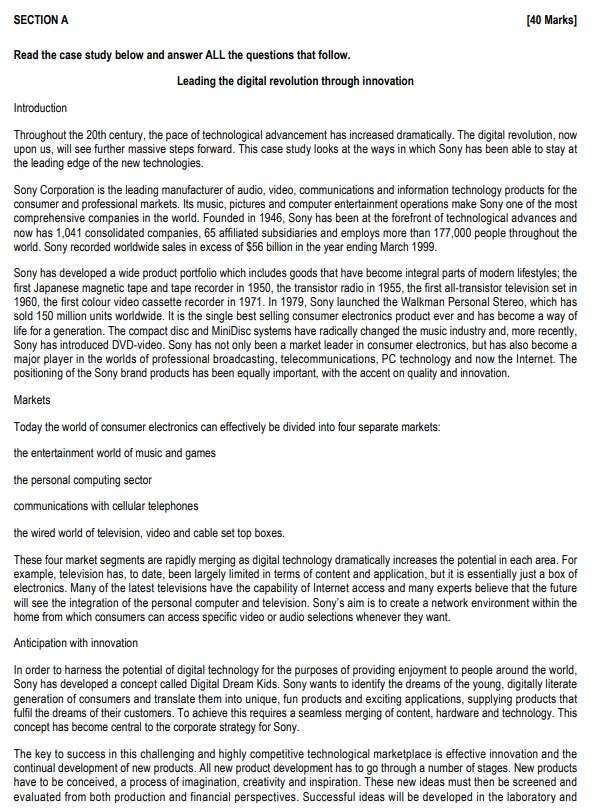
SECTION A Read the case study below and answer ALL the questions that follow. Leading the digital revolution through innovation [40 Marks] Introduction Throughout the 20th century, the pace of technological advancement has increased dramatically. The digital revolution, now upon us, will see further massive steps forward. This case study looks at the ways in which Sony has been able to stay at the leading edge of the new technologies. Sony Corporation is the leading manufacturer of audio, video, communications and information technology products for the consumer and professional markets. Its music, pictures and computer entertainment operations make Sony one of the most comprehensive companies in the world. Founded in 1946, Sony has been at the forefront of technological advances and now has 1,041 consolidated companies, 65 affiliated subsidiaries and employs more than 177,000 people throughout the world. Sony recorded worldwide sales in excess of $56 billion in the year ending March 1999. Sony has developed a wide product portfolio which includes goods that have become integral parts of modern lifestyles; the first Japanese magnetic tape and tape recorder in 1950, the transistor radio in 1955, the first all-transistor television set in 1960, the first colour video cassette recorder in 1971. In 1979, Sony launched the Walkman Personal Stereo, which has sold 150 million units worldwide. It is the single best selling consumer electronics product ever and has become a way of life for a generation. The compact disc and MiniDisc systems have radically changed the music industry and, more recently, Sony has introduced DVD-video. Sony has not only been a market leader in consumer electronics, but has also become a major player in the worlds of professional broadcasting, telecommunications, PC technology and now the Internet. The positioning of the Sony brand products has been equally important, with the accent on quality and innovation. Markets Today the world of consumer electronics can effectively be divided into four separate markets: the entertainment world of music and games the personal computing sector communications with cellular telephones the wired world of television, video and cable set top boxes. These four market segments are rapidly merging as digital technology dramatically increases the potential in each area. For example, television has, to date, been largely limited in terms of content and application, but it is essentially just a box of electronics. Many of the latest televisions have the capability of Internet access and many experts believe that the future will see the integration of the personal computer and television. Sony's aim is to create a network environment within the home from which consumers can access specific video or audio selections whenever they want. Anticipation with innovation In order to harness the potential of digital technology for the purposes of providing enjoyment to people around the world, Sony has developed a concept called Digital Dream Kids. Sony wants to identify the dreams of the young, digitally literate generation of consumers and translate them into unique, fun products and exciting applications, supplying products that fulfil the dreams of their customers. To achieve this requires a seamless merging of content, hardware and technology. This concept has become central to the corporate strategy for Sony. The key to success in this challenging and highly competitive technological marketplace is effective innovation and the continual development of new products. All new product development has to go through a number of stages. New products have to be conceived, a process of imagination, creativity and inspiration. These new ideas must then be screened and evaluated from both production and financial perspectives. Successful ideas will be developed in the laboratory and
Step by Step Solution
There are 3 Steps involved in it

Get step-by-step solutions from verified subject matter experts
 Study Help