







Question: Complete a) g) using the psychiatric data from Problem 3. The data are in Psychiatrists.csv and variable denitions are in PsychiatristsDataDictionary.pdf. 3) b) C) d)
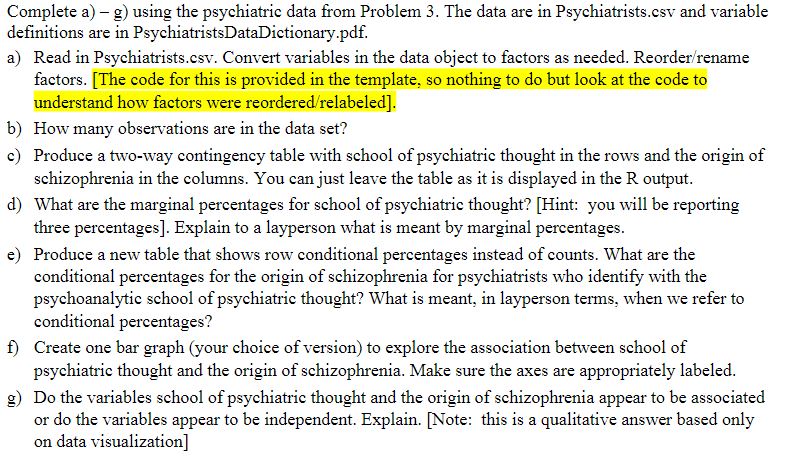
Complete a) g) using the psychiatric data from Problem 3. The data are in Psychiatrists.csv and variable denitions are in PsychiatristsDataDictionary.pdf. 3) b) C) d) a) Read in Psychiatristscsv. Convert variables in the data object to factors as needed. Reorder-"rename factors. [The code for this is provided in the template. so nothing to do but look at the code to understand how factors were reordered-ielabeled]. How many obseivations are in the data set'? Produce a two-way contingency table pith school of psychiatric thought in the rows and the origin of schizophrenia in the columns. You can just leave the table as it is displayed in the R output. 1'What are the marginal percentages for school of psychiatric thought\"? [Hint you will be reporting three percentages]. Explain to a layperson what is meant by marginal percentages. Produce a new table that shows row conditional percentages instead of counts. What are the conditional percentages for the origin of schizophrenia for psychiatrists who identifyr with the psychoanalytic school of psychiatric thought?I What is meant= in layperson terms, when we refer to conditional percentages? Create one bar graph [your choice of version) to explore the association between school of psychiatric thought and the origin of schizophrenia. Make sure the axes are appropriately labeled. Do the variables school of psychiatric thought and the origin of schizophrenia appear to be associated or do the variables appear to be independent. Explain. [INom: this is a qualitative answer based only on data visualization]
Step by Step Solution
There are 3 Steps involved in it

Get step-by-step solutions from verified subject matter experts
 Study Help