







Question: . A bus is travelling along a highway at a constant speed of U =110 km/h. There is no wind blowing. The bus is 6.2
.
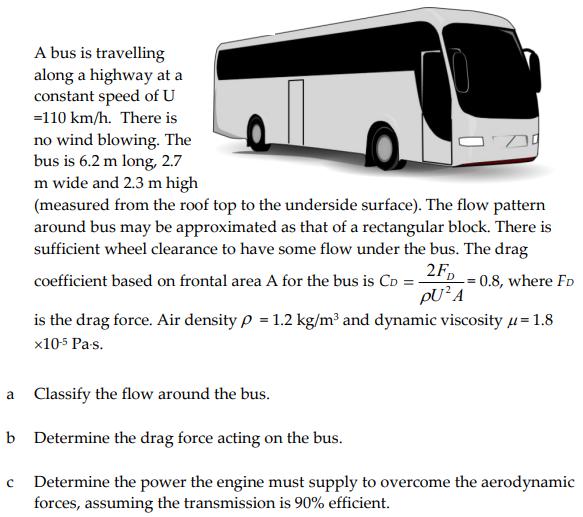
A bus is travelling along a highway at a constant speed of U =110 km/h. There is no wind blowing. The bus is 6.2 m long, 2.7 m wide and 2.3 m high (measured from the roof top to the underside surface). The flow pattern around bus may be approximated as that of a rectangular block. There is sufficient wheel clearance to have some flow under the bus. The drag coefficient based on frontal area A for the bus is CD = - 2FD PU A = 0.8, where FD is the drag force. Air density p = 1.2 kg/m and dynamic viscosity = 1.8 x10⁻⁵ Pa.s. a Classify the flow around the bus. b Determine the drag force acting on the bus. c Determine the power the engine must supply to overcome the aerodynamic forces, assuming the transmission is 90% efficient.
Step by Step Solution
3.51 Rating (154 Votes )
There are 3 Steps involved in it

Get step-by-step solutions from verified subject matter experts
 Study Help