Question: Complete part E only, please use pnorm(). You have decided to hire a crew and start making music videos in your spare time, and are
Complete part E only, please use pnorm().
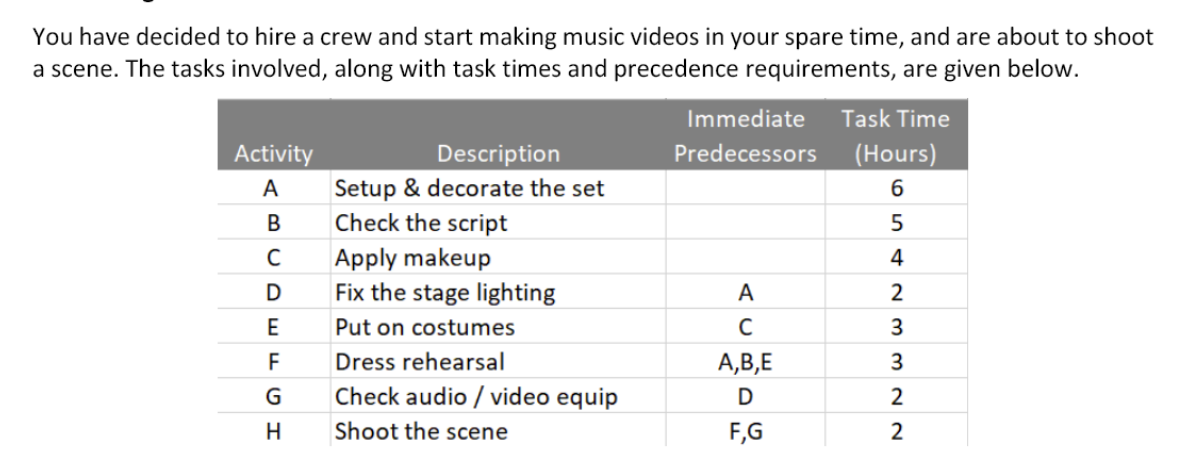
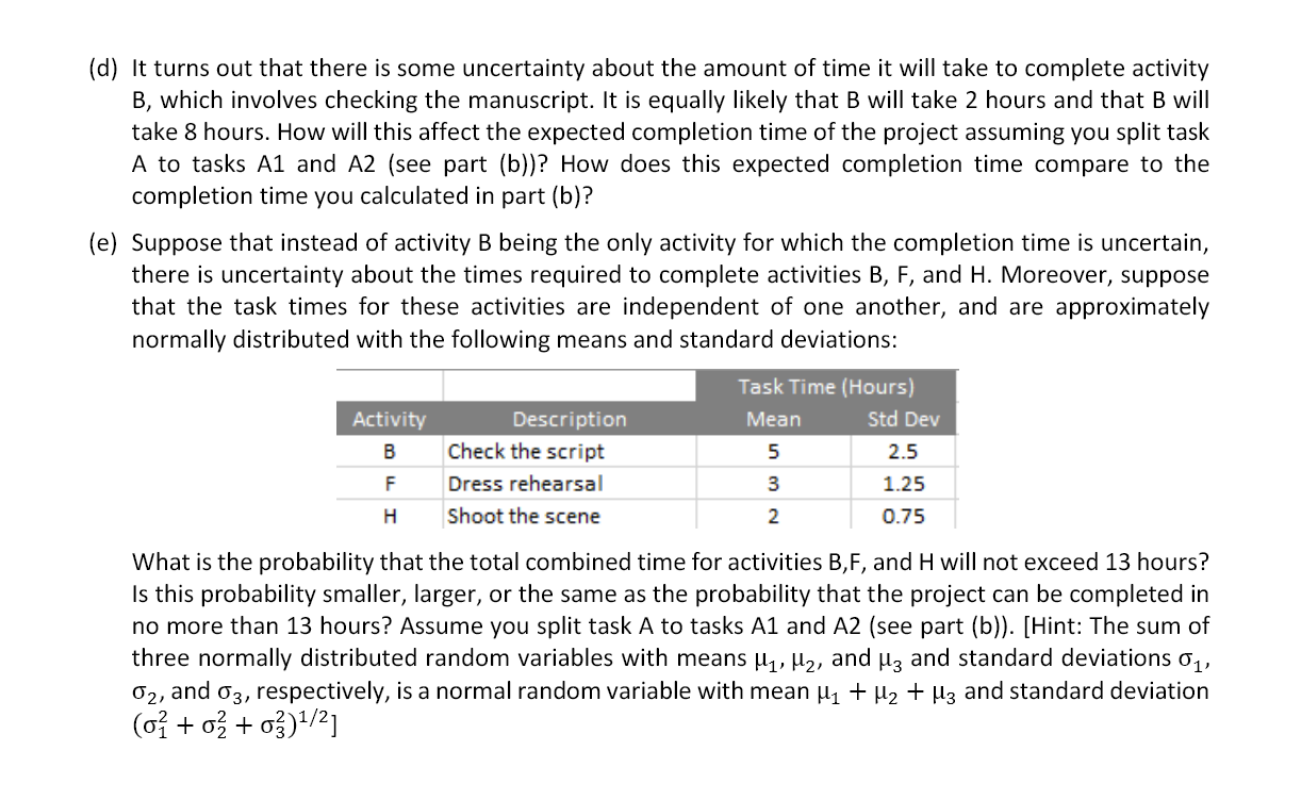
You have decided to hire a crew and start making music videos in your spare time, and are about to shoot a scene. The tasks involved, along with task times and precedence requirements, are given below. Immediate Predecessors Activity A Task Time (Hours) 6 B 5 4 D Description Setup & decorate the set Check the script Apply makeup Fix the stage lighting Put on costumes Dress rehearsal Check audio / video equip Shoot the scene D 2 3 E F NNW W NA 3 I TIM C A,B,E D F,G G 2 2 (d) It turns out that there is some uncertainty about the amount of time it will take to complete activity B, which involves checking the manuscript. It is equally likely that B will take 2 hours and that B will take 8 hours. How will this affect the expected completion time of the project assuming you split task A to tasks A1 and A2 (see part (b))? How does this expected completion time compare to the completion time you calculated in part (b)? (e) Suppose that instead of activity B being the only activity for which the completion time is uncertain, there is uncertainty about the times required to complete activities B, F, and H. Moreover, suppose that the task times for these activities are independent of one another, and are approximately normally distributed with the following means and standard deviations: Task Time (Hours) Activity Description Mean Std Dev B Check the script 5 2.5 F Dress rehearsal 3 1.25 . Shoot the scene 2 0.75 What is the probability that the total combined time for activities B, F, and H will not exceed 13 hours? Is this probability smaller, larger, or the same as the probability that the project can be completed in no more than 13 hours? Assume you split task A to tasks A1 and A2 (see part (b)). (Hint: The sum of three normally distributed random variables with means H1, H2, and uz and standard deviations 01, 02, and 03, respectively, is a normal random variable with mean Hz + H2 + Hz and standard deviation (c + o2 +03)1/2]









 Study Help