



Question: Complete question with instructions If we have a perfectly uniform ideally elastic string that is much longer than the radius of its circular cross-sections, then
Complete question with instructions
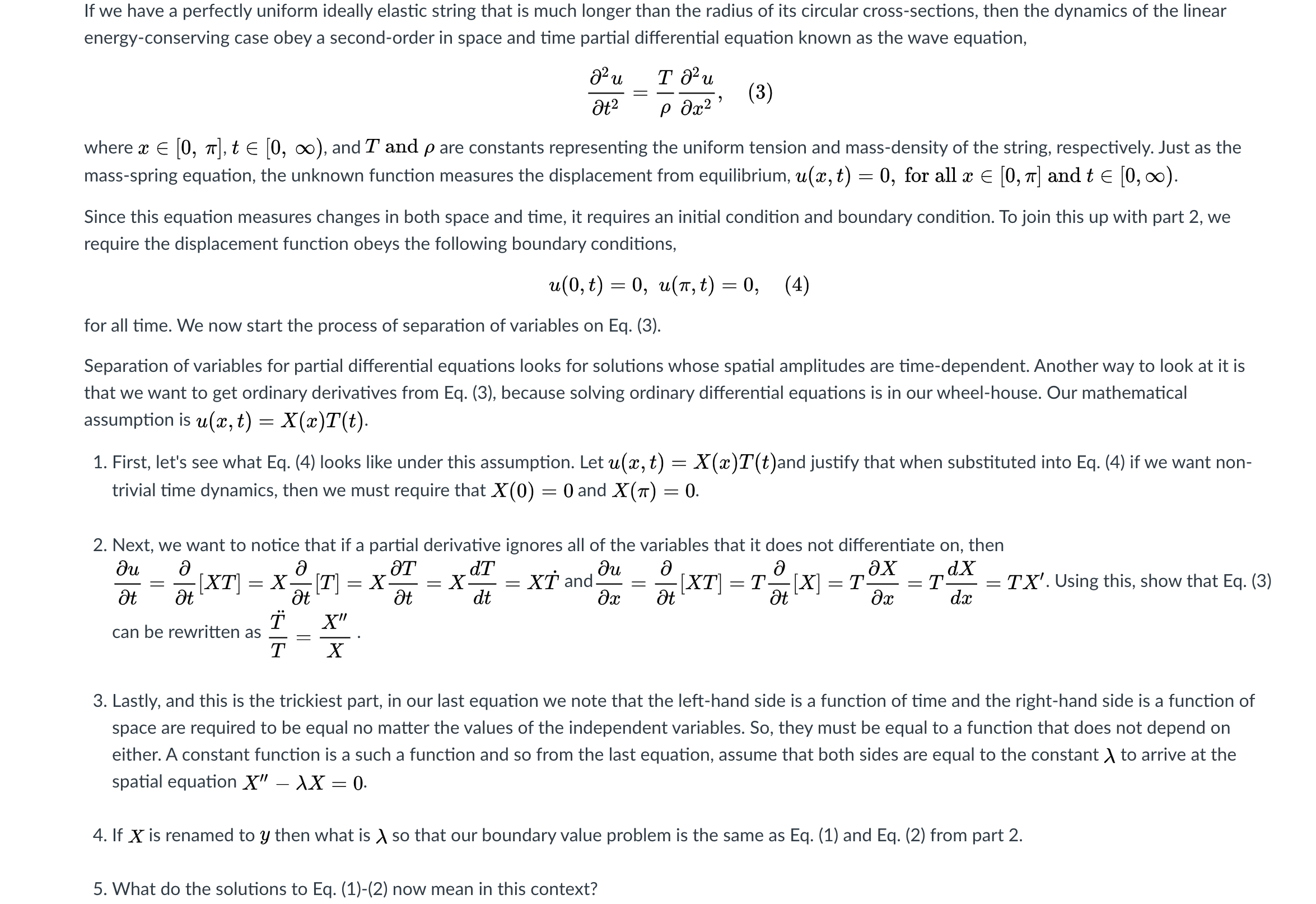
If we have a perfectly uniform ideally elastic string that is much longer than the radius of its circular cross-sections, then the dynamics of the linear energy-conserving case obey a second-order in space and time partial differential equation known as the wave equation, 2 2 = $1911, (3) 6752 ,0 3:22 where x E [0, 71'], t E [0, 00), and T and p are constants representing the uniform tension and mass-density of the string, respectively. Just as the mass-spring equation, the unknown function measures the displacement from equilibrium, u(:1:, t) = 0, for all :1: E [0, 71'] and t E [0, 00). Since this equation measures changes in both space and time, it requires an initial condition and boundary condition. To join this up with part 2, we require the displacement function obeys the following boundary conditions, \"'(Oa t) : 07 u(7T:t) = 01 (4) for all time. We now start the process of separation of variables on Eq. (3). Separation of variables for partial differential equations looks for solutions whose spatial amplitudes are time-dependent. Another way to look at it is that we want to get ordinary derivatives from Eq. (3), because solving ordinary differential equations is in our wheel-house. Our mathematical assumption is u(x, t) = X(:I:)T(t)- 1. First, let's see what Eq. (4) looks like under this assumption. Let u(a:, t) = X(x)T(t)and justify that when substituted into Eq. (4) if we want non- trivial time dynamics, then we must require that X(0) = 0 and X(7r) = 0. 2. Next, we want to notice that if a partial derivative ignores all of the variables that it does not differentiate on, then an 3 6 3T dT - 8a 6 6 (3X dX . . _ = _ X =X_T =X_ =X_ =XTand_ = _XT :TX =T =T =TX'.Usm this,showthatE .(3) at atl ll atl l at dt 8:1: atl l atll 8a: dm g q T xi! can be rewritten as _ T X 3. Lastly, and this is the trickiest part, in our last equation we note that the left-hand side is a function of time and the right-hand side is a function of space are required to be equal no matter the values of the independent variables. So, they must be equal to a function that does not depend on either. A constant function is a such a function and so from the last equation, assume that both sides are equal to the constant A to arrive at the spatial equation X\" AX = 0. 4. If X is renamed to y then what is A so that our boundary value problem is the same as Eq. (1) and Eq. (2) from part 2. 5. What do the solutions to Eq. (1)-(2) now mean in this context
Step by Step Solution
There are 3 Steps involved in it

Get step-by-step solutions from verified subject matter experts