







Question: complete solution pls 1.) When finding population variance, you divide the sum of squares by A.) N C.) N -1 B.) sum of x D.)
complete solution pls
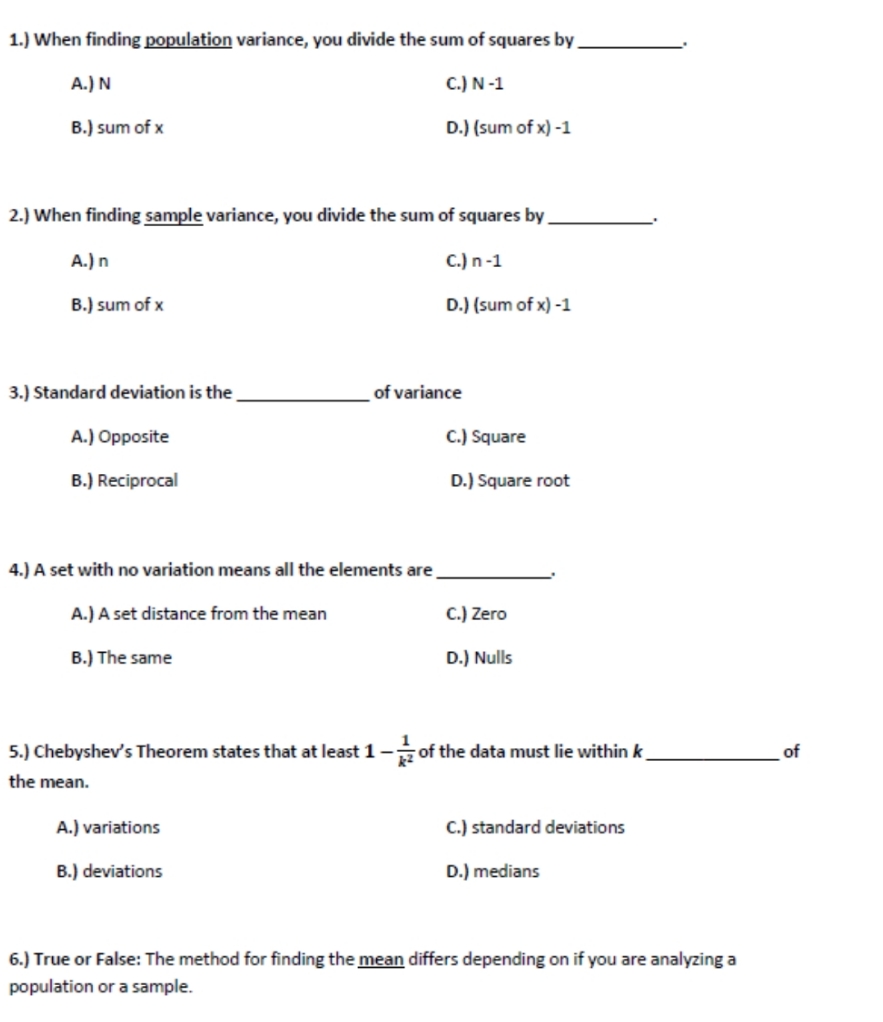
1.) When finding population variance, you divide the sum of squares by A.) N C.) N -1 B.) sum of x D.) (sum of x) -1 2.) When finding sample variance, you divide the sum of squares by A.) n C.) n -1 B.) sum of x D.) (sum of x) -1 3.) Standard deviation is the of variance A.) Opposite C.) Square B.) Reciprocal D.) Square root 4.) A set with no variation means all the elements are A.) A set distance from the mean C.) Zero B.) The same D.) Nulls 5.) Chebyshev's Theorem states that at least 1 -- of the data must lie within k of the mean. A.) variations C.) standard deviations B.) deviations D.) medians 6.) True or False: The method for finding the mean differs depending on if you are analyzing a population or a sample
Step by Step Solution
There are 3 Steps involved in it

Get step-by-step solutions from verified subject matter experts
 Study Help