







Question: complete table 2b. (12 pts) While Eqn. 3 is essentially a polynomial of order 20 - yikes! - it can be solved using the online
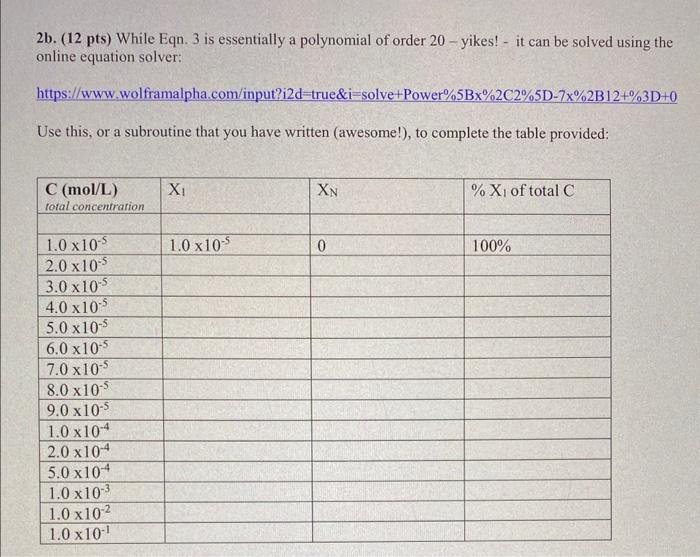
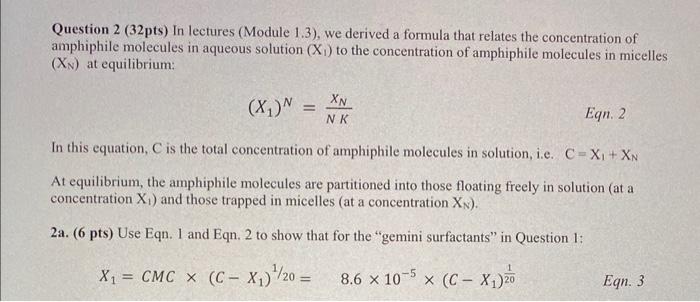
2b. (12 pts) While Eqn. 3 is essentially a polynomial of order 20 - yikes! - it can be solved using the online equation solver: https://www.wolframalpha.com/input? i2 d=true\&i=solve+Power %5Bx%2C2%5D7x%2B12+%3D+0 Use this, or a subroutine that you have written (awesome!), to complete the table provided: Question 2 (32pts) In lectures (Module 1.3), we derived a formula that relates the concentration of amphiphile molecules in aqueous solution (X1) to the concentration of amphiphile molecules in micelles (XN) at equilibrium: (X1)N=NKXN Eqn.2 In this equation, C is the total concentration of amphiphile molecules in solution, i.e. C=X1+XN At equilibrium, the amphiphile molecules are partitioned into those floating freely in solution (at a concentration X1 ) and those trapped in micelles (at a concentration XN ). 2a. (6 pts) Use Eqn. 1 and Eqn. 2 to show that for the "gemini surfactants" in Question 1: X1=CMC(CX1)1/20=8.6105(CX1)201 Eqn. 3
Step by Step Solution
There are 3 Steps involved in it

Get step-by-step solutions from verified subject matter experts
 Study Help