







Question: Complete the assignment below using additional paper if needed. A hard copy of all work must be submitted in class on the indicated due date.
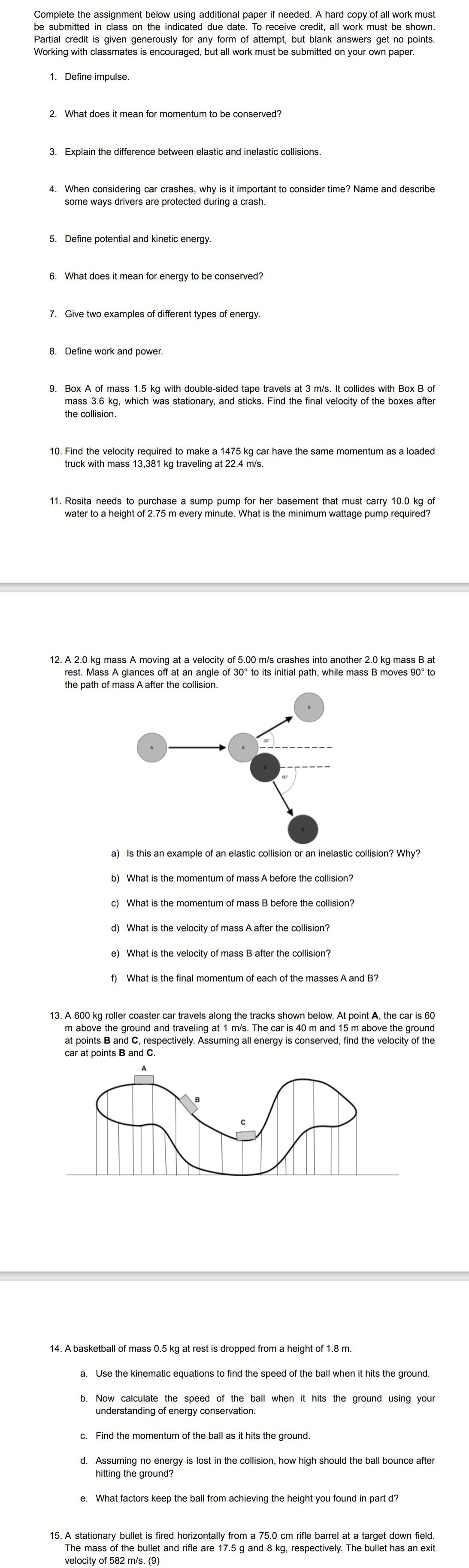
Complete the assignment below using additional paper if needed. A hard copy of all work must be submitted in class on the indicated due date. To receive credit, all work must be shown. Partial credit is given generously for any form of attempt, but blank answers get no points Working with classmates is encouraged, but all work must be submitted on your own paper. 1. Define impulse 2. What does it mean for momentum to be conserved? 3. Explain the difference between elastic and inelastic collisions. 4. When considering car crashes, why is it important to consider time? Name and describe some ways drivers are protected during a crash. 5. Define potential and kinetic energy. 6. What does it mean for energy to be conserved? 7. Give two examples of different types of energy. 3. Define work and power. 9. Box A of mass 1.5 kg with double-sided tape travels at 3 m/s. It collides with Box B of mass 3.6 kg, which was stationary, and sticks. Find the final velocity of the boxes after the collision 10. Find the velocity required to make a 1475 kg car have the same momentum as a loaded truck with mass 13,381 kg traveling at 22.4 m/s 11. Rosita needs to purchase a sump pump for her basement that must carry 10.0 kg of water to a height of 2.75 m every minute. What is the minimum wattage pump required? 12. A 2.0 kg mass A moving at a velocity of 5.00 m/s crashes into another 2.0 kg mass B at rest. Mass A glances off at an angle of 30 to its initial path, while mass B moves 90 to the path of mass A after the collision. a) Is this an example of an elastic collision or an inelastic collision? Why? b) What is the momentum of mass A before the collision? c) What is the momentum of mass B before the collision? d) What is the velocity of mass A after the collision? e) What is the velocity of mass B after the collision? f) What is the final momentum of each of the masses A and B? 13. A 600 kg roller coaster car travels along the tracks shown below. At point A, the car is 60 m above the ground and traveling at 1 m/s. The car is 40 m and 15 m above the ground at points B and C, respectively. Assuming all energy is conserved, find the velocity of the car at points B and C 14. A basketball of mass 0.5 kg at rest is dropped from a height of 1.8 m. a. Use the kinematic equations to find the speed of the ball when it hits the ground. b. Now calculate the speed of the ball when it hits the ground using your understanding of energy conservation. c. Find the momentum of the ball as it hits the ground. d. Assuming no energy is lost in the collision, how high should the ball bounce after hitting the ground? e. What factors keep the ball from achieving the height you found in part d? 15. A stationary bullet is fired horizontally from a 75.0 cm rifle barrel at a target down field. The mass of the bullet and rifle are 17.5 g and 8 kg, respectively. The bullet has an exit velocity of 582 m/s. (9)
Step by Step Solution
There are 3 Steps involved in it

Get step-by-step solutions from verified subject matter experts
 Study Help