







Question: Complete the attached template program with the following process synchronization behavior. This synchronization process continues forever. Note that SIGUSR2 is used from Parent to Child
Complete the attached template program with the following process synchronization behavior. This synchronization process continues forever.
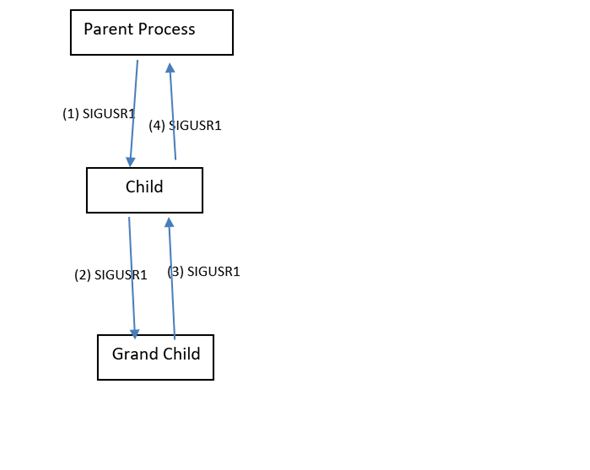
Note that SIGUSR2 is used from Parent to Child process, and SIGUSR1 is used from Child to Parent process. The order of signal generations are noted as numbers in the above diagram, (1) and (2).
The output from your program should be:
Child caught signal# 1
Parent caught signal# 1
Child caught signal# 2
Parent caught signal# 2
Child caught signal# 3
Parent caught signal# 3
Enter the missing fields, (a) through (h), into the Blackboard Final Exam Submission. You may refer to the example program synchro.c in page 144-145 in the textbook, which is implementing a slightly different synchronization behavior.
/* synchro */
#include
#include
int ntimes = 0;
main()
{
pid_t pid, ppid;
void p_action(int), c_action(int);
static struct sigaction pact, cact;
pact.sa_handler = (a) _______;
sigaction((b) _______, &pact, NULL);
switch(pid = fork()) {
case -1: /* error */
perror("synchro");
exit(l);
case 0: /* child */
/* set action for child */
cact.sa_handler = (c)_______;
sigaction((d)______, &cact, NULL);
/* get parent process-id */
ppid = getppid();
for (;;)
{
(e)________ ;
sleep(1);
(f)________;
}
/* never exits */
default: /*parent */
for(;;)
{
sleep(1);
(g)__________;
(h)_________;
}
/* never exits */
}
}
void p_action(int sig)
{
printf("Parent caught signal #%d ", ++ntimes);
}
void c_action(int sig)
(
printf("Child caught signal #%d ", ++ntimes);
}
Parent Process (1)
Step by Step Solution
There are 3 Steps involved in it

Get step-by-step solutions from verified subject matter experts
 Study Help