







Question: Complete the following: Part I: Create a complete ERD for the problem described in problem 1 on page 156 (12th edition).Instructions Follow the instructions below:
Complete the following:
Part I: Create a complete ERD for the problem described in problem 1 on page 156 (12th edition).Instructions
Follow the instructions below:
For all the problems use the Crow's foot notation. Do not create the Chen or UML diagrams, even if the author tells you to do so.Include connectivities (tick-marks and circles).You do not need to include verbs on your relationships. The exception is if there are two or more relationships between the same two tables.Include all the attributes described in the problem. Note that for some of these problems the author has intentionally left out most/all of the attributes. Do not make up non-key attributes.Your ERD should include the appropriate primary keys and foreign keys, even if the author omitted them. Create them if necessary. Keep it simple and straight forward. If you have a Product entity then an appropriate primary key would be Product_Number or Product_Id.Include solid or dashed lines for strong/weak relationships.Do not use multi-valued attributes or derived attributes.I only need the completed ERD in Crow's foot notation. You do not need to answer any of the author's questions, create lists, etc. When the author says to identify something you should include it in the ERD.Do not use any ternary relationships. Convert these into one to many relationships.Make sure you have no redundant data. See section 3-7 starting on p. 101 (12th edition).Other NotesThe point level for this assignment has increased.This assignment may take you longer to complete than previous assignments. Don't wait until the last day.Do not complicate the problem by adding to it. Your imagination can lead you astray. Do not add non-key attributes or entities that are not explicitly in the problem. Note that this is very easy to do without thinking about it. The human mind likes to fill in the blanks.Don't forget that instances of entities (rows in tables) never show up on an ERD.The organization that the database is for is almost never an entity. Often times it is never stored in the database.Some information in the problems is irrelevant to the ERD. This is common in data modeling.
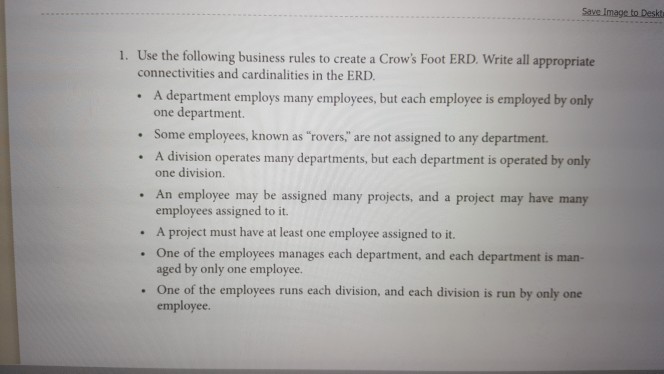
1. Use the following business rules to create a Crow's Foot ERD. Write all appropriate connectivities and cardinalities in the ERD. A department employs many employees, but each employee is employed by only one department. Some employees, known as "rovers," are not assigned to any department A division operates many departments, but each department is operated by only . one division. An employee may be assigned many projects, and a project may have employees assigned to it. A project must have at least one employee assigned to it. One of the employees manages each department, and each department is man- aged by only one employee. . One of the employees runs each division, and each division is run by only one employee
Step by Step Solution
There are 3 Steps involved in it

Get step-by-step solutions from verified subject matter experts
 Study Help