







Question: *COMPLETED IN EXCEL* INSTRUCTIONS: DRAW THE TREE, LABELING EACH BRANCH, INCLUDING PROBABILITIES IF APPROPRIATE. PUT THE PAYOFFS AT THE END OF THE BRANCHES, CALCULATE ALL
*COMPLETED IN EXCEL* 
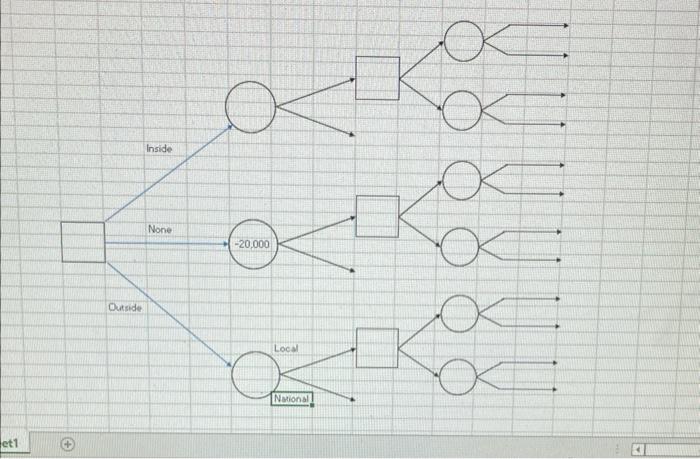
INSTRUCTIONS: DRAW THE TREE, LABELING EACH BRANCH, INCLUDING PROBABILITIES IF APPROPRIATE. PUT THE PAYOFFS AT THE END OF THE BRANCHES, CALCULATE ALL THE EXPECTED VALUES, AND PUT THEM IN TREE AS WELL. As head of Human Resources, you are in control of hiring new personnel. For a typical position opening, you must decide whether to search inside the company, outside the company, or simply do no search at all. No search means you don't fill the position. For the current opening, you estimate that not filling the position will cost the company $20,000 in lost efficiency. If you decide to do an outside search, you must decide whether to do just a local search, or a national one. You estimate there is an 80% chance of a local search turning up a qualified person for the current opening (if you don't find anyone, you're out the $3,000 you have spent and you haye te start over), while a national search has a 90% chance of finding someone qualified (losing $9,000 if you don't find anyone qualified, and you start over). If you find someone qualified in the national search, there is a 60% chance they will accept your offer, ultimately being worth $100,000 to the company, but if they reject your affer you start over after losing $10,000. For the local search, there is a 90% chance a qualified person would accept your offer, being worth $105,000 to your company, but if they turn you down you are out $4,000. If you choose to search inside the company, there is a 60% chance of finding a qualified person. If no qualified person is found, there 15 an 80% chance you can find a person who can be trained to fill the position. If no trainable person is found, you are out $3,000 and you start over. Even if a trainable person is found, you must decide jbether pr.not to make them an offer (there might be trouble over taking a person from another department). If you choose not to make an offer, you of it being accepted, which is worth $120,000 to the company, whereas a rejection of your offer rvould leave out $6,000 and starting over. If the inside search tums up a qualified person, you must decide whether or not to make them an offer (no offer leaves you out $2,000 and starting over). There is a 50% chance a qualified person would accept your $2,000 and starting over). There is a 50% chance a qualified person would accept your offer, being worth $150,000 to the company, but a rejection of your offer would cost you 2,500, and you start over. Note: starting over is the end of branch, with whatever costs have been accrued to that point as the payoff. INSTRUCTIONS: DRAW THE TREE, LABELING EACH BRANCH, INCLUDING PROBABILITIES IF APPROPRIATE. PUT THE PAYOFFS AT THE END OF THE BRANCHES, CALCULATE ALL THE EXPECTED VALUES, AND PUT THEM IN TREE AS WELL. As head of Human Resources, you are in control of hiring new personnel. For a typical position opening, you must decide whether to search inside the company, outside the company, or simply do no search at all. No search means you don't fill the position. For the current opening, you estimate that not filling the position will cost the company $20,000 in lost efficiency. If you decide to do an outside search, you must decide whether to do just a local search, or a national one. You estimate there is an 80% chance of a local search turning up a qualified person for the current opening (if you don't find anyone, you're out the $3,000 you have spent and you haye te start over), while a national search has a 90% chance of finding someone qualified (losing $9,000 if you don't find anyone qualified, and you start over). If you find someone qualified in the national search, there is a 60% chance they will accept your offer, ultimately being worth $100,000 to the company, but if they reject your affer you start over after losing $10,000. For the local search, there is a 90% chance a qualified person would accept your offer, being worth $105,000 to your company, but if they turn you down you are out $4,000. If you choose to search inside the company, there is a 60% chance of finding a qualified person. If no qualified person is found, there 15 an 80% chance you can find a person who can be trained to fill the position. If no trainable person is found, you are out $3,000 and you start over. Even if a trainable person is found, you must decide jbether pr.not to make them an offer (there might be trouble over taking a person from another department). If you choose not to make an offer, you of it being accepted, which is worth $120,000 to the company, whereas a rejection of your offer rvould leave out $6,000 and starting over. If the inside search tums up a qualified person, you must decide whether or not to make them an offer (no offer leaves you out $2,000 and starting over). There is a 50% chance a qualified person would accept your $2,000 and starting over). There is a 50% chance a qualified person would accept your offer, being worth $150,000 to the company, but a rejection of your offer would cost you 2,500, and you start over. Note: starting over is the end of branch, with whatever costs have been accrued to that point as the payoff
Step by Step Solution
There are 3 Steps involved in it
1 Expert Approved Answer
Step: 1 Unlock

Question Has Been Solved by an Expert!
Get step-by-step solutions from verified subject matter experts
Step: 2 Unlock
Step: 3 Unlock
 Study Help