







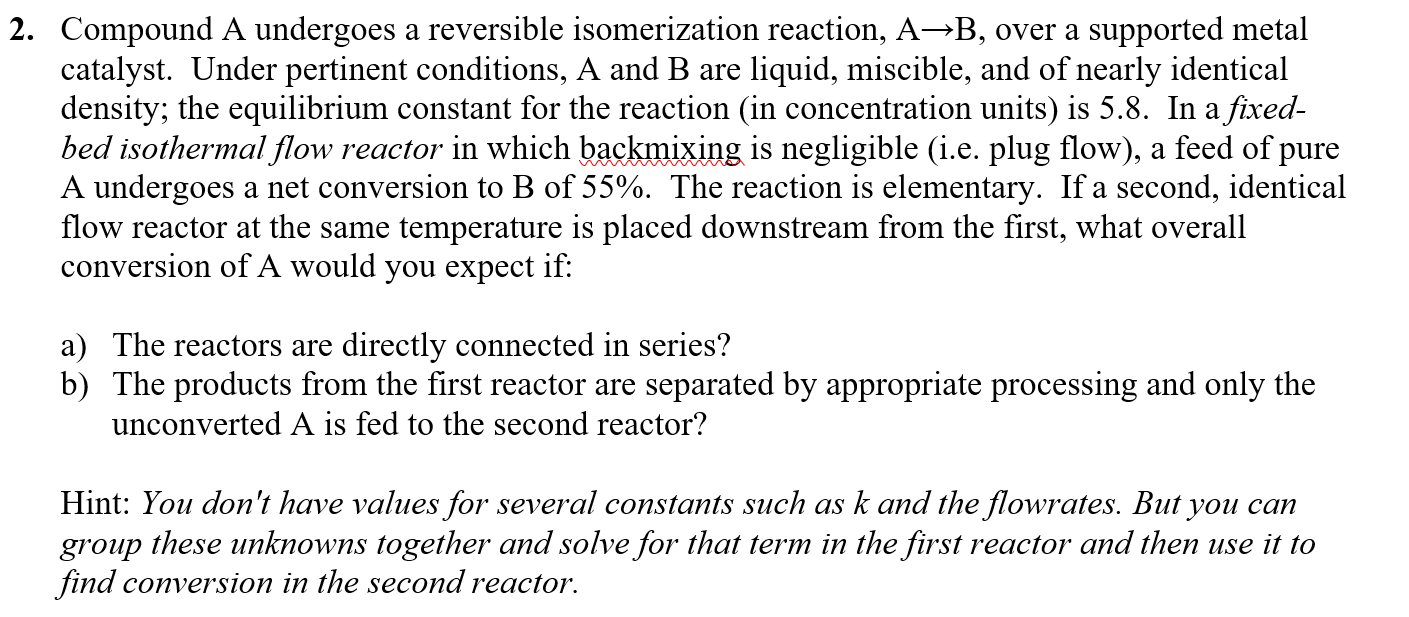
Question: Compound A undergoes a reversible isomerization reaction, A B , over a supported metal catalyst. Under pertinent conditions, A and B are liquid, miscible, and
Compound A undergoes a reversible isomerization reaction, over a supported metal
catalyst. Under pertinent conditions, A and B are liquid, miscible, and of nearly identical
density; the equilibrium constant for the reaction in concentration units is In a fixed
bed isothermal flow reactor in which backmixing is negligible ie plug flow a feed of pure
A undergoes a net conversion to B of The reaction is elementary. If a second, identical
flow reactor at the same temperature is placed downstream from the first, what overall
conversion of A would you expect if:
a The reactors are directly connected in series?
b The products from the first reactor are separated by appropriate processing and only the
unconverted A is fed to the second reactor?
Hint: You don't have values for several constants such as and the flowrates. But you can
group these unknowns together and solve for that term in the first reactor and then use it to
find conversion in the second reactor.
Step by Step Solution
There are 3 Steps involved in it
1 Expert Approved Answer
Step: 1 Unlock

Question Has Been Solved by an Expert!
Get step-by-step solutions from verified subject matter experts
Step: 2 Unlock
Step: 3 Unlock
 Study Help