







Question: Computational Thinking skills are not limited to solving problems with a computer; they can be observed in The data chosen to represent some real-world entity
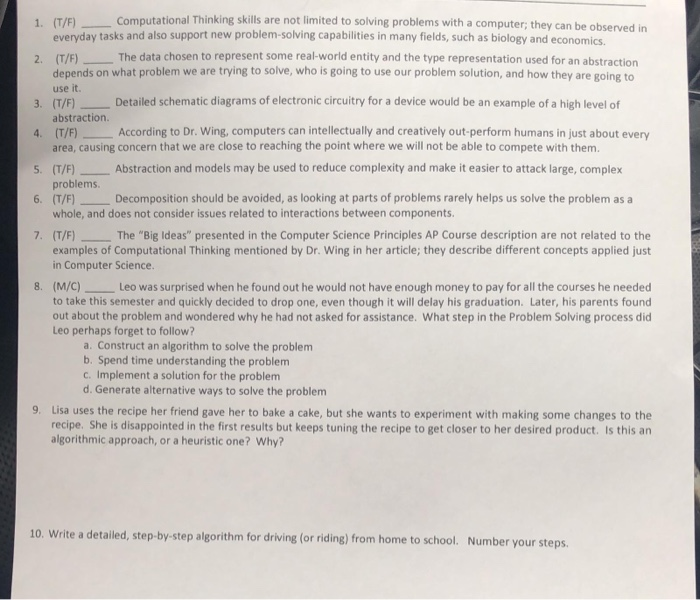
Computational Thinking skills are not limited to solving problems with a computer; they can be observed in The data chosen to represent some real-world entity and the type representation used for an abstraction Detailed schematic diagrams of electronic circuitry for a device would be an example of a high level of According to Dr. Wing, computers can intellectually and creatively out-perform humans in just about every 1. (T/F) everyday tasks and also support new problem-solving capabilities in many fields, such as biology and economics. depends on what problem we are trying to solve, who is going to use our problem solution, and how they are going to use it. abstraction area, causing concern that we are close to reaching the point where we will not be able to compete with them. 4. (T/F) . (T/ F) Abstraction and models may be used to reduce complexity and make it easier to attack large, complex problems. 6. (T/F) Decomposition should be avoided, as looking at parts of problems rarely helps us solve the problem as a whole, and does not consider issues related to interactions between components. The "Big Ideas" presented in the Computer Science Principles AP Course description are not related to the examples of Computational Thinking mentioned by Dr. Wing in her article; they describe different concepts applied just in Computer Science. (/) to take this semester and quickly decided to drop one, even though it will delay his graduation. Later, his parents found out about the problem and wondered why he had not asked for assistance. What step in the Problem Solving process did Leo perhaps forget to follow? 8. Leo was surprised when he found out he would not have enough money to pay for all the courses he needed a. Construct an algorithm to solve the problem b. Spend time understanding the problem c. Implement a solution for the problem d. Generate alternative ways to solve the problem 9. Lisa uses the recipe her friend gave her to bake a cake, but she wants to experiment with making some changes to the recipe. She is disappointed in the first results but keeps tuning the recipe to get closer to her desired product. Is this an algorithmic approach, or a heuristic one? Why? 10. Write a detailed, step-by-step algorithm for driving (or riding) from home to school. Number your steps
Step by Step Solution
There are 3 Steps involved in it

Get step-by-step solutions from verified subject matter experts
 Study Help