







Question: How are the changes that Taco Bell implemented, such as K-minus, SOS, etc., similar to, or different from, the various concepts/techniques that were presented in
How are the changes that Taco Bell implemented, such as K-minus, SOS, etc., similar to, or different from, the various concepts/techniques that were presented in weeks 1-8 in this module. Provide a brief description to support each similarity/difference. 2. Often companies face the challenge of maintaining a competitive edge over time. Is Taco Bell also vulnerable to losing its competitive edge to its major competitors as they become more familiar with Taco Bells strategy? Why or why not? In either case, will its competitors succeed? Why or why not? 3. Which of the various concepts, tools and techniques discussed in weeks 1-8 should John Martin consider to move Taco Bell forward? Provide a brief description of each concept/tool/technique that you recommend for Taco Bell to adopt. 4. There are various ethical issues associated with the food supply chains starting from the raw materials all the way to the end consumers. What are some of the challenges that Taco Bell will face and what solutions could be helpful in resolving them?
WEEKS 1-8 TALKED ABOUT: classification of operation. operation strategy, process planning, capacity planning, supply chain planning and management, monitoring and controlling, and six sigma and lean
Thank you
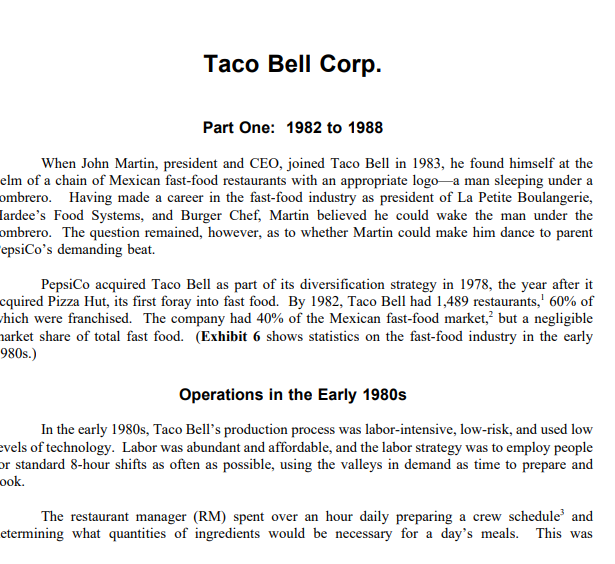
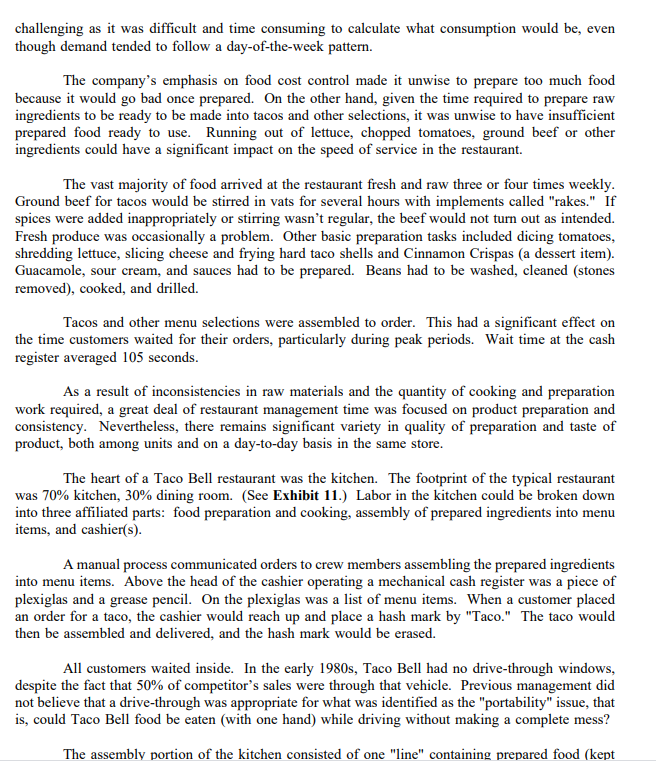
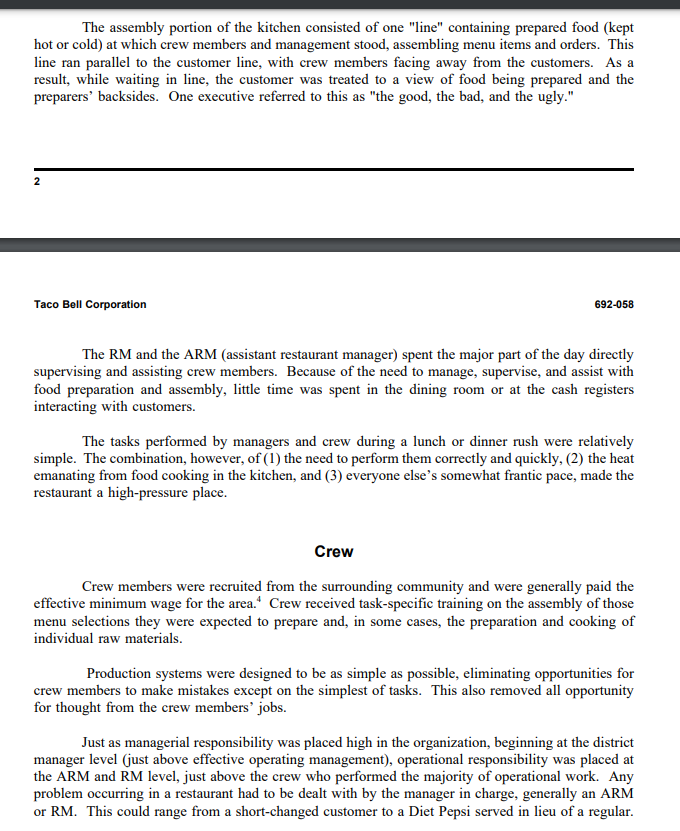
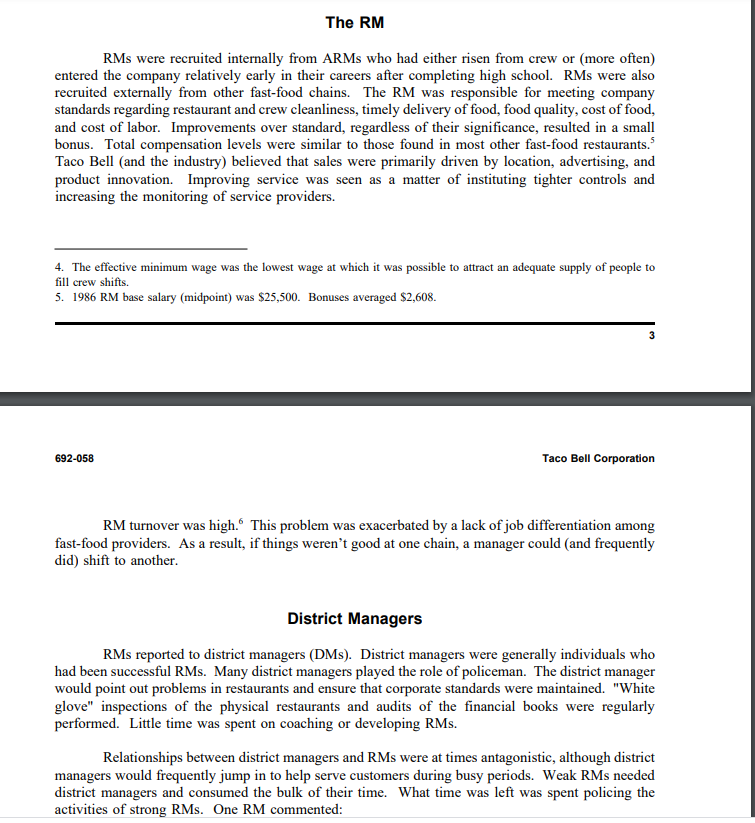
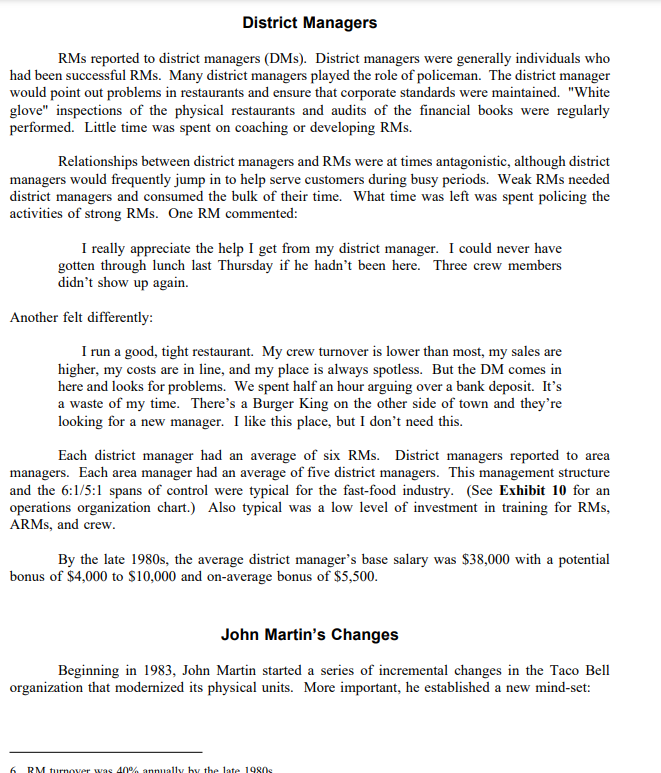
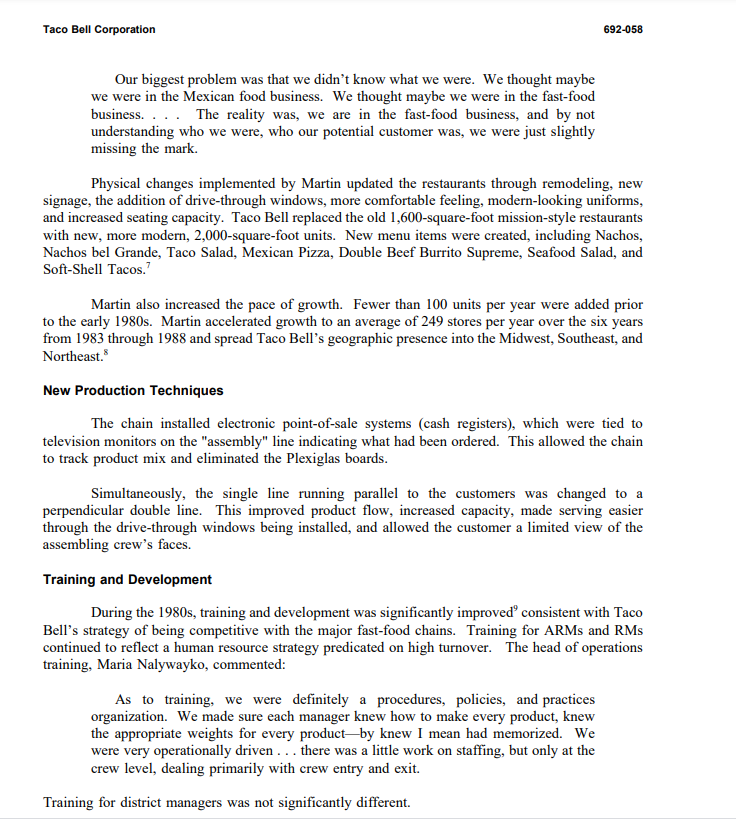
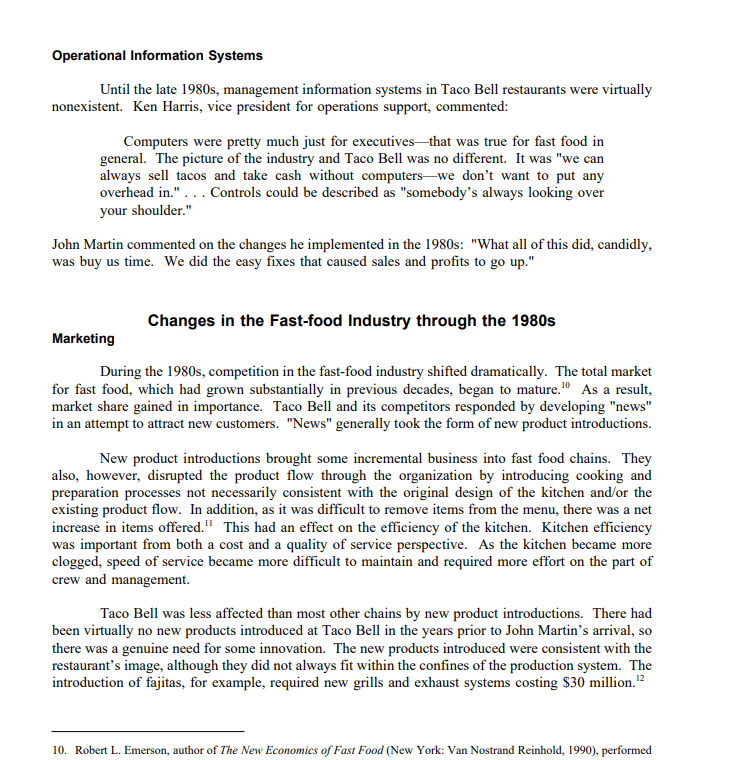
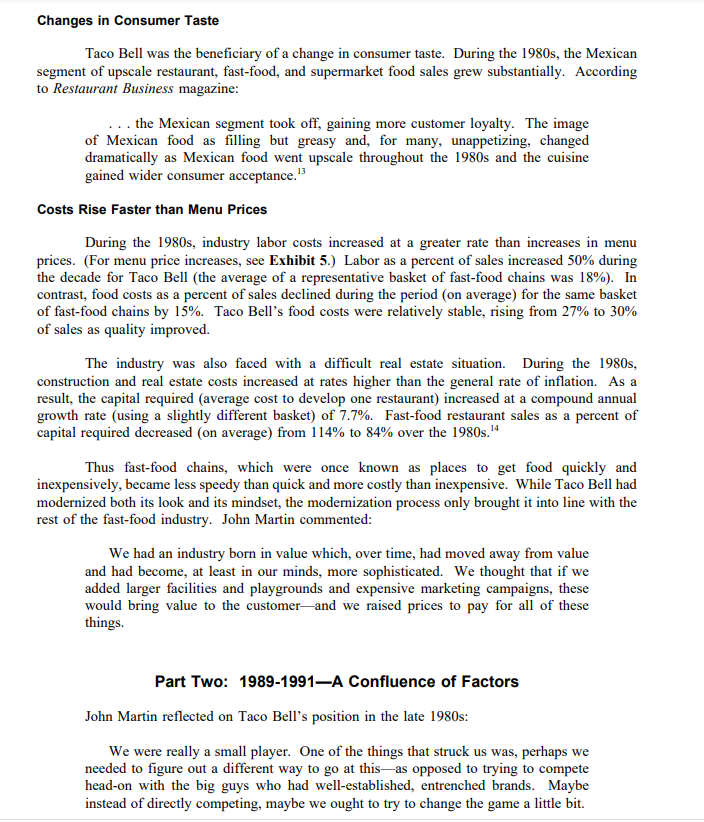
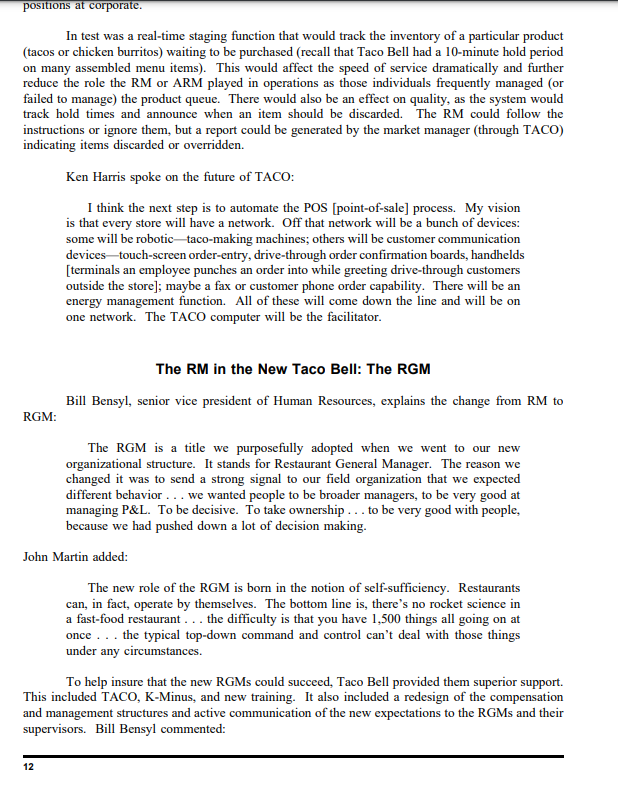
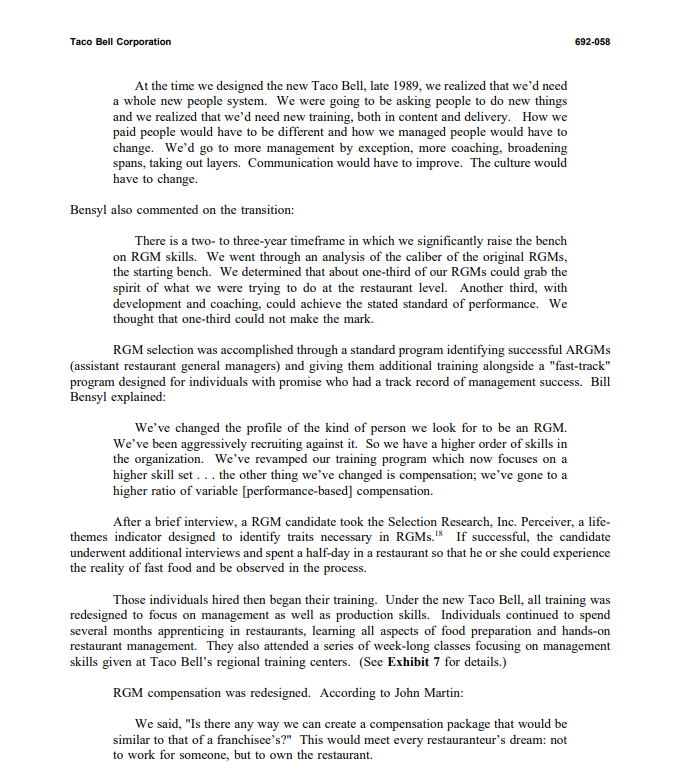
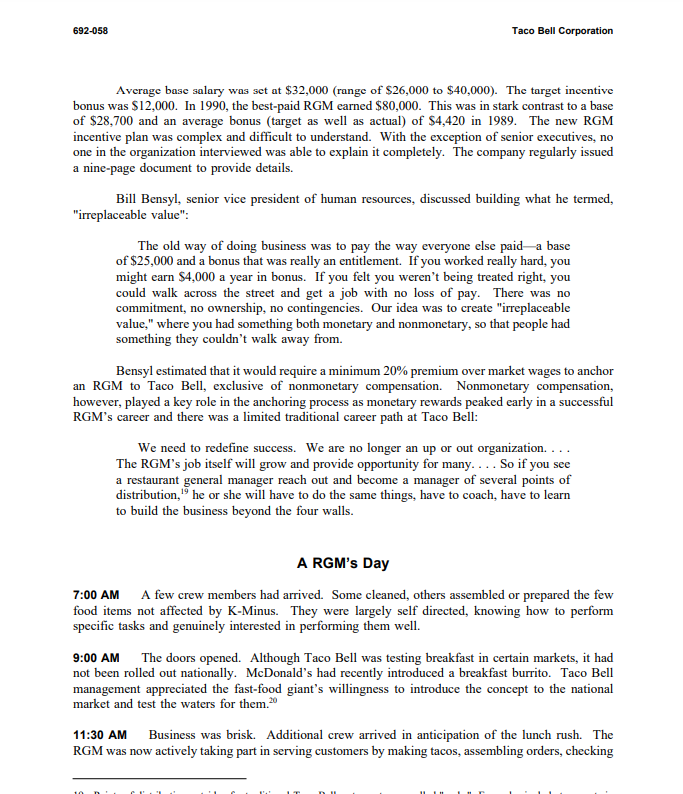
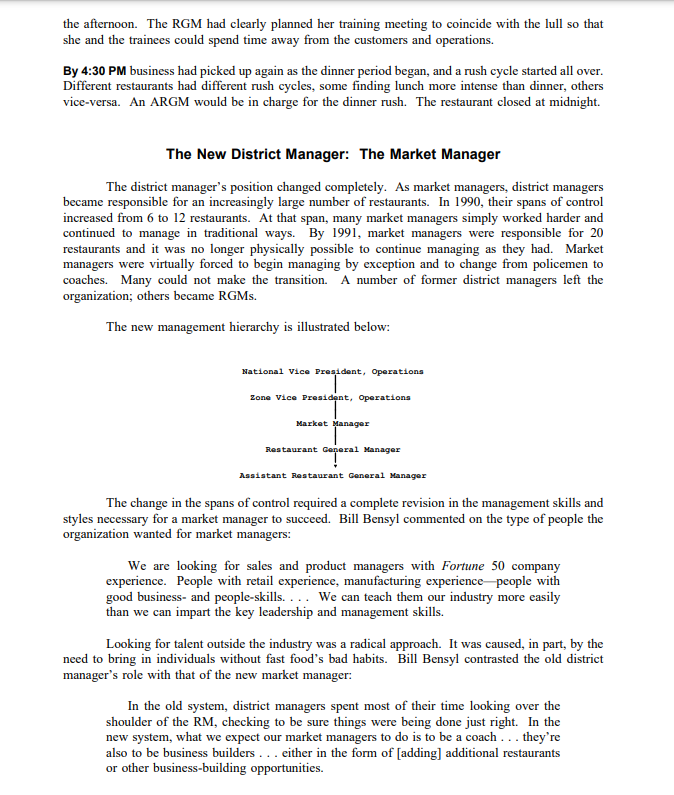
Taco Bell Corp. Part One: 1982 to 1988 When John Martin, president and CEO, joined Taco Bell in 1983, he found himself at the elm of a chain of Mexican fast-food restaurants with an appropriate logoa man sleeping under a ombrero. Having made a career in the fast-food industry as president of La Petite Boulangerie, Iardee's Food Systems, and Burger Chef, Martin believed he could wake the man under the ombrero. The question remained, however, as to whether Martin could make him dance to parent epsiCo's demanding beat. PepsiCo acquired Taco Bell as part of its diversification strategy in 1978, the year after it cquired Pizza Hut, its first foray into fast food. By 1982, Taco Bell had 1,489 restaurants,' 60% of hich were franchised. The company had 40% of the Mexican fast-food market, but a negligible narket share of total fast food. (Exhibit 6 shows statistics on the fast-food industry in the early 980s.) Operations in the Early 1980s In the early 1980s, Taco Bell's production process was labor-intensive, low-risk, and used low evels of technology. Labor was abundant and affordable, and the labor strategy was to employ people or standard 8-hour shifts as often as possible, using the valleys in demand as time to prepare and ook. The restaurant manager (RM) spent over an hour daily preparing a crew schedule and etermining what quantities of ingredients would be necessary for a day's meals. This was challenging as it was difficult and time consuming to calculate what consumption would be, even though demand tended to follow a day-of-the-week pattern. The company's emphasis on food cost control made it unwise to prepare too much food because it would go bad once prepared. On the other hand, given the time required to prepare raw ingredients to be ready to be made into tacos and other selections, it was unwise to have insufficient prepared food ready to use. Running out of lettuce, chopped tomatoes, ground beef or other ingredients could have a significant impact on the speed of service in the restaurant. The vast majority of food arrived at the restaurant fresh and raw three or four times weekly. Ground beef for tacos would be stirred in vats for several hours with implements called "rakes." If spices were added inappropriately or stirring wasn't regular, the beef would not turn out as intended. Fresh produce was occasionally a problem. Other basic preparation tasks included dicing tomatoes, shredding lettuce, slicing cheese and frying hard taco shells and Cinnamon Crispas (a dessert item). Guacamole, sour cream, and sauces had to be prepared. Beans had to be washed, cleaned (stones removed), cooked, and drilled. Tacos and other menu selections were assembled to order. This had a significant effect on the time customers waited for their orders, particularly during peak periods. Wait time at the cash register averaged 105 seconds. As a result of inconsistencies in raw materials and the quantity of cooking and preparation work required, a great deal of restaurant management time was focused on product preparation and consistency. Nevertheless, there remains significant variety in quality of preparation and taste of product, both among units and on a day-to-day basis in the same store. The heart of a Taco Bell restaurant was the kitchen. The footprint of the typical restaurant was 70% kitchen, 30% dining room. (See Exhibit 11.) Labor in the kitchen could be broken down into three affiliated parts: food preparation and cooking, assembly of prepared ingredients into menu items, and cashier(s). A manual process communicated orders to crew members assembling the prepared ingredients into menu items. Above the head of the cashier operating a mechanical cash register was a piece of plexiglas and a grease pencil. On the plexiglas was a list of menu items. When a customer placed an order for a taco, the cashier would reach up and place a hash mark by "Taco." The taco would then be assembled and delivered, and the hash mark would be erased. All customers waited inside. In the early 1980s, Taco Bell had no drive-through windows, despite the fact that 50% of competitor's sales were through that vehicle. Previous management did not believe that a drive-through was appropriate for what was identified as the "portability" issue, that is, could Taco Bell food be eaten (with one hand) while driving without making a complete mess? The assembly portion of the kitchen consisted of one "line" containing prepared food (kept The assembly portion of the kitchen consisted of one "line" containing prepared food (kept hot or cold) at which crew members and management stood, assembling menu items and orders. This line ran parallel to the customer line, with crew members facing away from the customers. As a result, while waiting in line, the customer was treated to a view of food being prepared and the preparers' backsides. One executive referred to this as "the good, the bad, and the ugly." 2 Taco Bell Corporation 692-058 The RM and the ARM (assistant restaurant manager) spent the major part of the day directly supervising and assisting crew members. Because of the need to manage, supervise, and assist with food preparation and assembly, little time was spent in the dining room or at the cash registers interacting with customers. The tasks performed by managers and crew during a lunch or dinner rush were relatively simple. The combination, however, of (1) the need to perform them correctly and quickly, (2) the heat emanating from food cooking in the kitchen, and (3) everyone else's somewhat frantic pace, made the restaurant a high-pressure place. Crew Crew members were recruited from the surrounding community and were generally paid the effective minimum wage for the area. Crew received task-specific training on the assembly of those menu selections they were expected to prepare and, in some cases, the preparation and cooking of individual raw materials. Production systems were designed to be as simple as possible, eliminating opportunities for crew members to make mistakes except on the simplest of tasks. This also removed all opportunity for thought from the crew members' jobs. Just as managerial responsibility was placed high in the organization, beginning at the district manager level (just above effective operating management), operational responsibility was placed at the ARM and RM level, just above the crew who performed the majority of operational work. Any problem occurring in a restaurant had to be dealt with by the manager in charge, generally an ARM or RM. This could range from a short-changed customer to a Diet Pepsi served in lieu of a regular. The RM RMs were recruited internally from ARMs who had either risen from crew or (more often) entered the company relatively early in their careers after completing high school. RMs were also recruited externally from other fast-food chains. The RM was responsible for meeting company standards regarding restaurant and crew cleanliness, timely delivery of food, food quality, cost of food, and cost of labor. Improvements over standard, regardless of their significance, resulted in a small bonus. Total compensation levels were similar to those found in most other fast-food restaurants Taco Bell (and the industry) believed that sales were primarily driven by location, advertising, and product innovation. Improving service was seen as a matter of instituting tighter controls and increasing the monitoring of service providers. 4. The effective minimum wage was the lowest wage at which it was possible to attract an adequate supply of people to fill crew shifts. 5. 1986 RM base salary (midpoint) was $25,500. Bonuses averaged $2,608. 3 692-058 Taco Bell Corporation RM turnover was high. This problem was exacerbated by a lack of job differentiation among fast-food providers. As a result, if things weren't good at one chain, a manager could (and frequently did) shift to another. District Managers RMs reported to district managers (DMS). District managers were generally individuals who had been successful RMs. Many district managers played the role of policeman. The district manager would point out problems in restaurants and ensure that corporate standards were maintained. "White glove" inspections of the physical restaurants and audits of the financial books were regularly performed. Little time was spent on coaching or developing RMs. Relationships between district managers and RMs were at times antagonistic, although district managers would frequently jump in to help serve customers during busy periods. Weak RMs needed district managers and consumed the bulk of their time. What time was left was spent policing the activities of strong RMs. One RM commented: District Managers RMs reported to district managers (DMS). District managers were generally individuals who had been successful RMs. Many district managers played the role of policeman. The district manager would point out problems in restaurants and ensure that corporate standards were maintained. "White glove" inspections of the physical restaurants and audits of the financial books were regularly performed. Little time was spent on coaching or developing RMs. Relationships between district managers and RMs were at times antagonistic, although district managers would frequently jump in to help serve customers during busy periods. Weak RMs needed district managers and consumed the bulk of their time. What time was left was spent policing the activities of strong RMs. One RM commented: I really appreciate the help I get from my district manager. I could never have gotten through lunch last Thursday if he hadn't been here. Three crew members didn't show up again. Another felt differently: I run a good, tight restaurant. My crew turnover is lower than most, my sales are higher, my costs are in line, and my place is always spotless. But the DM comes in here and looks for problems. We spent half an hour arguing over a bank deposit. It's a waste of my time. There's a Burger King on the other side of town and they're looking for a new manager. I like this place, but I don't need this. Each district manager had an average of six RMs. District managers reported to area managers. Each area manager had an average of five district managers. This management structure and the 6:175:1 spans of control were typical for the fast-food industry. (See Exhibit 10 for an operations organization chart.) Also typical was a low level of investment in training for RMS, ARMs, and crew. By the late 1980s, the average district manager's base salary was $38,000 with a potential bonus of $4,000 to $10,000 and on-average bonus of $5,500. John Martin's Changes Beginning in 1983, John Martin started a series of incremental changes in the Taco Bell organization that modernized its physical units. More important, he established a new mind-set: 6 RM turnover was 40% annually by the late 1980s Taco Bell Corporation 692-058 Our biggest problem was that we didn't know what we were. We thought maybe we were in the Mexican food business. We thought maybe we were in the fast-food business. ... The reality was, we are in the fast-food business, and by not understanding who we were, who our potential customer was, we were just slightly missing the mark. Physical changes implemented by Martin updated the restaurants through remodeling, new signage, the addition of drive-through windows, more comfortable feeling, modern-looking uniforms, and increased seating capacity. Taco Bell replaced the old 1,600-square-foot mission-style restaurants with new, more modern, 2,000-square-foot units. New menu items were created, including Nachos, Nachos bel Grande, Taco Salad, Mexican Pizza, Double Beef Burrito Supreme, Seafood Salad, and Soft-Shell Tacos.? Martin also increased the pace of growth. Fewer than 100 units per year were added prior to the early 1980s. Martin accelerated growth to an average of 249 stores per year over the six years from 1983 through 1988 and spread Taco Bell's geographic presence into the Midwest, Southeast, and Northeast New Production Techniques The chain installed electronic point-of-sale systems (cash registers), which were tied to television monitors on the "assembly" line indicating what had been ordered. This allowed the chain to track product mix and eliminated the Plexiglas boards. Simultaneously, the single line running parallel to the customers was changed to a perpendicular double line. This improved product flow, increased capacity, made serving easier through the drive-through windows being installed, and allowed the customer a limited view of the assembling crew's faces. Training and Development During the 1980s, training and development was significantly improved consistent with Taco Bell's strategy of being competitive with the major fast-food chains. Training for ARMs and RMS continued to reflect a human resource strategy predicated on high turnover. The head of operations training, Maria Nalywayko, commented: As to training, we were definitely a procedures, policies, and practices organization. We made sure each manager knew how to make every product, knew the appropriate weights for every product-by knew I mean had memorized. We were very operationally driven ... there was a little work on staffing, but only at the crew level, dealing primarily with crew entry and exit. Training for district managers was not significantly different. Operational Information Systems Until the late 1980s, management information systems in Taco Bell restaurants were virtually nonexistent. Ken Harris, vice president for operations support, commented: Computers were pretty much just for executives that was true for fast food in general. The picture of the industry and Taco Bell was no different. It was "we can always sell tacos and take cash without computerswe don't want to put any overhead in." ...Controls could be described as "somebody's always looking over your shoulder." John Martin commented on the changes he implemented in the 1980s: "What all of this did, candidly, was buy us time. We did the easy fixes that caused sales and profits to go up." Changes in the Fast-food Industry through the 1980s Marketing During the 1980s, competition in the fast-food industry shifted dramatically. The total market for fast food, which had grown substantially in previous decades, began to mature." As a result, market share gained in importance. Taco Bell and its competitors responded by developing "news" in an attempt to attract new customers. "News" generally took the form of new product introductions. New product introductions brought some incremental business into fast food chains. They also, however, disrupted the product flow through the organization by introducing cooking and preparation processes not necessarily consistent with the original design of the kitchen and/or the existing product flow. In addition, as it was difficult to remove items from the menu, there was a net increase in items offered." This had an effect on the efficiency of the kitchen. Kitchen efficiency was important from both a cost and a quality of service perspective. As the kitchen became more clogged, speed of service became more difficult to maintain and required more effort on the part of crew and management. Taco Bell was less affected than most other chains by new product introductions. There had been virtually no new products introduced at Taco Bell in the years prior to John Martin's arrival, so there was a genuine need for some innovation. The new products introduced were consistent with the restaurant's image, although they did not always fit within the confines of the production system. The introduction of fajitas, for example, required new grills and exhaust systems costing $30 million." 10. Robert L. Emerson, author of The New Economics of Fast Food (New York: Van Nostrand Reinhold, 1990), performed Changes in Consumer Taste Taco Bell was the beneficiary of a change in consumer taste. During the 1980s, the Mexican segment of upscale restaurant, fast-food, and supermarket food sales grew substantially. According to Restaurant Business magazine: ... the Mexican segment took off, gaining more customer loyalty. The image of Mexican food as filling but greasy and, for many, unappetizing, changed dramatically as Mexican food went upscale throughout the 1980s and the cuisine gained wider consumer acceptance." Costs Rise Faster than Menu Prices During the 1980s, industry labor costs increased at a greater rate than increases in menu prices. (For menu price increases, see Exhibit 5.) Labor as a percent of sales increased 50% during the decade for Taco Bell (the average of a representative basket of fast-food chains was 18%). In contrast, food costs as a percent of sales declined during the period (on average) for the same basket of fast-food chains by 15%. Taco Bell's food costs were relatively stable, rising from 27% to 30% of sales as quality improved. The industry was also faced with a difficult real estate situation. During the 1980s, construction and real estate costs increased at rates higher than the general rate of inflation. As a result, the capital required (average cost to develop one restaurant) increased at a compound annual growth rate (using a slightly different basket) of 7.7%. Fast-food restaurant sales as a percent of capital required decreased on average) from 114% to 84% over the 1980s.' Thus fast-food chains, which were once known as places to get food quickly and inexpensively, became less speedy than quick and more costly than inexpensive. While Taco Bell had modernized both its look and its mindset, the modernization process only brought it into line with the rest of the fast-food industry. John Martin commented: We had an industry born in value which, over time, had moved away from value and had become, at least in our minds, more sophisticated. We thought that if we added larger facilities and playgrounds and expensive marketing campaigns, these would bring value to the customerand we raised prices to pay for all of these things. Part Two: 1989-1991-A Confluence of Factors John Martin reflected on Taco Bell's position in the late 1980s: We were really a small player. One of the things that struck us was, perhaps we needed to figure out a different way to go at this as opposed to trying to compete head-on with the big guys who had well-established, entrenched brands. Maybe instead of directly competing, maybe we ought to try to change the game a little bit. Martin had seen the industry margin squeeze coming and developed a strategy to begin to "change the game." The approach he took was direct and straightforward. He focused on value- defined as lower prices and improved serviceby placing resources in the hands of those managers closest to the customer and eliminating several middle management layers within the organization. The concept was elegant in its simplicity. One executive suggested that "the reason this has worked is because of a convergence of a business philosophy with an employee philosophy with all of the cultural and operational changes pointing in the same direction all happening simultaneously." Developing a Solution: Value Taco Bell replaced its 1980s marketing concept of "news" in the form of new product introductions with a 1990s holistic strategy of value. Value had two components: quality and price. Taco Bell believed that if it were to deliver value it would have to provide both. To do that, the organization would have to stop viewing quality and price as contradictory items, one having to be traded for the other. This required a fundamental change in management thinking and numerous small revolutions in the organization. As part of the process of determining the specific actions Taco Bell should take to provide value, John Martin commissioned a study in 1987 to understand better what Taco Bell's best customers wanted from a fast-food restaurant. This was followed by another study in early 1989, the results of which reinforced the appeal of the fundamentals that made fast food successful in its early days of extraordinary growth. Customers said they wanted FACT: fast-food Fast; fast-food orders Accurate;'s fast food served in a restaurant that was Clean; and fast food at the appropriate Temperature.' FACT comprised the nonmonetary portion of the value strategy and the company's standard for customer service. The study provided data on the relative importance of FACT and other service attributes. Using conjoint analysis, the study was able to predict the potential benefits of improving different FACT attributes to various levels ranging from modest improvements to consistently perfect execution. Further, it showed the benefits of trading off various levels of improvements of different FACT attributes. For example, if speed were improved to "good" (better than "adequate," not as good as "excellent") and food was "almost always" (as opposed to "usually" or "always") hot, x% of customers would come with a greater frequency of y%. This allowed Taco Bell to analyze potential improvements in light of estimated costs and to optimize projected outcomes. History of the Monetary (pricing) Portion of Value Taco Bell's value strategy went through several transformations before it was rolled out on a national basis. In its original form, it began as an experiment by franchisees in a depressed market Taco Bell Corporation 692-058 area in 1986 and 1987. The franchisees implemented a high/low pricing strategy designed to attract customers with a particularly low-priced item and then tempt the customer to switch to a higher-priced selection. This improved results at the franchisees' restaurants. Almost simultaneously, one region attempted to generate increased business on Sundays (historically the weakest sales day) by reducing regular taco prices to $.49. This increased volume to a level higher than the store was experiencing on weekdays. Another region tried pricing a regular taco at $.59 and this, too, was successful, as was another program initiated in January 1988. By October 1988, the value concept was adopted by corporate and spread across the country. By 1991, the value menu had come to be recognized as part of Taco Bell's advertising. "$.59, $.79, $.99" ("$.69, $.89, $1.09" in selected markets) rang out across airwaves. Value for Whom? The value strategy provided Taco Bell with a remarkable formula for increasing sales. It was all too clear, however, that price reductions alone wouldn't solve the company's problems. At lower prices, margins were stretched. Given the general condition of the industry and Taco Bell in particular, there was not a great deal of "give" left in profit, and anticipated volume increases alone were not the answer Taco Bell knew it had to reduce costs. The question remained where and how. In answering the question, Taco Bell implemented a radical approach that was to have a significant effect on the fast-food industry. The traditional cost-cutting approach focused on lowering ingredient cost (through purchasing and/or a relaxation in quality standards) and reducing direct labor. Taco Bell, however, knew that it needed to enhance the level of service provided." Thus a reduction in direct labor was unlikely to be a successful strategy. The public already viewed the company as having high-quality ingredients (see Exhibit 9). There was no desire to endanger that important consumer perception. Recognizing that consumers wanted FACT, Taco Bell realized that it was the front-line service workers (crew, ARMs, and RMs) who were best suited to provide it. The New Taco Bell: K-Minus K-Minus (standing for kitchen minus) was one aspect of the new Taco Bell. A program was designed to invert the space configuration of the typical restaurant from the previously cited 70%/30% ratio to 30% kitchen, 70% seating area. This was accomplished by simplifying the in-restaurant food preparation process. Taba Martin had enalan on the idan babind K Minus and the na Toca Rall. Maybe we can simplify this whole thing. Maybe we can be less of a manufacturing concept. We're really not in the business of making food. We're in the business of feeding people. Under K-Minus, ground beef, chicken, and beans all arrived at the restaurant precooked and spiced in plastic bags that could be boiled for a specified period until they reached serving temperature. Lettuce arrived pre-shredded in sealed packages. Most hard tortilla products were prefried. Even sour cream and guacamole came in cartridges to be inserted in "guns" not unlike those used for pastry decoration or caulking. The company was also testing pre-shredded cheese and pre- diced tomatoes. K-Minus had several effects. First, it allowed RMS, ARMs, and crew to focus more of their energy on issues affecting quality of service and sales. As John Martin put it: Imagine yourself coming to work at Taco Bell at 8:00 A.M. From 8:00 until 10:00, all you're doing is slicing and dicing things. By the time the restaurant door opens you look like a bomb has gone off in the walk-in refrigerator because you're covered with lettuce and beans and cheese and garbage. Now you're going to be friendly and attractive to the customers? No way. No way. Second, it made food product consistent across corporate-owned Taco Bells and among those franchisees choosing to participate. Third, it reduced the size of the kitchen. Under K-minus, the restaurant kitchen became a heating and assembly unit. Virtually all chopping and cooking and the associated washing up) was eliminated. More than just changing the ratio of total space to selling space (with a concurrent positive effect on real estate expense relative to sales), the reallocation of labor produced what Zane Leshner, senior vice president, operations, described as "a modest decrease in aggregate labor costs." There was also an increase in potential K- Minus kitchen output greater than that required to serve the additional seating area created. Thus there was additional kitchen capacity, which allowed enhanced take-out, drive-through, and other non-eat-in sales. The nature of Taco Bell's food product (ground beef, sliced chicken, and beans, all in sauces) which could be made in advance and held, helped Taco Bell develop an advantage not easily copied by its competitors. Speed of Service Speed of service (SOS) was a program that reduced waiting time for customers in restaurants. It was designed to put the fast back in fast food. By reformulating certain recipes and developing a heated holding area (called staging), by 1990 Taco Bell was able to inventory 60% of its menu items ready for immediate sale (representing the vast majority of sales by volume) for up to 10 minutes. This increased peak hour transaction capacity by 54% and decreased customer waiting time by 71% to 30 seconds. The change occurred entirely with the introduction of the SOS program in 1990. John Martin stated: "We didn't invent anything new. We just borrowed a system that McDonald's had used for years. ... And our quality has actually improved. This is not just what we think, but what our customers think." TACO TACO, Total Automation of Company Operations, was an MIS project to place a computer, networked to headquarters, in every store. The project began in 1988. TACO laid significant groundwork for the transformation to the new Taco Bell by reducing in-restaurant RM paperwork approximately 10 to 16 hours per week and by providing support and communications functions uncommon in the fast-food industry. John Martin commented on its most important attribute: The restaurant manager now has more information than the corporation ever gets. He or she has it immediately and has the tools to take care of problems without someone saying, "You've got a problem." Talking empowerment is one thing. Really living it is another. Ken Harris commented that in setting up TACO, decisions about hardware were difficult: We were talking about $5,000 per-store machines. At the time. I was hearing "I can buy the concept of a computer in the store, but why can't we go out to Radio Shack?" Then there was another group who said there should be one computer in every sixth or seventh restaurant and we should let the district manager run it.. They were still in the mentality of don't spend money on the business.... I wanted a computer in every restaurant and a sufficiently powerful computer. What has to be done has changed considerably since then ... we had a vision of multiple user, multiple task, which the system can do. TACO provided the RM with reports on food cost, labor cost, inventory, perishable items, and period to date costs, all with variances. TACO also provided the RM's manager with a report of 46 relevant pieces of data on store operations daily. TACO had functions that helped the RM with labor scheduling and product production planning, that is, what volume of sales to anticipate on Friday between noon and 1:00 P.M. based on the previous six weeks' volume. This function could be adjusted by the RM to account for holidays, special events, and so on, or disregarded entirely at the RM's discretion. TACO had a communications function allowing the RMs' superiors and more senior managers to send messages to any combination of their restaurants. This had a significant effect on the way field operations managers spent their time. Before TACO, those managers would have to either mail information to, visit, or call RMs they wanted to reach. Each had its problems. For example, calling was difficult as RMs were frequently too busy to come to the telephone. Ken Harris commented: It [TACO] really changed the organization and no one knew it. The communication has kept the revolution going. There had been no way to communicate with an RM [efficiently]. ... Now we can create one message and send it out to any number of restaurants. positions at corporate. In test was a real-time staging function that would track the inventory of a particular product (tacos or chicken burritos) waiting to be purchased (recall that Taco Bell had a 10-minute hold period on many assembled menu items). This would affect the speed of service dramatically and further reduce the role the RM or ARM played in operations as those individuals frequently managed (or failed to manage the product queue. There would also be an effect on quality, as the system would track hold times and announce when an item should be discarded. The RM could follow the instructions or ignore them, but a report could be generated by the market manager (through TACO) indicating items discarded or overridden. Ken Harris spoke on the future of TACO: I think the next step is to automate the POS [point-of-sale] process. My vision is that every store will have a network. Off that network will be a bunch of devices: some will be robotic-taco-making machines; others will be customer communication devices-touch-screen order-entry, drive-through order confirmation boards, handhelds [terminals an employee punches an order into while greeting drive-through customers outside the store); maybe a fax or customer phone order capability. There will be an energy management function. All of these will come down the line and will be on one network. The TACO computer will be the facilitator. The RM in the New Taco Bell: The RGM Bill Bensyl, senior vice president of Human Resources, explains the change from RM to RGM: The RGM is a title we purposefully adopted when we went to our new organizational structure. It stands for Restaurant General Manager. The reason we changed it was to send a strong signal to our field organization that we expected different behavior ... we wanted people to be broader managers, to be very good at managing P&L. To be decisive. To take ownership ... to be very good with people, because we had pushed down a lot of decision making. John Martin added: The new role of the RGM is born in the notion of self-sufficiency. Restaurants can, in fact, operate by themselves. The bottom line is, there's no rocket science in a fast-food restaurant ... the difficulty is that you have 1,500 things all going on at once ... the typical top-down command and control can't deal with those things under any circumstances. To help insure that the new RGMs could succeed, Taco Bell provided them superior support. This included TACO, K-Minus, and new training. It also included a redesign of the compensation and management structures and active communication of the new expectations to the RGMs and their supervisors. Bill Bensyl commented: 12 positions at corporate. In test was a real-time staging function that would track the inventory of a particular product (tacos or chicken burritos) waiting to be purchased (recall that Taco Bell had a 10-minute hold period on many assembled menu items). This would affect the speed of service dramatically and further reduce the role the RM or ARM played in operations as those individuals frequently managed (or failed to manage the product queue. There would also be an effect on quality, as the system would track hold times and announce when an item should be discarded. The RM could follow the instructions or ignore them, but a report could be generated by the market manager (through TACO) indicating items discarded or overridden. Ken Harris spoke on the future of TACO: I think the next step is to automate the POS [point-of-sale] process. My vision is that every store will have a network. Off that network will be a bunch of devices: some will be robotic-taco-making machines; others will be customer communication devices-touch-screen order-entry, drive-through order confirmation boards, handhelds [terminals an employee punches an order into while greeting drive-through customers outside the store); maybe a fax or customer phone order capability. There will be an energy management function. All of these will come down the line and will be on one network. The TACO computer will be the facilitator. The RM in the New Taco Bell: The RGM Bill Bensyl, senior vice president of Human Resources, explains the change from RM to RGM: The RGM is a title we purposefully adopted when we went to our new organizational structure. It stands for Restaurant General Manager. The reason we changed it was to send a strong signal to our field organization that we expected different behavior ... we wanted people to be broader managers, to be very good at managing P&L. To be decisive. To take ownership ... to be very good with people, because we had pushed down a lot of decision making. John Martin added: The new role of the RGM is born in the notion of self-sufficiency. Restaurants can, in fact, operate by themselves. The bottom line is, there's no rocket science in a fast-food restaurant ... the difficulty is that you have 1,500 things all going on at once ... the typical top-down command and control can't deal with those things under any circumstances. To help insure that the new RGMs could succeed, Taco Bell provided them superior support. This included TACO, K-Minus, and new training. It also included a redesign of the compensation and management structures and active communication of the new expectations to the RGMs and their supervisors. Bill Bensyl commented: 12 Taco Bell Corporation 692-058 At the time we designed the new Taco Bell late 1989, we realized that we'd need a whole new people system. We were going to be asking people to do new things and we realized that we'd need new training, both in content and delivery. How we paid people would have to be different and how we managed people would have to change. We'd go to more management by exception, more coaching, broadening spans, taking out layers. Communication would have to improve. The culture would have to change. Bensyl also commented on the transition: There is a two-to three-year timeframe in which we significantly raise the bench on RGM skills. We went through an analysis of the caliber of the original RGMs, the starting bench. We determined that about one-third of our RGMs could grab the spirit of what we were trying to do at the restaurant level. Another third, with development and coaching, could achieve the stated standard of performance. We thought that one-third could not make the mark. RGM selection was accomplished through a standard program identifying successful ARGMs (assistant restaurant general managers) and giving them additional training alongside a "fast-track" program designed for individuals with promise who had a track record of management success. Bill Bensyl explained: We've changed the profile of the kind of person we look for to be an RGM. We've been aggressively recruiting against it. So we have a higher order of skills in the organization. We've revamped our training program which now focuses on a higher skill set ... the other thing we've changed is compensation; we've gone to a higher ratio of variable [performance-based] compensation. After a brief interview, a RGM candidate took the Selection Research, Inc. Perceiver, a life- themes indicator designed to identify traits necessary in RGMs.18 If successful, the candidate underwent additional interviews and spent a half-day in a restaurant so that he or she could experience the reality of fast food and be observed in the process. Those individuals hired then began their training. Under the new Taco Bell, all training was redesigned to focus on management as well as production skills. Individuals continued to spend several months apprenticing in restaurants, learning all aspects of food preparation and hands-on restaurant management. They also attended a series of week-long classes focusing on management skills given at Taco Bell's regional training centers. (See Exhibit 7 for details.) RGM compensation was redesigned. According to John Martin: We said, "Is there any way we can create a compensation package that would be similar to that of a franchisee's?" This would meet every restauranteur's dream: not to work for someone, but to own the restaurant. 692-058 Taco Bell Corporation Average base salary was set at $32,000 (range of $26,000 to $40,000). The target incentive bonus was $12,000. In 1990, the best-paid RGM earned $80,000. This was in stark contrast to a base of $28,700 and an average bonus (target as well as actual) of $4,420 in 1989. The new RGM incentive plan was complex and difficult to understand. With the exception of senior executives, no one in the organization interviewed was able to explain it completely. The company regularly issued a nine-page document to provide details. Bill Bensyl, senior vice president of human resources, discussed building what he termed, "irreplaceable value": The old way of doing business was to pay the way everyone else paid a base of $25,000 and a bonus that was really an entitlement. If you worked really hard, you might earn $4,000 a year in bonus. If you felt you weren't being treated right, you could walk across the street and get a job with no loss of pay. There was no commitment, no ownership, no contingencies. Our idea was to create "irreplaceable value," where you had something both monetary and nonmonetary, so that people had something they couldn't walk away from. Bensyl estimated that it would require a minimum 20% premium over market wages to anchor an RGM to Taco Bell, exclusive of nonmonetary compensation. Nonmonetary compensation, however, played a key role in the anchoring process as monetary rewards peaked early in a successful RGM's career and there was a limited traditional career path at Taco Bell: We need to redefine success. We are no longer an up or out organization.... The RGM's job itself will grow and provide opportunity for many.... So if you see a restaurant general manager reach out and become a manager of several points of distribution," he or she will have to do the same things, have to coach, have to learn to build the business beyond the four walls. A RGM's Day 7:00 AM A few crew members had arrived. Some cleaned, others assembled or prepared the few food items not affected by K-Minus. They were largely self directed, knowing how to perform specific tasks and genuinely interested in performing them well. 9:00 AM The doors opened. Although Taco Bell was testing breakfast in certain markets, it had not been rolled out nationally. McDonald's had recently introduced a breakfast burrito. Taco Bell management appreciated the fast-food giant's willingness to introduce the concept to the national market and test the waters for them.20 11:30 AM Business was brisk. Additional crew arrived in anticipation of the lunch rush. The RGM was now actively taking part in serving customers by making tacos, assembling orders, checking the cleanliness of the restaurant, and generally keeping an eye on staging levels and customer lines, redeploying crew (or reminding them to redeploy themselves) when necessary. Noon The restaurant was running flat out. The single line feeding several registers was 5 to 15 customers deep, but moving quickly. The production process was simple. One or two "lines" (depending on volume) were dedicated to standard items while one line prepared specialty items." For the most part, Taco Bell had a "have it our way" approach to food. Thus specialty items were nonstandard menu selections less frequently ordered, such as Taco Salads and Mexican Pizzas. The lines had holding bins (either heated or cooled) for all ingredients. A crew member making tacos was thus able to grab all ingredients from one location, including the paper wrapping. As volume increased, crew members could be added to the line, with each performing specific tasks such as adding ground beef and lettuce and then passing the half-completed taco up the line where it would be finished by other crew members. At the end of the line was staging, with movable signs indicating which type of food product had been made in advance and when. Some RGMs used these signs while others ignored them especially when volume was high and there was no chance of an item sitting beyond its expiration. Computer screens mounted above the lines were linked to the POS system and automatically indicated food products required for customers. Order assemblers would grab those items requested from the staging and deliver them to the customer, pushing a button that removed the order from the screen. Simultaneously, crew members on the lines would either build inventory or make specific items for specific orders (depending on their availability in staging). The RGM or ARGM could run this anyway he or she chose and delegate or retain control of inventory levels and the number and nature of food products in inventory. While the pace in the restaurant at lunch was frantic in aggregate, the way operations were divided allowed individuals to work at a sustainable, modestly quick pace. Most in-restaurant customers received their orders in under one minute, thanks to the efficient order assemblers, hot food staging, and self-service drinks. Drive-through orders tended to take longer due to the limited point of contact crew members had with drivers (the window bottleneck), in contrast to the more flexible points of contact possible across the in-store counter with multiple registers. Taco Bell had implemented outdoor order boards (common in the industry) where a driver would speak to the restaurant through an intercom. The company was testing a handheld computer board (virtually identical to a cash register) which was radio-linked to the POS system and could be used during rush periods. 2:00 PM Volume decreased substantially, the number of crew members on duty was reduced, the second line for standard items shut down, the quantity of prepared food in staging was dropped, and the roar of the lunchtime crowd subsided. The RGM, who was also a field training manager, sat down with several of her trainees and went over some of the details of a particular test they would be given. She asked how they felt about the progress they were making in preparation. Several concerns were voiced and she helped the group of three trainees to understand what the test was looking for and how best to learn what they needed to know. Volume was light but steady throughout the afternoon. The RGM had clearly planned her training meeting to coincide with the lull so that she and the trainees could spend time away from the customers and operations. By 4:30 PM business had picked up again as the dinner period began, and a rush cycle started all over. Different restaurants had different rush cycles, some finding lunch more intense than dinner, others vice-versa. An ARGM would be in charge for the dinner rush. The restaurant closed at midnight. The New District Manager: The Market Manager The district manager's position changed completely. As market managers, district managers became responsible for an increasingly large number of restaurants. In 1990, their spans of control increased from 6 to 12 restaurants. At that span, many market managers simply worked harder and continued to manage in traditional ways. By 1991, market managers were responsible for 20 restaurants and it was no longer physically possible to continue managing as they had. Market managers were virtually forced to begin managing by exception and to change from policemen to coaches. Many could not make the transition. A number of former district managers left the organization; others became RGMs. The new management hierarchy is illustrated below: National Vice President, Operations Zone Vice President, Operations Market Manager Restaurant General Manager caperal Assistant Restaurant General Manager The change in the spans of control required a complete revision in the management skills and styles necessary for a market manager to succeed. Bill Bensyl commented on the type of people the organization wanted for market managers: We are looking for sales and product managers with Fortune 50 company experience. People with retail experience, manufacturing experience people with good business- and people-skills. ... We can teach them our industry more easily than we can impart the key leadership and management skills. Looking for talent outside the industry was a radical approach. It was caused, in part, by the need to bring in individuals without fast food's bad habits. Bill Bensyl contrasted the old district manager's role with that of the new market manager: In the old system, district managers spent most of their time looking over the shoulder of the RM, checking to be sure things were being done just right. In the new system, what we expect our market managers to do is to be a coach ... they're also to be business builders ... either in the form of [adding] additional restaurants or other business-building opportunities. Taco Bell Corporation 692-058 Bensyl went on: The real challenge for the market managers right now is getting the specifications on the kind of person they want to be RGM, the mind's eye view of the right person and recognizing when they don't have the right person and being willing to move the person out if they can't be developed. It's getting the understanding that that person is hurting the business and that's hurting me, because I can't afford to have many people who aren't performing at standard. Market managers were given support in their new role. Training for new and old managers was enhanced. The communication functions of TACO saved a great deal of time for the market managers. The TACO reports on the restaurants allowed them to monitor individual restaurant operations from their offices, located in their homes. Market manager compensation was designed to attract the type of individuals referred to above and create incentives to keep them challenged. In 1991, the average base salary was $48,000. This excluded an expanding group of new employees referred to as "hot shots" whose base averaged $60,000. The discrepancy was caused by the need to offer a higher base to the more experienced executives from outside the company and industry) that Taco Bell had chosen to recruit. The maximum base salary was $94,000. Target bonus was $1,200 per unit supervised. Bonuses for market managers tended to be less volatile in quantity than those for RGMs because a group of 20 restaurants tended to have closer to average performance in aggregate. The smaller, leaner management organization created concern about career advancement for market managers. Bill Bensyl commented: [As with RGMs] we had to redefine career success... success was going to be defined more in terms of staying in a job longer and growing within the job ... [I]nstead of having narrow salary ranges for our market managers, we went to a very broad band and divided it into thirds. We said that market managers are going to migrate through that band, predicated on a couple of variables. One is, obviously, how strong their performance is. The second is how complex their market is. The third is job tenure. This is a little bit of a reverse from what we've been doing over the last 10 to 15 years in human resources. A day in the life of a market manager might have been spent reviewing operating reports on his or her computer, delivered via TACO. This saved the market managers a great deal of time by providing a comprehensive financial snapshot of their stores operations. This, in turn, helped the market manager determine which stores needed attention. One market manager commented that there were some restaurants he visited a least twice weekly. Others might go three weeks without a physical visit. Working with individual RGMs on solving problems or building sales was the heart of the market manager's intended role. This, however, was still in the process of being taught to the former district managers who had survived through 1991. Some market managers still maintained aspects of their old styles. "I couldn't just sit there" one commented, explaining why he had spent the last 30 minutes making tacos and pouring drinks. Safety Nets The new, lean Taco Bell had the potential for significant profit and growth if things ran smoothly. It also had the potential for disaster if standards were not maintained. With the removal of layers of management and frequent supervision of restaurants, new controls were required to ensure adherence to standards. These were called safety nets. Ken Harris commented: We said if we're going to get rid of all these controlling managers, we need someone who knows what's going on. We'll have three things, a 1-800 number so people can complain, mystery shoppers, and marketing surveys (the customer intercept program) The 1-800 number was a toll-free telephone number customers could call to comment on the restaurants. The number and basic instructions on its use were printed on each restaurant's main door. The number elicited a significant amount of customer feedback on a variety of issues germane to Taco Bell, from the restaurant was dirty" to "the tacos are too spicy." As a result, the number had the opportunity to become a customer relations vehicle, connected to ideas such as service recovery and marketing research as much as the maintenance of operational standards. Calls, however, were answered by an external vendor that could only record comments, which were forwarded exclusively to the operations area. Mystery shopping was the second safety net. Mystery shoppers were anonymous individuals employed by a mystery shopping service who rated a restaurant on specific quality issues. Restaurants were regularly and randomly mystery shopped and results were a part of the RGM's and ARGM's bonus calculation The mystery shopping program was contentious among RGMs, market managers, and other operations people. They felt that the mystery shoppers' scores were somewhat random as a result of a lack of specific standards tied to the qualitative issues that were evaluated. They believed that mystery shoppers were poorly paid employees of an outside agency who were unfamiliar with Taco Bell's internal standards. Examples provided by the operations staff included this question and its iterations: Is the restaurant floor clean? If there is litter on the floor, is the floor clean? If the litter was left there by a customer who got up 30 seconds ago, is it clean? What about a minute, or five? And this qualitative quandary: When rating the appearance of a soft drink, on a scale of one to five, what is the difference between a three and a four? Supporting concern over the validity of mystery shopping results was the fact that they tended to group toward the middle. While extreme outliers appeared, reasonable and important distinctions in the quality of restaurant operations were often not reflected. Taco Bell Corporation 692-058 Marketing surveys, also known as the customer intercept program, were the third safety net. Marketing surveys were performed by a team of Taco Bell employees who would arrive at a restaurant, unannounced, and spend the rest of the day asking customers (chosen by age, sex, and frequency of Taco Bell use) to fill out brief questionnaires on their Taco Bell experience. Approximately 150 intercepts were performed per restaurant. One-half of all restaurants were reached in each of two "waves" occurring each year. The marketing research function used the data from the intercepts to better understand how the chain was viewed at the market level. The data was also used in determining the market manager's bonus. Marketing research believed that the data was statistically invalid at the restaurant level. As a result, data was given to market managers who could share it with RGMs at their discretion. The intercept program, and its results, enjoyed respect from the operations function. There were, however, anomalies. After the team performing the intercepts arrived at a store, many RGMs would put on additional staff for the day to improve service levels on a one-time basis. While the surveys did request data on previous visits to that restaurant, this practice undoubtedly skewed customers' perceptions. A more extreme version of this problem occurred when an RGM saw an intercept team approaching and called other local RGMs who sent crew members, posing as ordinary customers, to the restaurant being examined. The restaurant received the highest score on record for the area. This practice was subsequently discouraged. Other safety nets included a toll-free number that employees could anonymously call to report abuses within the restaurants and controls such as an electronic comparison of revenues (from the POS system) and individual store bank deposits through TACO. Results Taco Bell's financial results included significant increases in profitability and sales (see Exhibit 1). Furthermore, turnover had decreased substantially from 1989 to 1991. ARGM turnover declined 52% to 22%. RGM turnover declined 45% to 22%. Crew turnover declined 29% from 223% to 160%. The company had reached the point where it could start management-induced turnover among RGMs and ARGMs. (Customer satisfaction indices can be seen in Exhibit 9.) Systemwide food cost variances declined from 1.8% to .6%. Perhaps most significantly, Taco Bell had caused a shift in the fast-food industry. Taco Bell was the first fast-food chain to focus on value for the customer at the end of the 1980s. By 1991, Wendy's, Burger King (to a much lesser degree), and even the giant McDonald's featured value as a significant component of their message to customers. McDonald's focus on value caused a change in several stock analysts' opinion of its stock. According to the "Heard on the Street" column in the Wall Street Journal,"... analysts think the 692-058 Taco Bell Corporation hamburger chain may finally be on the mend."23 McDonald's and the other chains had yet to elaborate on how they planned to make money in the process of providing value. The Future John Martin's ultimate vision (metaphorically) was to have 10,000 RGMs who reported to him directly. He and the organization knew that this would not happen in their lifetimes, but Martin's message was clear: the restaurant is the heart of the organization and everyone not in a restaurant has a job for the sole purpose of supporting the restaurants. In 1991 this had yet to be appreciated at all levels of the organization. Taco Bell intended to enhance sales and maximize return on assets by developing pods. These were to be alternate distribution sites, taking Taco Bell food prepared at a restaurant to where the customer was, instead of waiting for the customer to come to the restaurant. In test were taco carts for malls and grocery stores, school lunch programs, and Taco Bell Express (smaller, limited menu units). All offered limited menus, fast service, and Taco Bell quality at a highly convenient location. The strategy was essentially that the chain would go to the customers instead of waiting for the customers to go to the chain. Bensyl commented: We no longer think of ourselves as being in the quick-service restaurant business-the operative word being restaurant as we know it today. We've expanded our concept to include distribution points, wherever they might be. This has implications in terms of people. We will need more highly empowered people. People will be running these multiple points of distribution like independent businesses. The issue is how do we provide adequate levels of support and control? When you start attaching these distribution points to a host, the caliber of people you need managing the host goes up. Pods were part of the company's strategy for reaching a "point of distribution" to a market manager span of 60 to 1. Executives believed that 30 to 1 (restaurants to market managers) was within reach. If each restaurant added a pod, 60 to 1 would be achieved. In thinking about the future, John Martin recognized that his fundamental assumptions about Taco Bell's cost drivers had changed: The first week I came to Taco Bell ... our cost of goods sold (food cost) was 27%. We were really proud. In fact, we were going to figure out how to get it down to 25%. I guess that my revelation has been that we were really ripping people off. The bottom line is, if people come in and spend 100 of their hard earned pennies in your restaurant and you give them 27 cents worth of food, that is not a good dealStep by Step Solution
There are 3 Steps involved in it

Get step-by-step solutions from verified subject matter experts
 Study Help