







Question: COMPUTER EXAMPLE C2.3 Determine the impulse response h(t) for an LTIC system specified by the differential equation (D2 +3D +2)y()-Dx(t) This is a second-order system
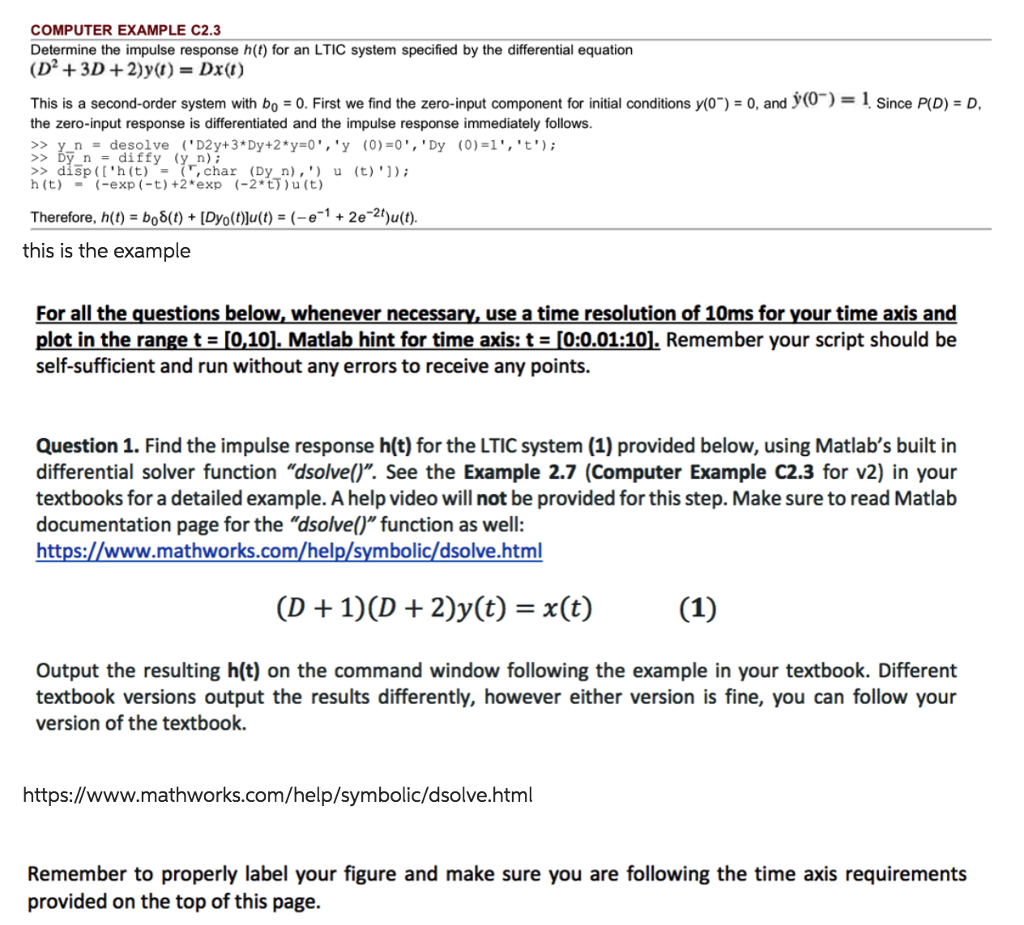
COMPUTER EXAMPLE C2.3 Determine the impulse response h(t) for an LTIC system specified by the differential equation (D2 +3D +2)y()-Dx(t) This is a second-order system with bo 0. First we find the zero-input component for initial conditions y(o-)-0, and y(O)-1 since P(D) - D, the zero-input response is differentiated and the impulse response immediately follows. (0)=0','Dy (t)')); (0)=1','t'); >> y-n desolve.("D2yt3"Dy+2*y=0','y >> by-n =diffy (y-n); >>disp ('h(t) h(t) (-exp (-t) +2*exp (-2 tu (t) (r, char (Dyn),') u - Therefore, h(t) = b06() + [Do(t)lu(t) = (-e-1 + 2e-2t)u(t). this is the example For all the questions below, whenever necessary. use a time resolution of 10ms for your time axis and plot in the range t10,101. Matlab hint for time axis: t 10:0.01:10L Remember your script should be self-sufficient and run without any errors to receive any points. Question 1. Find the impulse response h(t) for the LTIC system (1) provided below, using Matlab's built in differential solver function "dsolve(l)". See the Example 2.7 (Computer Example C2.3 for v2) in your textbooks for a detailed example. A help video will not be provided for this step. Make sure to read Matlab documentation page for the "dsolve()" function as well: https://www.mathworks.com/help/symbolic/dsolve.html (D + 1)(D + 2)y(t) x(t) Output the resulting h(t) on the command window following the example in your textbook. Different textbook versions output the results differently, however either version is fine, you can follow your version of the textbook. https://www.mathworks.com/help/symbolic/dsolve.html Remember to properly label your figure and make sure you are following the time axis requirements provided on the top of this page. COMPUTER EXAMPLE C2.3 Determine the impulse response h(t) for an LTIC system specified by the differential equation (D2 +3D +2)y()-Dx(t) This is a second-order system with bo 0. First we find the zero-input component for initial conditions y(o-)-0, and y(O)-1 since P(D) - D, the zero-input response is differentiated and the impulse response immediately follows. (0)=0','Dy (t)')); (0)=1','t'); >> y-n desolve.("D2yt3"Dy+2*y=0','y >> by-n =diffy (y-n); >>disp ('h(t) h(t) (-exp (-t) +2*exp (-2 tu (t) (r, char (Dyn),') u - Therefore, h(t) = b06() + [Do(t)lu(t) = (-e-1 + 2e-2t)u(t). this is the example For all the questions below, whenever necessary. use a time resolution of 10ms for your time axis and plot in the range t10,101. Matlab hint for time axis: t 10:0.01:10L Remember your script should be self-sufficient and run without any errors to receive any points. Question 1. Find the impulse response h(t) for the LTIC system (1) provided below, using Matlab's built in differential solver function "dsolve(l)". See the Example 2.7 (Computer Example C2.3 for v2) in your textbooks for a detailed example. A help video will not be provided for this step. Make sure to read Matlab documentation page for the "dsolve()" function as well: https://www.mathworks.com/help/symbolic/dsolve.html (D + 1)(D + 2)y(t) x(t) Output the resulting h(t) on the command window following the example in your textbook. Different textbook versions output the results differently, however either version is fine, you can follow your version of the textbook. https://www.mathworks.com/help/symbolic/dsolve.html Remember to properly label your figure and make sure you are following the time axis requirements provided on the top of this page
Step by Step Solution
There are 3 Steps involved in it

Get step-by-step solutions from verified subject matter experts
 Study Help