







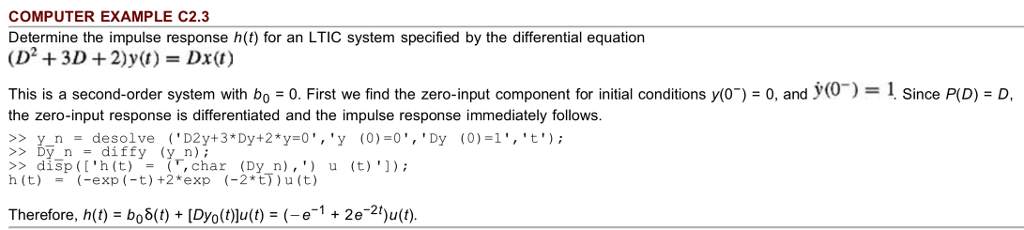
Question: this is the example https://www.mathworks.com/help/symbolic/dsolve.html COMPUTER EXAMPLE C2.3 Determine the impulse response h(t) for an LTIC system specified by the differential equation (D2 + 3D
 this is the example
https://www.mathworks.com/help/symbolic/dsolve.html

COMPUTER EXAMPLE C2.3 Determine the impulse response h(t) for an LTIC system specified by the differential equation (D2 + 3D + 2)y(t) = Dx(t) This is a second-order system with bo 0. First we find the zero-input component for initial conditions y(o) - 0, and (O)1 since PD) D the zero-input response is differentiated and the impulse response immediately follows. (0)=1','t') >> y_n = de solve. ("D2y+ 3 * Dy+2*y=0', 'y (0)=0','Dy >> by n = diffy (y n); >> disp ( [ 'h (t)-= (r, char (Dyn),') u (t)')); h(t)(-exp (-t) +2 exp (2 t)) u (t) Therefore, h(t) = b06() + [Dyo(t)]u(t) = (-e-1 + 2e-2t)u(t). COMPUTER EXAMPLE C2.3 Determine the impulse response h(t) for an LTIC system specified by the differential equation (D2 + 3D + 2)y(t) = Dx(t) This is a second-order system with bo 0. First we find the zero-input component for initial conditions y(o) - 0, and (O)1 since PD) D the zero-input response is differentiated and the impulse response immediately follows. (0)=1','t') >> y_n = de solve. ("D2y+ 3 * Dy+2*y=0', 'y (0)=0','Dy >> by n = diffy (y n); >> disp ( [ 'h (t)-= (r, char (Dyn),') u (t)')); h(t)(-exp (-t) +2 exp (2 t)) u (t) Therefore, h(t) = b06() + [Dyo(t)]u(t) = (-e-1 + 2e-2t)u(t)
Step by Step Solution
There are 3 Steps involved in it

Get step-by-step solutions from verified subject matter experts
 Study Help