







Question: computer networking Problem 3 Hosts A, B, and C want to send segments to Host S. Each of A, B, and is connected to S
computer networking
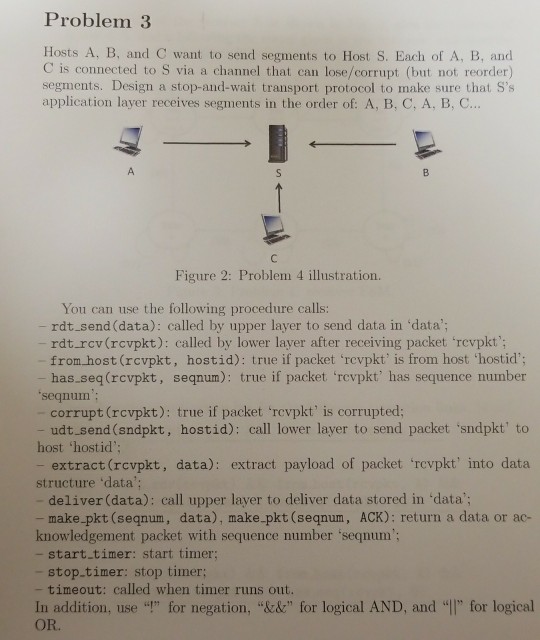
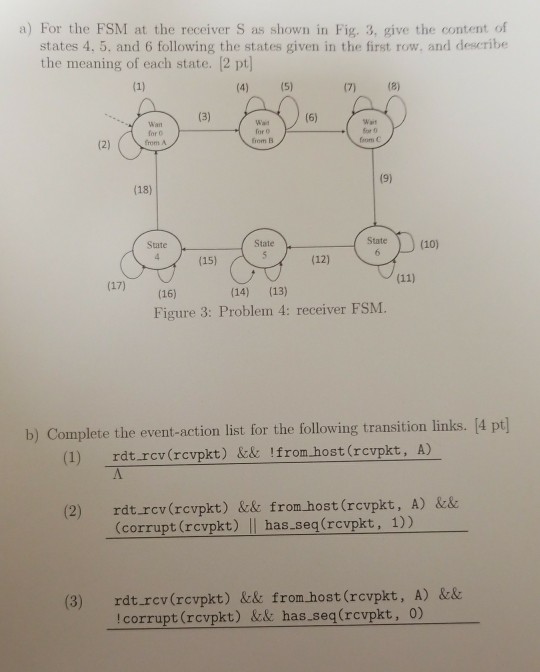
Problem 3 Hosts A, B, and C want to send segments to Host S. Each of A, B, and is connected to S via a channel that can lose/corrupt (but not reorder) segments. Design a stop-and-wait transport protocol to make sure that S's application layer receives segments in the order of: A, B, C, A, B, C. Figure 2: Problem 4 illustration. You can use the following procedure calls: rdt send(data): called by upper layer to send data in 'data'; rdt.rcv(rcvpkt): called by lower layer after receiving packet 'revpkt'; from host (rcvpkt, hostid): true if packet 'revpkt' is from host 'hostid'; has.seq (rcvpkt, seqnum): true if packet 'revpkt' has sequence number seqnum corrupt (rcvpkt): true if packet 'revpkt' is corrupted; udt.send(sndpkt, hostid): call lower layer to send packet 'sndpkt' to host 'hostid': extract (rcvpkt, data): extract payload of packet 'revpkt' into data structure 'data' deliver (data): call upper layer to deliver data stored in 'data'; make-pkt (seqnum, data), make-pkt (seqnum, ACK): return a data or ac- knowledgement packet with sequence number 'seqnum'; - start.timer: start timer stop.timer: stop timer; timeout: called when timer runs out. In addition, use " for negation, "&&" for logical AND, and "I" for logical OR. Problem 3 Hosts A, B, and C want to send segments to Host S. Each of A, B, and is connected to S via a channel that can lose/corrupt (but not reorder) segments. Design a stop-and-wait transport protocol to make sure that S's application layer receives segments in the order of: A, B, C, A, B, C. Figure 2: Problem 4 illustration. You can use the following procedure calls: rdt send(data): called by upper layer to send data in 'data'; rdt.rcv(rcvpkt): called by lower layer after receiving packet 'revpkt'; from host (rcvpkt, hostid): true if packet 'revpkt' is from host 'hostid'; has.seq (rcvpkt, seqnum): true if packet 'revpkt' has sequence number seqnum corrupt (rcvpkt): true if packet 'revpkt' is corrupted; udt.send(sndpkt, hostid): call lower layer to send packet 'sndpkt' to host 'hostid': extract (rcvpkt, data): extract payload of packet 'revpkt' into data structure 'data' deliver (data): call upper layer to deliver data stored in 'data'; make-pkt (seqnum, data), make-pkt (seqnum, ACK): return a data or ac- knowledgement packet with sequence number 'seqnum'; - start.timer: start timer stop.timer: stop timer; timeout: called when timer runs out. In addition, use " for negation, "&&" for logical AND, and "I" for logical OR
Step by Step Solution
There are 3 Steps involved in it

Get step-by-step solutions from verified subject matter experts
 Study Help