







Question: Computer Networks Question: Consider the Go-back-N protocol operating between nodes A and B under the following assumptions: - Node A transmits data packets to B
Computer Networks Question:
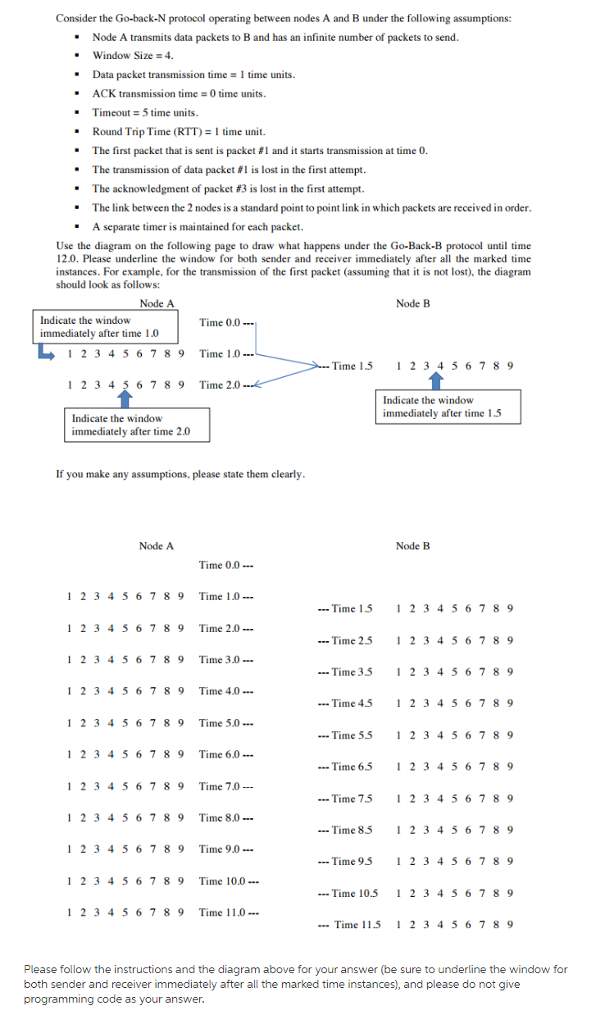
Consider the Go-back-N protocol operating between nodes A and B under the following assumptions: - Node A transmits data packets to B and has an infinite number of packets to send Window Size4. Data packet transmission time 1 time units ACK transmission time 0 time units. Timeout = 5 time units Round Trip Time (RTT) The first packet that is sent is packet #1 and it starts transmission at time 0. The transmission of data packet #1 is lost in the first attempt. The acknowledgment of packet #3 is lost in the first attempt. time unit. . -The link between the 2 nodes is a standard point to point link in which packets are received in order -A separate timer is maintained for each packet. Use the diagram on the following page to draw what happens under the Go-Back-B protocol until time 12.0. Please underline the window for both sender and receiver immediately after all the marked time instances. For example, for the transmission of the first packet (assuming that it is not lost), the diagram should look as follows Node A Node B Indicate the window immediately after time 1.0 Time 0.0 1 2 3 4 5 6 789 Time 1.0 Time 1523 4 5 6 7 8 9 1 2 34 5 6 789 Time 2.0 Indicate the window immediately after time 1.5 Indicate the window immediately after time 2.0 If you make any assumptions, please state them clearly Node A Node B Time 0.0 1 2 3 4 56789Time 1.0 -Time 15 2 34 56789 1 2 3 4 5 6 789Time 2.0 Time 25 2 3 4 5 6 789 1 2 3 4 5 6 789 Time 3.0 1 2 3 4 56789Time 4.0 1 2 3 4 56789Time 5.0 1 2 3 4 56789Time 6.0 1 2 3 4 56789Time 7.0- 1 2 3 4 5 6 7 89 Time 8.0.- -Time 35 12 3 4 56789 -Time 45 23456789 -Time 551 234 56789 -Time 65 2 3 4 5 6 789 -Time 751 2 3 4 5 6 789 1 2 3 4 56789 Time 9.0 1 2 3 4 56789Time 10.0 1 2 3 4 56789Time 11.0 Time 85 2345678 9 Time 951 23456789 -Time 10.5 23456789 -Time 115 1 2 3 4 5 6 7 8 9 Please follow the instructions and the diagram above for your answer (be sure to underline the window for both sender and receiver immediately after all the marked time instances), and please do not give g code as your answer Consider the Go-back-N protocol operating between nodes A and B under the following assumptions: - Node A transmits data packets to B and has an infinite number of packets to send Window Size4. Data packet transmission time 1 time units ACK transmission time 0 time units. Timeout = 5 time units Round Trip Time (RTT) The first packet that is sent is packet #1 and it starts transmission at time 0. The transmission of data packet #1 is lost in the first attempt. The acknowledgment of packet #3 is lost in the first attempt. time unit. . -The link between the 2 nodes is a standard point to point link in which packets are received in order -A separate timer is maintained for each packet. Use the diagram on the following page to draw what happens under the Go-Back-B protocol until time 12.0. Please underline the window for both sender and receiver immediately after all the marked time instances. For example, for the transmission of the first packet (assuming that it is not lost), the diagram should look as follows Node A Node B Indicate the window immediately after time 1.0 Time 0.0 1 2 3 4 5 6 789 Time 1.0 Time 1523 4 5 6 7 8 9 1 2 34 5 6 789 Time 2.0 Indicate the window immediately after time 1.5 Indicate the window immediately after time 2.0 If you make any assumptions, please state them clearly Node A Node B Time 0.0 1 2 3 4 56789Time 1.0 -Time 15 2 34 56789 1 2 3 4 5 6 789Time 2.0 Time 25 2 3 4 5 6 789 1 2 3 4 5 6 789 Time 3.0 1 2 3 4 56789Time 4.0 1 2 3 4 56789Time 5.0 1 2 3 4 56789Time 6.0 1 2 3 4 56789Time 7.0- 1 2 3 4 5 6 7 89 Time 8.0.- -Time 35 12 3 4 56789 -Time 45 23456789 -Time 551 234 56789 -Time 65 2 3 4 5 6 789 -Time 751 2 3 4 5 6 789 1 2 3 4 56789 Time 9.0 1 2 3 4 56789Time 10.0 1 2 3 4 56789Time 11.0 Time 85 2345678 9 Time 951 23456789 -Time 10.5 23456789 -Time 115 1 2 3 4 5 6 7 8 9 Please follow the instructions and the diagram above for your answer (be sure to underline the window for both sender and receiver immediately after all the marked time instances), and please do not give g code as your
Step by Step Solution
There are 3 Steps involved in it

Get step-by-step solutions from verified subject matter experts
 Study Help