







Question: Computer programs are effective data analysis tools. A program is used here to analyze lift coefficient data from wind tunnel tests on a wing. Lift
Computer programs are effective data analysis tools. A program is used here to analyze lift coefficient data from wind tunnel tests on a wing. Lift coefficient C is a unitless lift generation factor that depends on the bodys angle of attack alpha, being the angle between a reference body line and the line of motion. Lift coefficients are measured for many angle of attack values of a wing and recorded in Table 1.
A theoretical model is used to compute lift coefficient C vs. alpha (entered in degrees). The modeled expression is C = Asin(2(pi)(alpha)/B). Here, A = 1.3 [unitless] and B = 95 [degrees] are empirical coefficients from curve-fitting. In this lab, you will write a program to query a user for a data point alpha-C pair in Table 1. The program will then compute the modelled lift coefficient for the entered angle of attack, and compare the difference between the measured and modeled lift coefficient values. Table 1. Measured lift coefficient C as a function of angle of attack . Angle of attack, 0 2 4 6 8 10 12 14 16 18 19 20 21 22 23 24 Lift coefficient, C 0 0.126 0.279 0.42 0.603 0.661 0.836 0.974 1.106 1.217 1.258 1.285 1.302 1.303 1.303 1.281 Program Specification Write a C++ program to: - prompt the user to enter, and then read in, an angle of attack ()and the corresponding measured lift coefficient from Table 1 (remember units!) - compute the modeled lift coefficient for the entered angle of attack using the expression C = Asin(2/B) where A = 1.3 [unitless], B = 95 degrees and is in degrees1 - compute the percent difference between measured and modeled lift coefficients. Compute this percentage as the absolute difference between measured and modeled lift coefficients divided by the modeled lift coefficient. - output the angle of attack, measured lift coefficient, modeled lift coefficient, and lift coefficient percent difference as in the following example of user/computer interaction
- use a constant for pi (using the arccosine function) You will need the sin(), abs(), and acos() functions to calculate sine, absolute value, and arccosine. Enter the angle of attack in degrees: 24 Enter the corresponding measured lift coefficient: 1.281 Angle of attack in degrees 24 Measured lift coefficient 1.281 Modeled lift coefficient 1.29982 Percent difference 1.44807
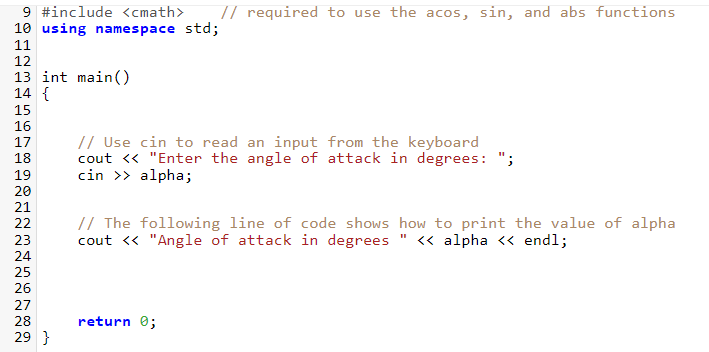
9 #include
Step by Step Solution
There are 3 Steps involved in it

Get step-by-step solutions from verified subject matter experts
 Study Help