







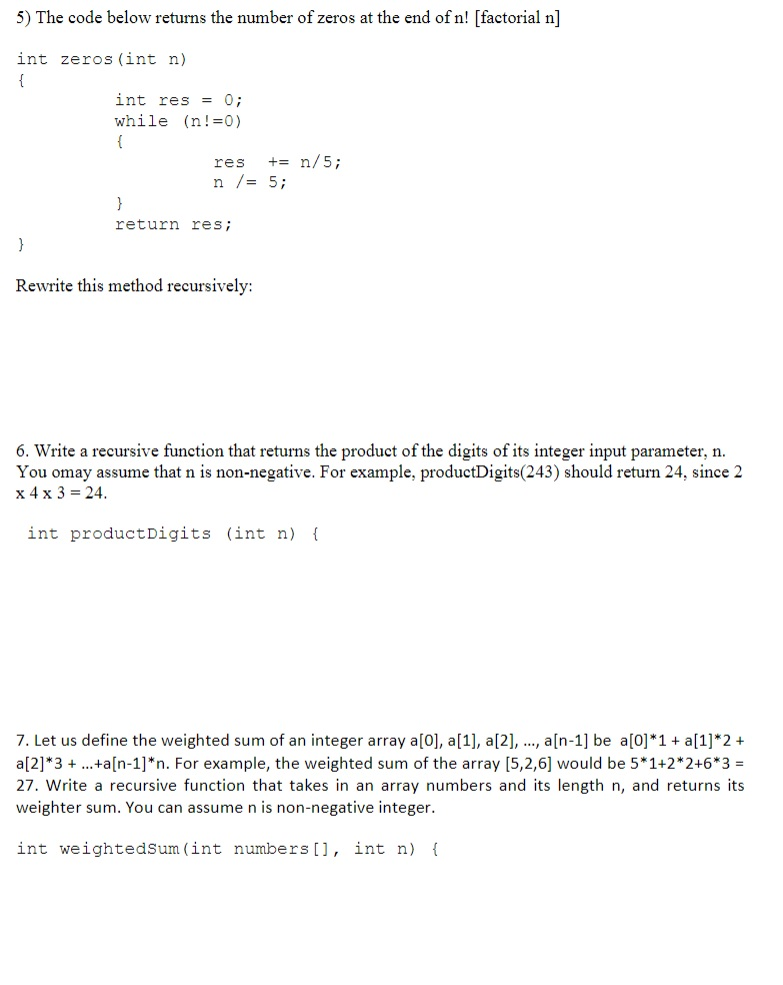
Question: Computer Science I Exercise: Recursion 5) The code below returns the number of zeros at the end of n! (factorial n] int zeros (int n)
Computer Science I
Exercise: Recursion
![of zeros at the end of n! (factorial n] int zeros (int](https://dsd5zvtm8ll6.cloudfront.net/si.experts.images/questions/2024/09/66f2ff1a1374a_04966f2ff1981663.jpg)
5) The code below returns the number of zeros at the end of n! (factorial n] int zeros (int n) int res = 0; while (n!=0) n/5; res n /= += 5; return res; Rewrite this method recursively: 6. Write a recursive function that returns the product of the digits of its integer input parameter, n. You omay assume that n is non-negative. For example, productDigits(243) should return 24, since 2 x 4 x 3 = 24. int productDigits (int n) { 7. Let us define the weighted sum of an integer array a[0], a[1], a[2], ..., a[n-1] be a[0]*1 + a[1]* 2 + a[2]*3 + ...+a[n-1]*n. For example, the weighted sum of the array (5,2,6] would be 5*1+2* 246*3 = 27. Write a recursive function that takes in an array numbers and its length n, and returns its weighter sum. You can assume n is non-negative integer. int weightedSum(int numbers [], int n) { 8. Mathematically, given a function f, we recursively define f(n) as follows: if k=1, f(n) = f(n). Otherwise, for k> 1, f*(n) = f(f(n)). Assume that there is an existing function f, which takes in a single integer and returns an integer. Write a recursive function fcomp, which takes in both n and k (k>0), and returns f(n). int f(int n); int fcomp(int n, int k){
Step by Step Solution
There are 3 Steps involved in it

Get step-by-step solutions from verified subject matter experts
 Study Help