







Question: CON Tutorial: Torque and statics Ill. Torque for non-perpendicular forces: ? = Fearparticular When the force is not perp endicular to the object it's trying
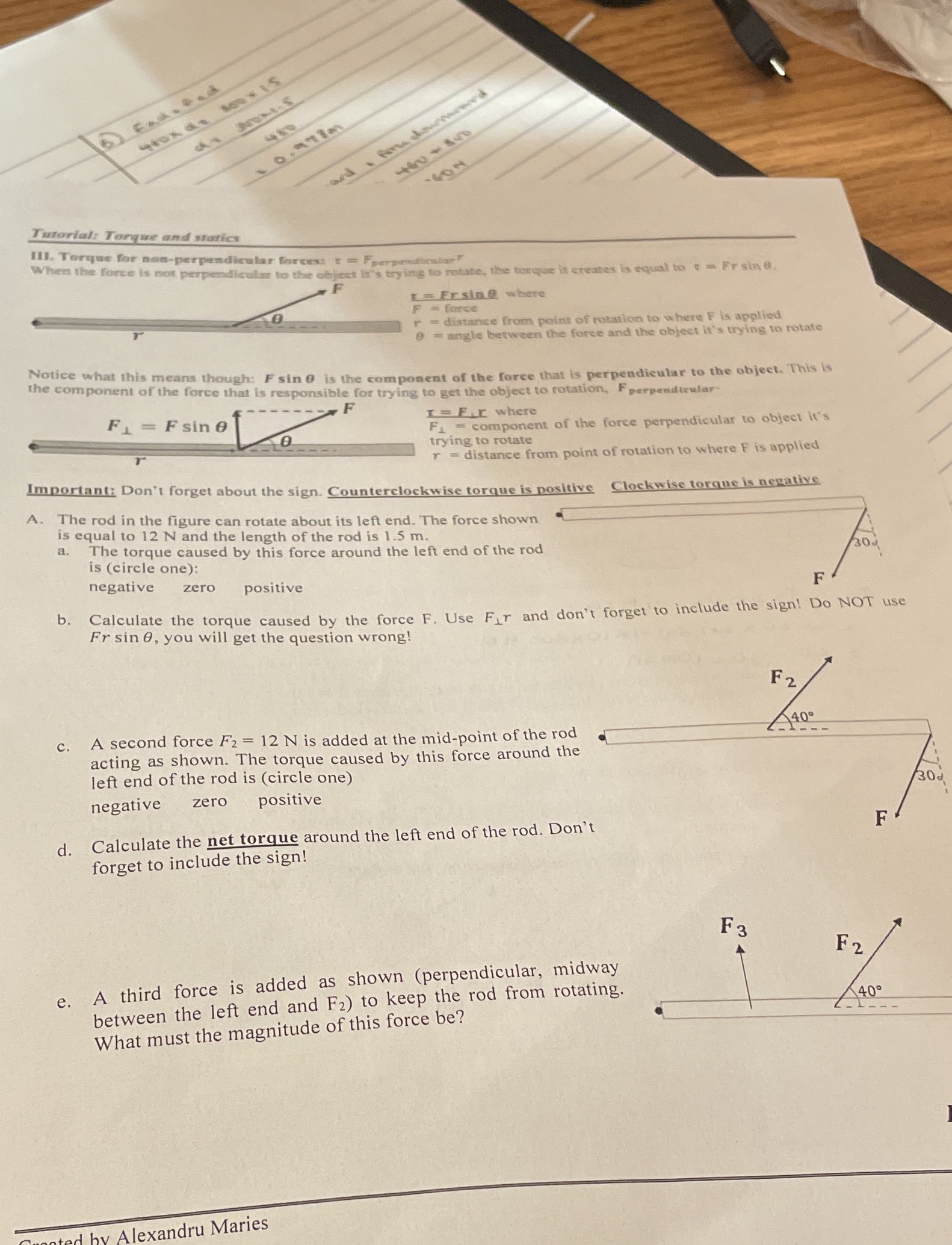
CON Tutorial: Torque and statics Ill. Torque for non-perpendicular forces: ? = Fearparticular When the force is not perp endicular to the object it's trying to rotate, the torque it creates is equal to ? = Fr sin . L= Ersin@ where F - force r = distance from point of rotation to where F is applied = angle between the force and the object it's trying to rotate Notice what this means though: F sin 0 is the component of the force that is perpendicular to the object. This is the component of the force that is responsible for trying to get the object to rotation, Fperpendicular F F1 = F sin 0 L= Fir where Fi = component of the force perpendicular to object it's trying to rotate r = distance from point of rotation to where F is applied Important: Don't forget about the sign. Counterclockwise torque is positive Clockwise torque is negative A . The rod in the figure can rotate about its left end. The force shown is equal to 12 N and the length of the rod is 1.5 m. a. The torque caused by this force around the left end of the rod is (circle one): negative zero positive F b . Calculate the torque caused by the force F. Use Fir and don't forget to include the sign! Do NOT use Fr sin 0, you will get the question wrong! F 2 40 C. A second force F2 = 12 N is added at the mid-point of the rod acting as shown. The torque caused by this force around the left end of the rod is (circle one) 30d negative zero positive d. Calculate the net torque around the left end of the rod. Don't F forget to include the sign! F 3 F 2 e. A third force is added as shown (perpendicular, midway between the left end and F2) to keep the rod from rotating. 40 1- - - What must the magnitude of this force be? Alexandru Maries
Step by Step Solution
There are 3 Steps involved in it

Get step-by-step solutions from verified subject matter experts
 Study Help