







Question: Conceptual models play a key role in the process because they help us to decide which aspects of organizational behavior require attention and provide a
Conceptual models play a key role in the
process because they help us to
decide which aspects of organizational behavior require attention and provide a focus for
gathering.
A diagnostic, information
B information, diagnostic
C interview, diagnostic
D forcefield, cultural
Which is a key leadership task?
A Sensemaking
B Aligning
C Enabling
D All of the above
Power is inherent in any relationship in which one person or group is
on another.
A selfinterested
B dependent
C independent
D motivated
Action research is the basic model underpinning most organizational development
interventions.
A True
B False
In action research, the motive force for learning and change is
and the
experience of
A freezing, untreezng
B participation, collaboration
C cognitive dissonance, disconfirmation
D dependence, freezing
inquiry is a process that involves exploring the best of what is and amplifying
this dest practice. he essence of inquiry is the generation of a shared image of
a better future: 'What would the future de ke in tne dest of what is became the norm?
A Appreciative, appreciative
B Action, action
C Lean, lean
D Training, reengineering
learning occurs when leaders are able to think outside the box by reflecting
on outcomes, identifying and challenging the assumptions and beliefs that underpinned the
decisions and actions that led to these outcomes, and, where appropriate, revising their
assumptions in ways that open the possibility of experimenting with new ways of behaving.
A Singleloop
B Doubleloop
C Continuousloop
D Bouncingloop
Appreciative inquiry is based on the assumption that we are free to choose which aspects of
our experience we pay attention to
A True
B False Which statement is false?
A Organizational change is typically associated with some degree of individual change.
B The training needs analysis involves three steps: systemslevel review, task analysis, and
persona analysis.
C Training is a key determinant of the success of teams.
D A task analysis review determines how the proposed change will affect organizational goals,
objectives and task demands.
Training is not a key determinant of the success of teams.
A True
B False
Which statement is false regarding the evaluation of training effectiveness?
A At level one, the criterion is how trainees reacted to the training.
B At level two, the criterion is what they learned.
C It is relatively easy to apply the relevant principles of learning to design a training activity that
will encourage learning, but much more difficult to design one that will ensure that the learning is
transferred and used in the work situation.
D At level four, the criterion is behavior.
High performance management is an intervention that change agents can use to improve
performance by aligning people management practices. This is a much more effective intervention
than working to improve separate people management practices, such as training, performance
management or reward systems, in isolation.
A True
B False
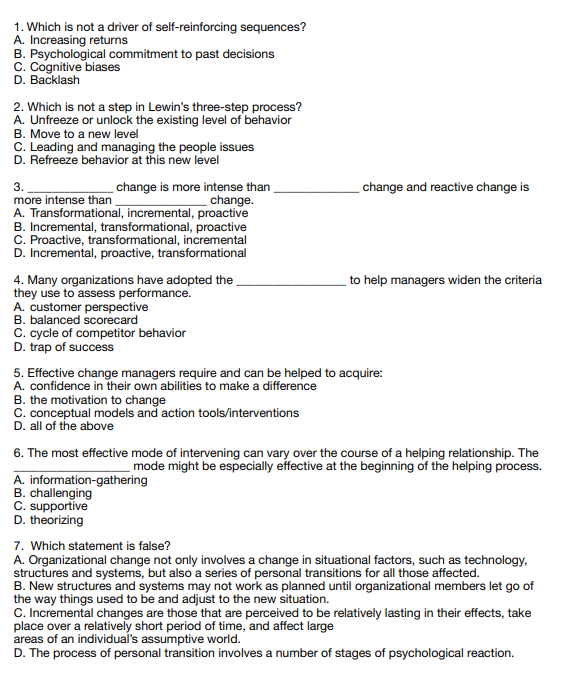
The maWhich is not a driver of selfreinforcing sequences?
A Increasing returns
B Psychological commitment to past decisions
C Cognitive biases
D Backlash
Which is not a step in Lewin's threestep process?
A Unfreeze or unlock the existing level of behavior
B Move to a new level
C Leading and managing the people issues
D Refreeze behavior at this new level
change is more intense than
change and reactive change is
more intense tnan.
change.
A Transformational, incremental, proactive
B Incremental, transformational, proactive
C Proactive, transformational, incremental
D Incremental, proactive, transformational
Many organizations have adopted the
to help managers widen the criteria
they use to assess performance.
A customer perspective
B balanced scorecard
C cycle of competitor behavior
D trap of success
Effective change managers require and can be helped to acquire:
A confidence in their own abilities to make a difference
B the motivation to change
C conceptual models and action toolsinterventions
D all of the above
The most effective mode of intervening can vary over the course of a helping relationship. The
mode might be especially effective at the beginning of the helping process.
A informationgathering
B challenging
C supportive
D theorizing
Which statement is false?
A Organizational change not only involves a change in situational factors, such as technology,
structures and systems, but also a series of personal transitions for all those affected.
B New structures and systems may not work as planned until organizational members let go of
the way things used to be and adjust to the new situation.
C Incremental changes are those that are perceived to be relatively lasting in their effects, take
place over a relatively short period of time, and affect large
areas of an individual's assumptive world.
D The process of personal transition involves a number of stages of
Step by Step Solution
There are 3 Steps involved in it
1 Expert Approved Answer
Step: 1 Unlock

Question Has Been Solved by an Expert!
Get step-by-step solutions from verified subject matter experts
Step: 2 Unlock
Step: 3 Unlock
 Study Help