



Question: Conceptual Overview: Explore how the value of a stock changes as a function of the discount interest rate. The blue stair-step line depicts the value
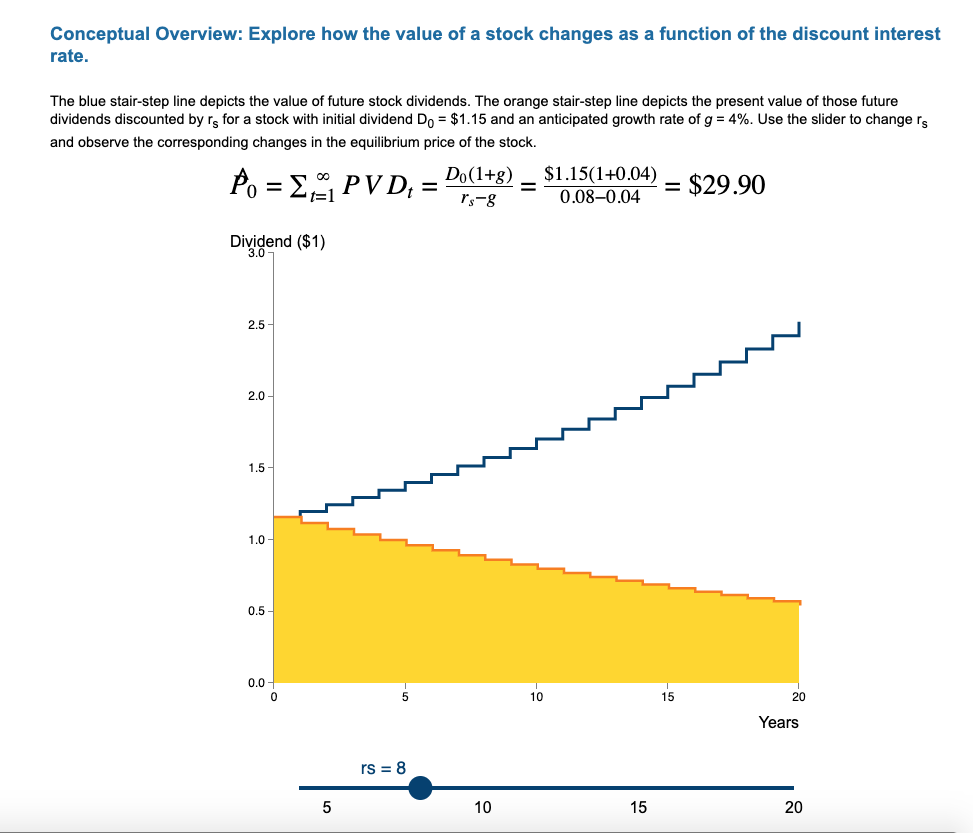
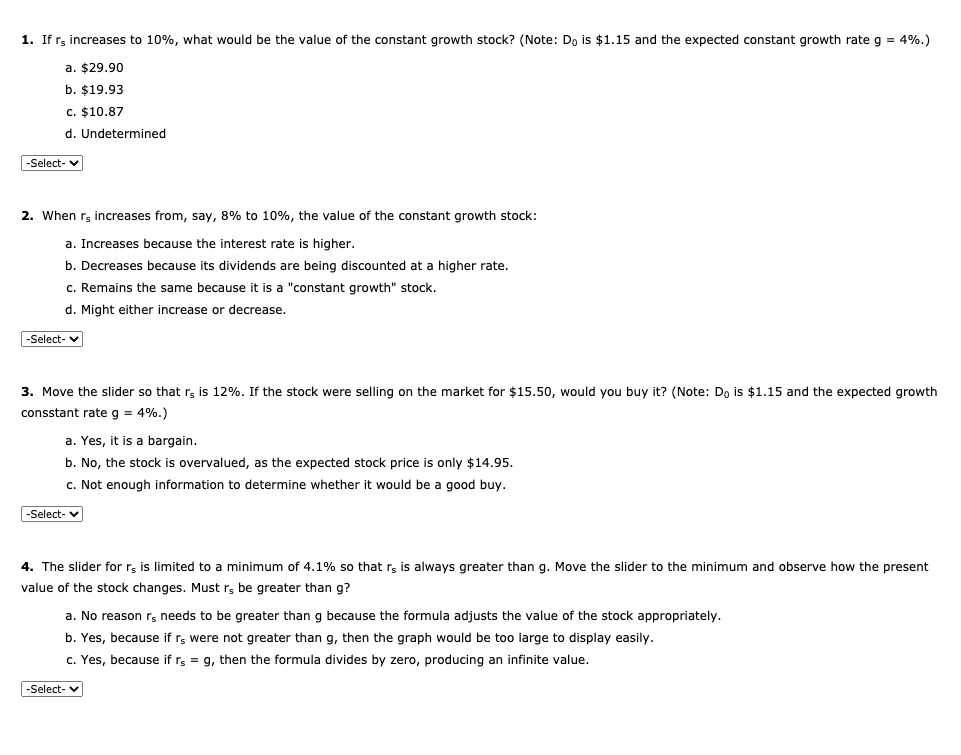
Conceptual Overview: Explore how the value of a stock changes as a function of the discount interest rate. The blue stair-step line depicts the value of future stock dividends. The orange stair-step line depicts the present value of those future dividends discounted by rs for a stock with initial dividend Do = $1.15 and an anticipated growth rate of g = 4%. Use the slider to changers and observe the corresponding changes in the equilibrium price of the stock. D.(1+) $1.15(1+0.04) $29.90 r's-g 0.08-0.04 Po = 2:0 PVD, = - Dividend ($1) 2.5 2.0 1.5 1.0 0.5 0.0 0 5 10 15 20 Years rs = 8 5 10 15 20 1. If rs increases to 10%, what would be the value of the constant growth stock? (Note: Do is $1.15 and the expected constant growth rate g = 4%.) a. $29.90 b. $19.93 C. $10.87 d. Undetermined -Select- 2. When rs increases from, say, 8% to 10%, the value of the constant growth stock: a. Increases because the interest rate is higher. b. Decreases because its dividends are being discounted at a higher rate. c. Remains the same because it is a "constant growth" stock. d. Might either increase or decrease. -Select- 3. Move the slider so that rs is 12%. If the stock were selling on the market for $15.50, would you buy it? (Note: D, is $1.15 and the expected growth consstant rate g = 4%.) a. Yes, it is a bargain. b. No, the ock is overvalued, as the expected ock price is only $14.95. c. Not enough information to determine whether it would be a good buy. -Select- 4. The slider for rs is limited to a minimum of 4.1% so that rs is always greater than g. Move the slider to the minimum and observe how the present value of the stock changes. Must rs be greater than g? a. No reason is needs to be greater than g because the formula adjusts the value of the stock appropriately. b. Yes, because if rs were not greater than g, then the graph would be too large to display easily. c. Yes, because if rs = g, then the formula divides by zero, producing an infinite value. -Select
Step by Step Solution
There are 3 Steps involved in it

Get step-by-step solutions from verified subject matter experts