







Question: The distance de(u, v) of two vertices in a graph G = (V, E) is defined to be the length of a shortest path
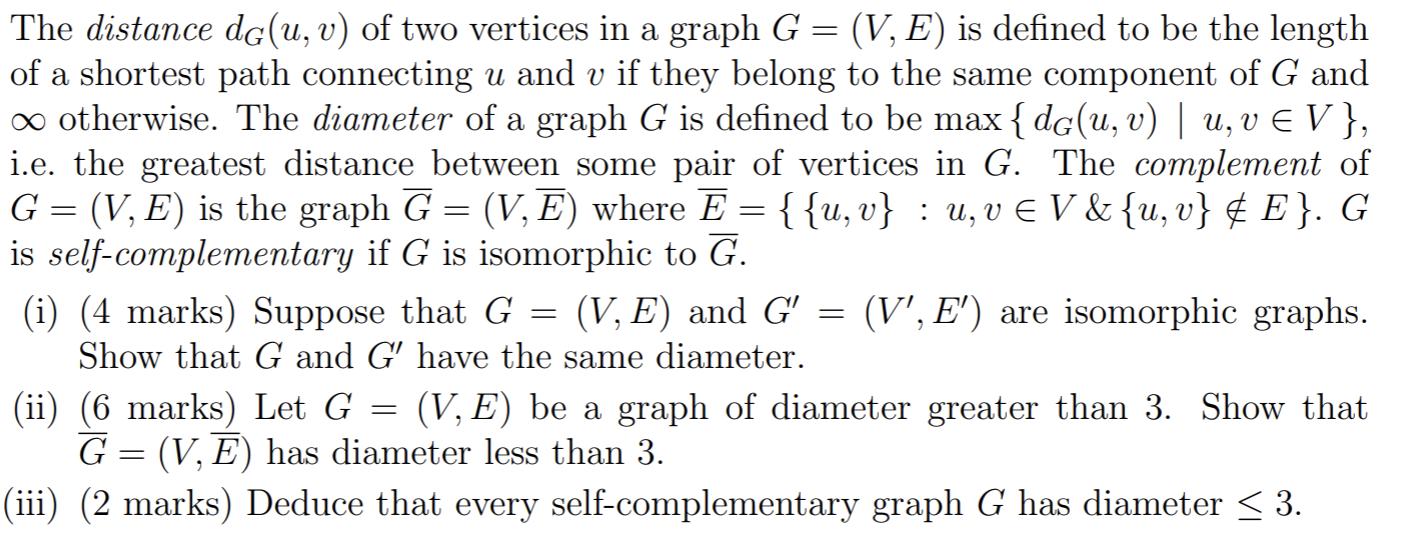
The distance de(u, v) of two vertices in a graph G = (V, E) is defined to be the length of a shortest path connecting u and v if they belong to the same component of G and otherwise. The diameter of a graph G is defined to be max { d(u, v) | u, v V }, i.e. the greatest distance between some pair of vertices in G. The complement of G = (V, E) is the graph G = (V, E) where E = { {u, v} : u, v V & {u, v} E}. G is self-complementary if G is isomorphic to G. (i) (4 marks) Suppose that G = (V, E) and G' = (V', E') are isomorphic graphs. Show that G and G' have the same diameter. (ii) (6 marks) Let G (V, E) be a graph of diameter greater than 3. Show that G = (V, E) has diameter less than 3. (iii) (2 marks) Deduce that every self-complementary graph G has diameter 3. =
Step by Step Solution
3.54 Rating (161 Votes )
There are 3 Steps involved in it
Solution Given that the dist... View full answer

Get step-by-step solutions from verified subject matter experts
 Study Help