







Question: Consider a 2 D flow between two very long parallel plates separated by a distance h=50m. Assume that the plate at the bottom is fixed
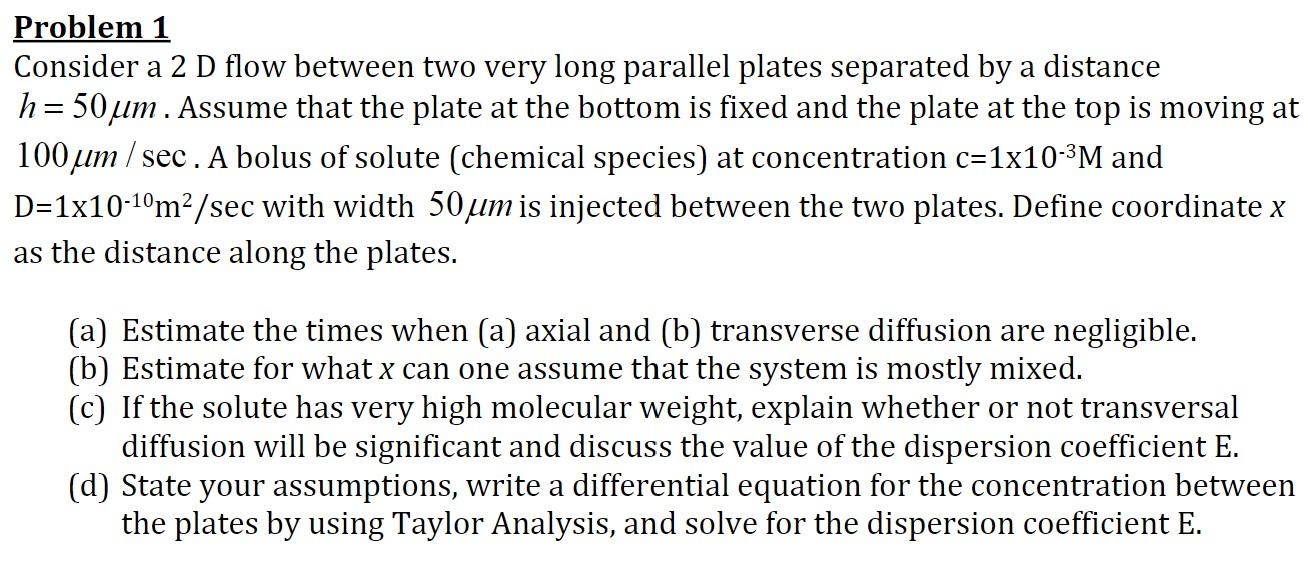
Consider a 2 D flow between two very long parallel plates separated by a distance h=50m. Assume that the plate at the bottom is fixed and the plate at the top is moving at 100m/sec. A bolus of solute (chemical species) at concentration c=1103M and D=1x10¹⁰m2/sec with width 50m is injected between the two plates. Define coordinate x as the distance along the plates. (a) Estimate the times when (a) axial and (b) transverse diffusion are negligible. (b) Estimate for what x can one assume that the system is mostly mixed. (c) If the solute has very high molecular weight, explain whether or not transversal diffusion will be significant and discuss the value of the dispersion coefficient E. (d) State your assumptions, write a differential equation for the concentration between the plates by using Taylor Analysis, and solve for the dispersion coefficient E. Consider a 2 D flow between two very long parallel plates separated by a distance h=50m. Assume that the plate at the bottom is fixed and the plate at the top is moving at 100m/sec. A bolus of solute (chemical species) at concentration c=1103M and D=1x10¹⁰m2/sec with width 50m is injected between the two plates. Define coordinate x as the distance along the plates. (a) Estimate the times when (a) axial and (b) transverse diffusion are negligible. (b) Estimate for what x can one assume that the system is mostly mixed. (c) If the solute has very high molecular weight, explain whether or not transversal diffusion will be significant and discuss the value of the dispersion coefficient E. (d) State your assumptions, write a differential equation for the concentration between the plates by using Taylor Analysis, and solve for the dispersion coefficient E
Step by Step Solution
There are 3 Steps involved in it

Get step-by-step solutions from verified subject matter experts
 Study Help