







Question: Two horizontal, infinite, parallel plates are spaced a distance ( b ) apart. A viscous liquid is contained between the plates. The bottom
Two horizontal, infinite, parallel plates are spaced a distance b apart. A viscous liquid is contained between the plates. The bottom plate is fixed, and the upper plate moves parallel to the bottom plate with a velocity U Because of the noslip boundary condition see the Video the liquid motion is caused by the liquid being dragged along by the moving boundary. There is no pressure gradient in the direction of flow. Note that this is a socalled simple Couette flow discussed in Section
a Start with the NavierStokes equations and determine the velocity distribution between the plates.
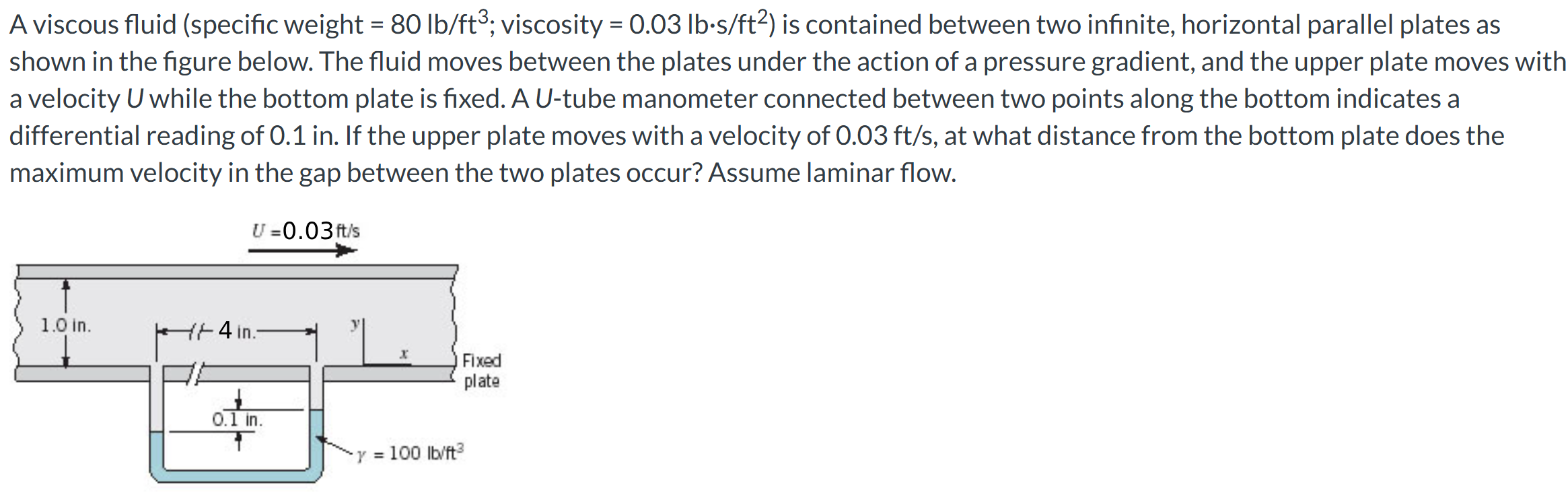
b Determine an expression for the flowrate passing between the plates for a unit width Express your answer in terms of y b and U A viscous fluid specific weight mathrmlbmathrmft ; viscosity mathrmlbcdot mathrmsmathrmft is contained between two infinite, horizontal parallel plates as shown in the figure below. The fluid moves between the plates under the action of a pressure gradient, and the upper plate moves with a velocity U while the bottom plate is fixed. A U tube manometer connected between two points along the bottom indicates a differential reading of in If the upper plate moves with a velocity of mathrmftmathrms at what distance from the bottom plate does the maximum velocity in the gap between the two plates occur? Assume laminar flow.
Step by Step Solution
There are 3 Steps involved in it
1 Expert Approved Answer
Step: 1 Unlock

Question Has Been Solved by an Expert!
Get step-by-step solutions from verified subject matter experts
Step: 2 Unlock
Step: 3 Unlock
 Study Help