







Question: Consider a 40-bit floating point representation with a sign bit S, an exponent E (biased, 11 bits), and a significand (28 bits). The value
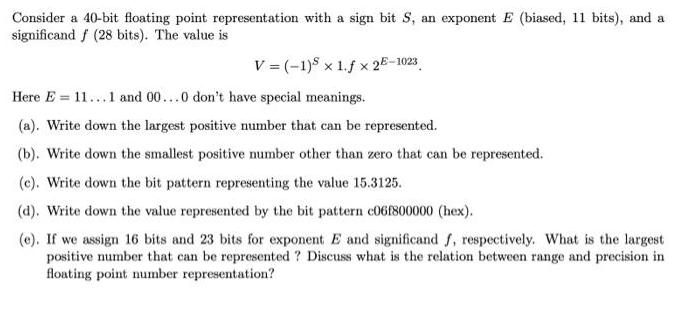
Consider a 40-bit floating point representation with a sign bit S, an exponent E (biased, 11 bits), and a significand (28 bits). The value is V=(-1) x 1.fx 2E-1023 Here E 11...1 and 00...0 don't have special meanings. (a). Write down the largest positive number that can be represented. (b). Write down the smallest positive number other than zero that can be represented. (c). Write down the bit pattern representing the value 15.3125. (d). Write down the value represented by the bit pattern c06f800000 (hex). (e). If we assign 16 bits and 23 bits for exponent E and significand f, respectively. What is the largest positive number that can be represented? Discuss what is the relation between range and precision in floating point number representation?
Step by Step Solution
3.34 Rating (163 Votes )
There are 3 Steps involved in it

Get step-by-step solutions from verified subject matter experts
 Study Help