







Question: Consider a 5-bit floating point representation with one sign bit, two exponent bits, and two fraction bits. The exponent bias is 1. A normalize fraction
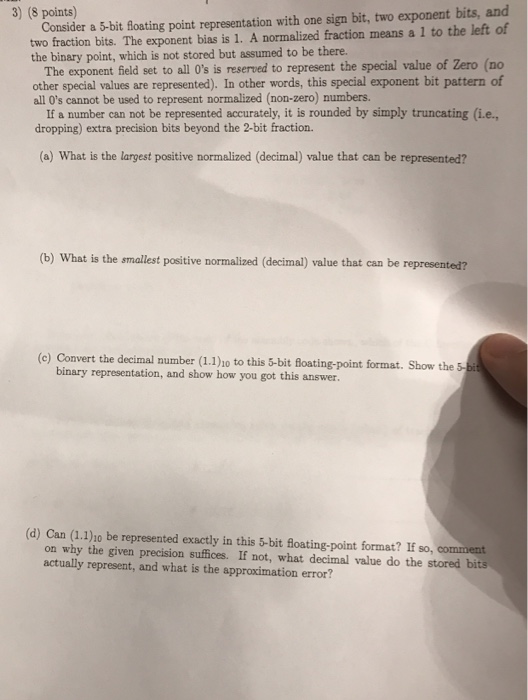
Consider a 5-bit floating point representation with one sign bit, two exponent bits, and two fraction bits. The exponent bias is 1. A normalize fraction means a 1 to the left of the binary point, which is not stored but assumed to be there. The exponent field set to all 0's is reserved to represent the special value of Zero (no other special values are represented). In other words, this special exponent bit pattern of all 0's cannot be used to represent normalized (non-zero) numbers. If a number can not be represented accurately, it is rounded by simply truncating (i.e., dropping) extra precision bits beyond the 2-bit fraction. What is the largest positive normalized (decimal) value that can be represented? What is the smallest positive normalized (decimal) value that can be represented? Convert the decimal number (1.1)_10 to this 5-bit floating-point format. Show the 5-bit binary representation, and show how you got this answer. Can (1.1)_10 be represented exactly in this 5-bit floating-point format? If so, comment on why the given precision suffices. If not, what decimal value do the stored bits actually represent, and what is the approximation error
Step by Step Solution
There are 3 Steps involved in it

Get step-by-step solutions from verified subject matter experts
 Study Help