







Question: solve these questions Consider a 7-bit floating-point representation based on the IEEE floating-point format, with one sign bit, three exponent bits (k 3), and three
solve these questions
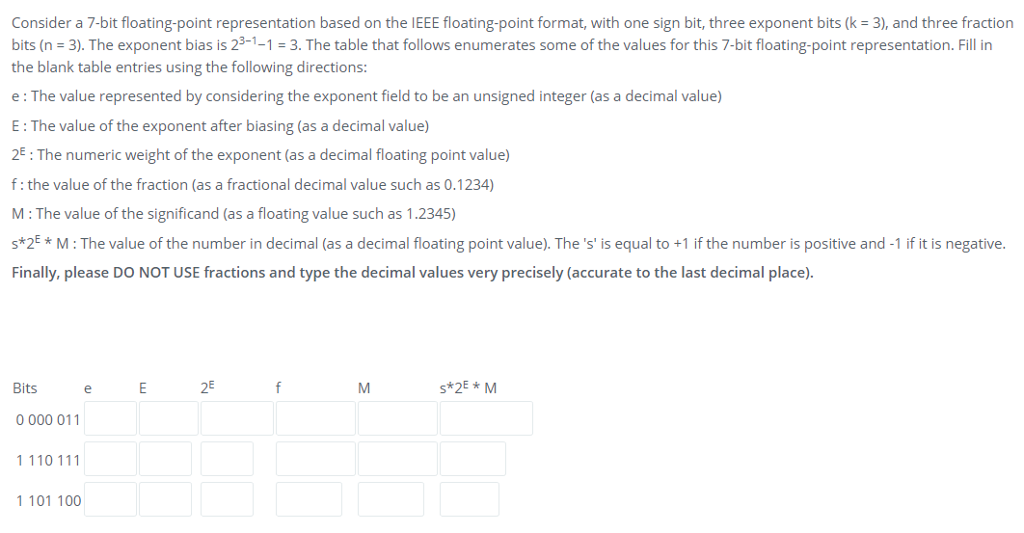
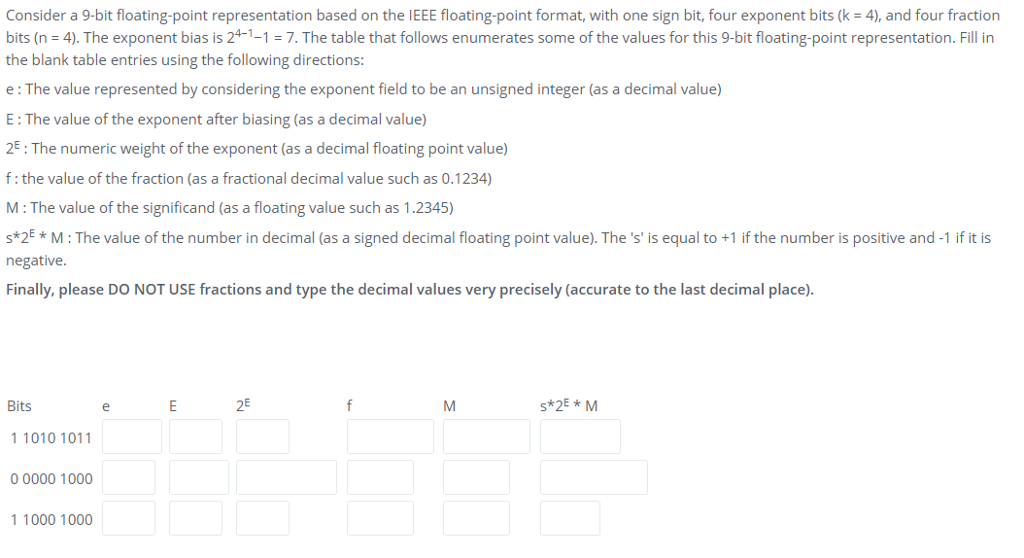
Consider a 7-bit floating-point representation based on the IEEE floating-point format, with one sign bit, three exponent bits (k 3), and three fraction bits (n = 3). The exponent bias is 23-1-1 = 3. The table that follows enumerates some of the values for this 7-bit floating-point representation. Fill in the blank table entries using the following directions: e: The value represented by considering the exponent field to be an unsigned integer (as a decimal value) E: The value of the exponent after biasing (as a decimal value) 2E: The numeric weight of the exponent (as a decimal floating point value f: the value of the fraction (as a fractional decimal value such as 0.1234) M: The value of the significand (as a floating value such as 1.2345) s*2E *M: The value of the number in decimal (as a decimal floating point value). The 's' is equal to +1 if the number is positive and -1 if it is negative. Finally, please DO NOT USE fractions and type the decimal values very precisely (accurate to the last decimal place) Bits E 2 25 000 011 101 100 Consider a 9-bit floating-point representation based on the IEEE floating-point format, with one sign bit, four exponent bits (k- 4), and four fraction bits (n -4). The exponent bias is 24-1-1 7. The table that follows enumerates some of the values for this 9-bit floating-point representation. Fill in the blank table entries using the following directions: e: The value represented by considering the exponent field to be an unsigned integer (as a decimal value) E: The value of the exponent after biasing (as a decimal value 2E: The numeric weight of the exponent (as a decimal floating point value f: the value of the fraction (as a fractional decimal value such as 0.1234) M : The value of the significand (as a floating value such as 1.2345) s*2M: The value of the number in decimal (as a signed decimal floating point value). The 's' is equal to +1 if the number is positive and -1 if it is negative Finally, please DO NOT USE fractions and type the decimal values very precisely (accurate to the last decimal place). Bits 2E s*2E*M ex 1010 1011 0000 1000 1000 1000
Step by Step Solution
There are 3 Steps involved in it

Get step-by-step solutions from verified subject matter experts
 Study Help