







Question: Consider a basic refrigeration system as given in the diagram, which used Refrigerant R-134 with a flow rate of 2.0kg/sec. The Refrigerant leaves the evaporator
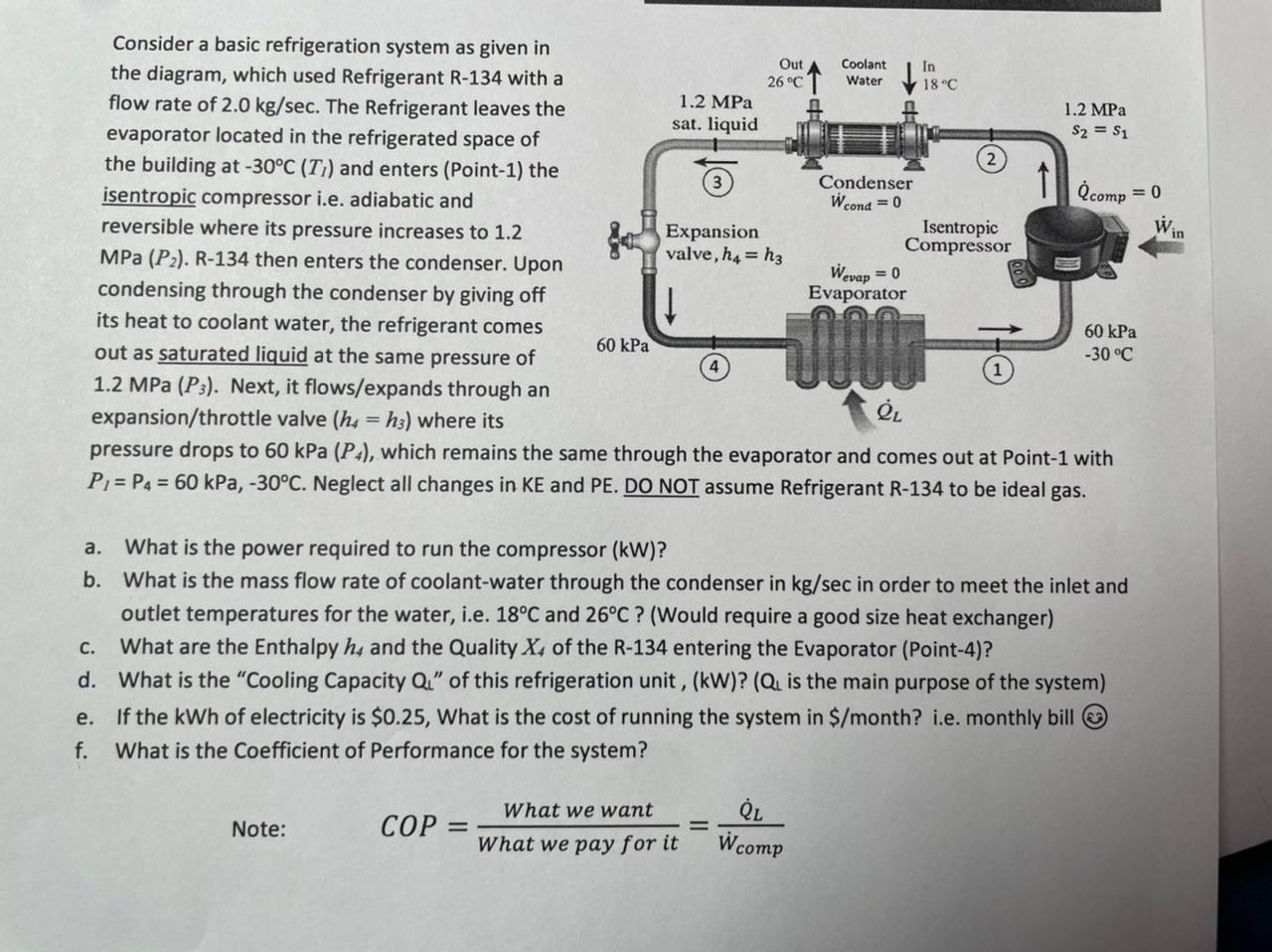
Consider a basic refrigeration system as given in the diagram, which used Refrigerant R-134 with a flow rate of 2.0kg/sec. The Refrigerant leaves the evaporator located in the refrigerated space of the building at 30C(Tl) and enters (Point-1) the isentropic compressor i.e. adiabatic and reversible where its pressure increases to 1.2 MPa (P2). R-134 then enters the condenser. Upon condensing through the condenser by giving off its heat to coolant water, the refrigerant comes out as saturated liquid at the same pressure of 1.2 MPa (P3). Next, it flows/expands through an expansion/throttle valve (h4=h3) where its pressure drops to 60kPa(P4), which remains the same through the evaporator and comes out at Point-1 with P1=P4=60kPa,30C. Neglect all changes in KE and PE. DO NOT assume Refrigerant R-134 to be ideal gas. a. What is the power required to run the compressor (kW)? b. What is the mass flow rate of coolant-water through the condenser in kg/sec in order to meet the inlet and outlet temperatures for the water, i.e. 18C and 26C ? (Would require a good size heat exchanger) c. What are the Enthalpy h4 and the Quality X4 of the R-134 entering the Evaporator (Point-4)? d. What is the "Cooling Capacity Q" of this refrigeration unit, (kW)? (QL is the main purpose of the system) e. If the kWh of electricity is $0.25, What is the cost of running the system in $/month ? i.e. monthly bill f. What is the Coefficient of Performance for the system? Note: COP=WhatwepayforitWhatwewant=WcompQL
Step by Step Solution
There are 3 Steps involved in it

Get step-by-step solutions from verified subject matter experts
 Study Help