







Question: Consider a batch granulator in which coalescence is the primary mechanism of growth. By very careful control of the nucleation process, we produce nuclei granules
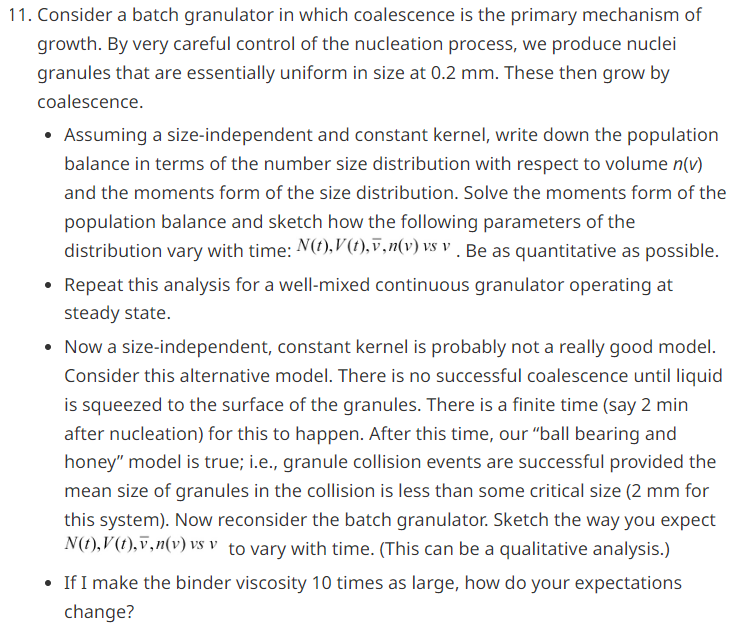
Consider a batch granulator in which coalescence is the primary mechanism of
growth. By very careful control of the nucleation process, we produce nuclei
granules that are essentially uniform in size at These then grow by
coalescence.
Assuming a sizeindependent and constant kernel, write down the population
balance in terms of the number size distribution with respect to volume
and the moments form of the size distribution. Solve the moments form of the
population balance and sketch how the following parameters of the
distribution vary with time: Be as quantitative as possible.
Repeat this analysis for a wellmixed continuous granulator operating at
steady state.
Now a sizeindependent, constant kernel is probably not a really good model.
Consider this alternative model. There is no successful coalescence until liquid
is squeezed to the surface of the granules. There is a finite time say min
after nucleation for this to happen. After this time, our "ball bearing and
honey" model is true; ie granule collision events are successful provided the
mean size of granules in the collision is less than some critical size for
this system Now reconsider the batch granulator. Sketch the way you expect
to vary with time. This can be a qualitative analysis.
If I make the binder viscosity times as large, how do your expectations
change?
Step by Step Solution
There are 3 Steps involved in it
1 Expert Approved Answer
Step: 1 Unlock

Question Has Been Solved by an Expert!
Get step-by-step solutions from verified subject matter experts
Step: 2 Unlock
Step: 3 Unlock
 Study Help