







Question: Consider a binomial tree with two future periods (T=0, 1, 2) in which the return per period on a risky asset can be either 50%
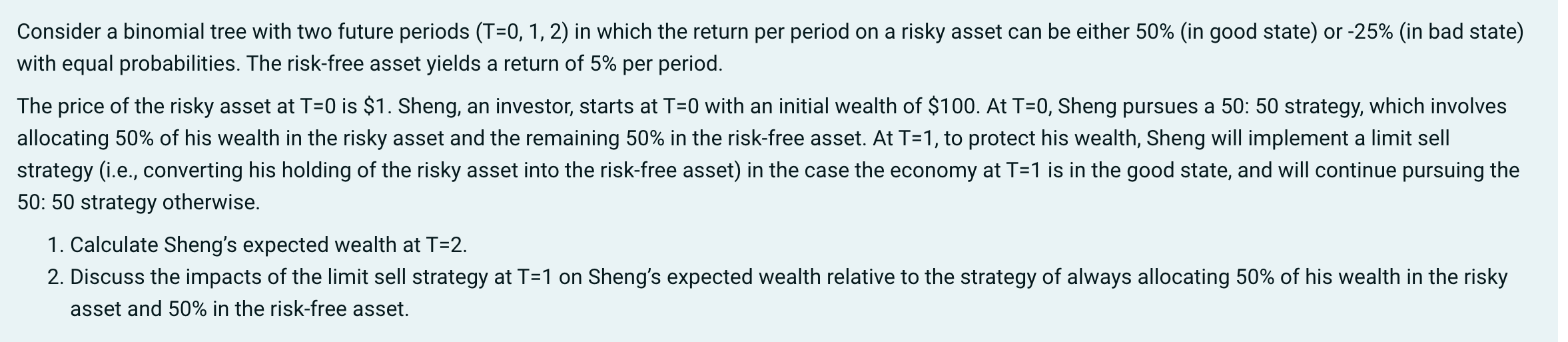
Consider a binomial tree with two future periods (T=0, 1, 2) in which the return per period on a risky asset can be either 50% (in good state) or -25% (in bad state) with equal probabilities. The risk-free asset yields a return of 5% per period. The price of the risky asset at T=0 is $1. Sheng, an investor, starts at T=0 with an initial wealth of $1 00. At T=0, Sheng pursues a 50: 50 strategy, which involves allocating 50% of his wealth in the risky asset and the remaining 50% in the risk-free asset. At T=1, to protect his wealth, Sheng will implement a limit sell strategy (i.e., converting his holding of the risky asset into the risk-free asset) in the case the economy at T=1 is in the good state, and will continue pursuing the 50: 50 strategy otherwise. 1. Calculate Sheng's expected wealth at T=2. 2. Discuss the impacts of the limit sell strategy at T=1 on Sheng's expected wealth relative to the strategy of always allocating 50% of his wealth in the risky asset and 50% in the risk-free asset
Step by Step Solution
There are 3 Steps involved in it

Get step-by-step solutions from verified subject matter experts
 Study Help