





Question: Consider a carsharing (on-demand car rental) program operating a fleet of 12 identical cars with a single site. All cars are picked up and returned
Consider a carsharing (on-demand car rental)

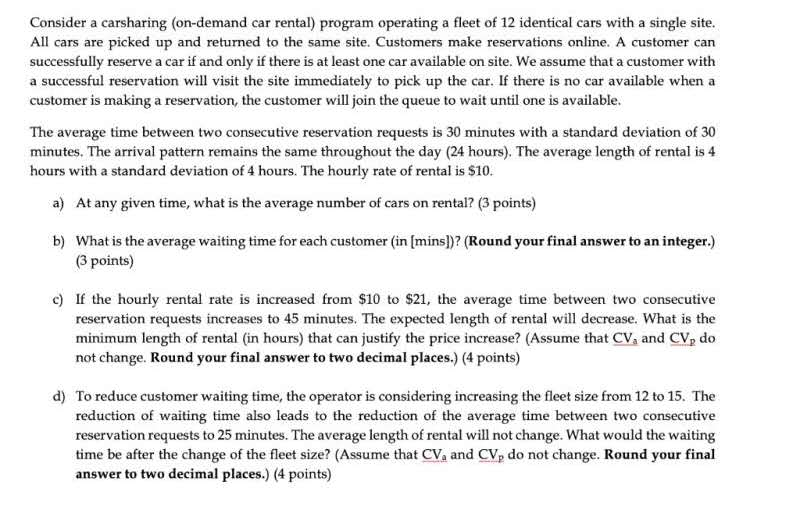
Consider a carsharing (on-demand car rental) program operating a fleet of 12 identical cars with a single site. All cars are picked up and returned to the same site. Customers make reservations online. A customer can successfully reserve a car if and only if there is at least one car available on site. We assume that a customer with a successful reservation will visit the site immediately to pick up the car. If there is no car available when a customer is making a reservation, the customer will join the queue to wait until one is available. The average time between two consecutive reservation requests is 30 minutes with a standard deviation of 30 minutes. The arrival pattern remains the same throughout the day (24 hours). The average length of rental is 4 hours with a standard deviation of 4 hours. The hourly rate of rental is $10. a) At any given time, what is the average number of cars on rental? (3 points) b) What is the average waiting time for each customer (in (mins])? (Round your final answer to an integer.) (3 points) c) If the hourly rental rate is increased from $10 to $21, the average time between two consecutive reservation requests increases to 45 minutes. The expected length of rental will decrease. What is the minimum length of rental (in hours) that can justify the price increase? (Assume that CV, and CV, do not change. Round your final answer to two decimal places.) (4 points) d) To reduce customer waiting time, the operator is considering increasing the fleet size from 12 to 15. The reduction of waiting time also leads to the reduction of the average time between two consecutive reservation requests to 25 minutes. The average length of rental will not change. What would the waiting time be after the change of the fleet size? (Assume that CV, and CV, do not change. Round your final answer to two decimal places.) (4 points) Consider a carsharing (on-demand car rental) program operating a fleet of 12 identical cars with a single site. All cars are picked up and returned to the same site. Customers make reservations online. A customer can successfully reserve a car if and only if there is at least one car available on site. We assume that a customer with a successful reservation will visit the site immediately to pick up the car. If there is no car available when a customer is making a reservation, the customer will join the queue to wait until one is available. The average time between two consecutive reservation requests is 30 minutes with a standard deviation of 30 minutes. The arrival pattern remains the same throughout the day (24 hours). The average length of rental is 4 hours with a standard deviation of 4 hours. The hourly rate of rental is $10. a) At any given time, what is the average number of cars on rental? (3 points) b) What is the average waiting time for each customer (in (mins])? (Round your final answer to an integer.) (3 points) c) If the hourly rental rate is increased from $10 to $21, the average time between two consecutive reservation requests increases to 45 minutes. The expected length of rental will decrease. What is the minimum length of rental (in hours) that can justify the price increase? (Assume that CV, and CV, do not change. Round your final answer to two decimal places.) (4 points) d) To reduce customer waiting time, the operator is considering increasing the fleet size from 12 to 15. The reduction of waiting time also leads to the reduction of the average time between two consecutive reservation requests to 25 minutes. The average length of rental will not change. What would the waiting time be after the change of the fleet size? (Assume that CV, and CV, do not change. Round your final answer to two decimal places.) (4 points)

Step by Step Solution

There are 3 Steps involved in it

1 Expert Approved Answer
Step: 1 Unlock blur-text-image

Question Has Been Solved by an Expert!

Get step-by-step solutions from verified subject matter experts

Step: 2 Unlock
Step: 3 Unlock

Students Have Also Explored These Related General Management Questions!