







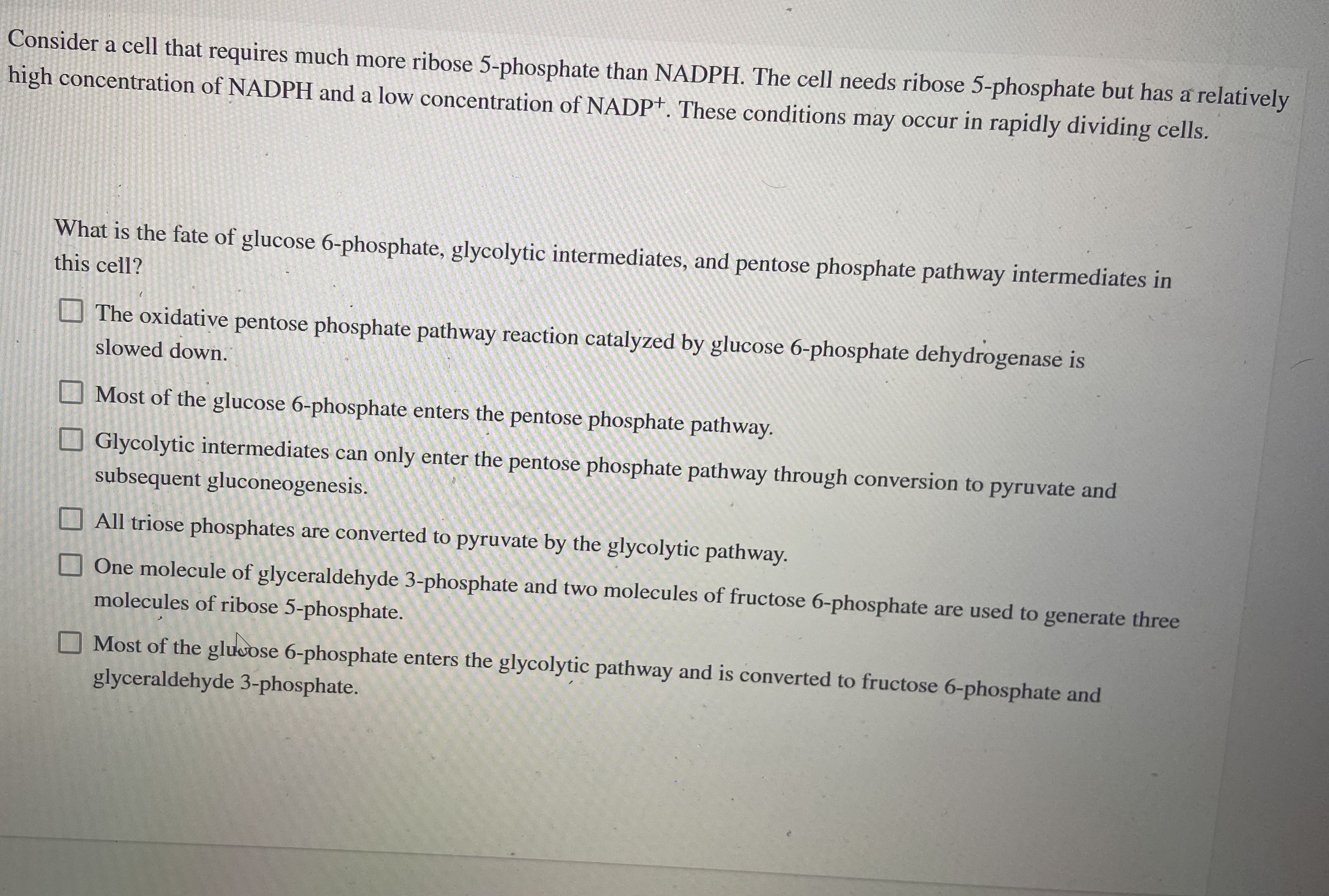
Question: Consider a cell that requires much more ribose 5 - phosphate than NADPH. The cell needs ribose 5 - phosphate but has a relatively high
Consider a cell that requires much more ribose phosphate than NADPH. The cell needs ribose phosphate but has a relatively high concentration of NADPH and a low concentration of NADP These conditions may occur in rapidly dividing cells.
What is the fate of glucose phosphate, glycolytic intermediates, and pentose phosphate pathway intermediates in this cell?
The oxidative pentose phosphate pathway reaction catalyzed by glucose phosphate dehydrogenase is slowed down.
Most of the glucose phosphate enters the pentose phosphate pathway.
Glycolytic intermediates can only enter the pentose phosphate pathway through conversion to pyruvate and subsequent gluconeogenesis.
All triose phosphates are converted to pyruvate by the glycolytic pathway.
One molecule of glyceraldehyde phosphate and two molecules of fructose phosphate are used to generate three molecules of ribose phosphate.
Most of the glucose phosphate enters the glycolytic pathway and is converted to fructose phosphate and glyceraldehyde phosphate.
Step by Step Solution
There are 3 Steps involved in it
1 Expert Approved Answer
Step: 1 Unlock

Question Has Been Solved by an Expert!
Get step-by-step solutions from verified subject matter experts
Step: 2 Unlock
Step: 3 Unlock
 Study Help