







Question: Problem 4 Consider a path from host A, through intermediate nodes 1, 2, ...,K, to host B. Suppose the links between two neighboring nodes have
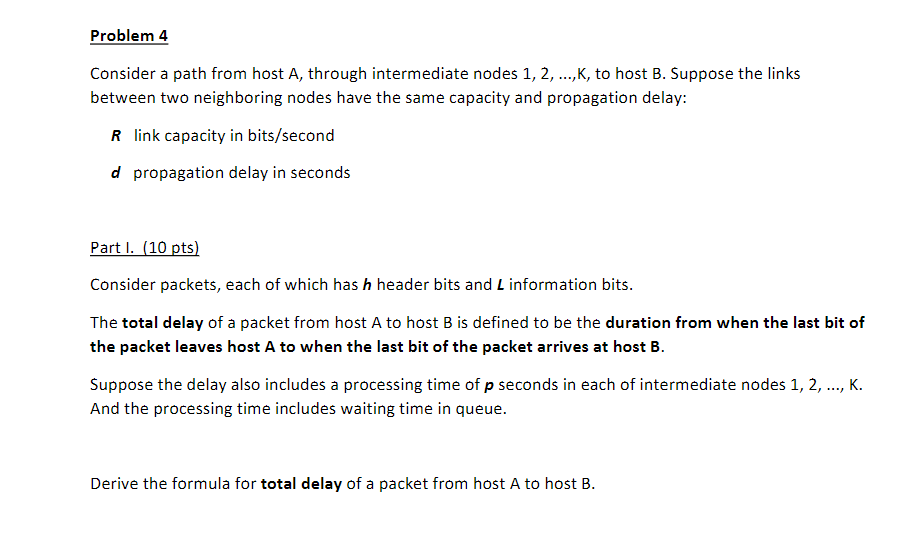
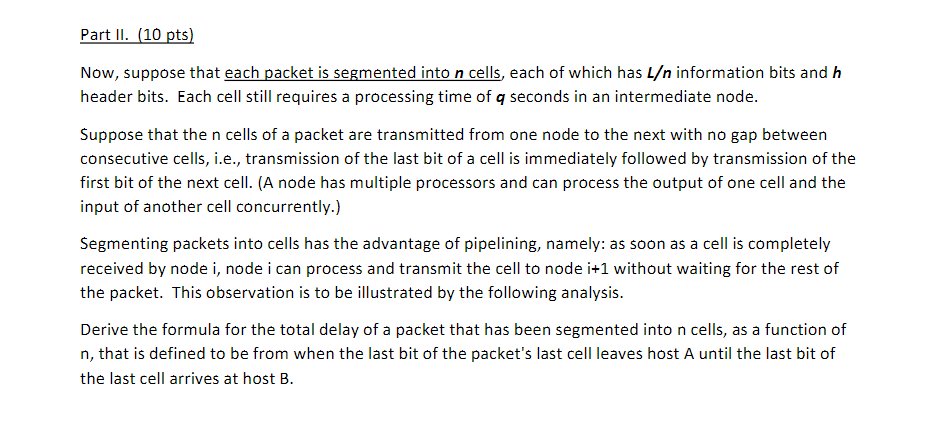
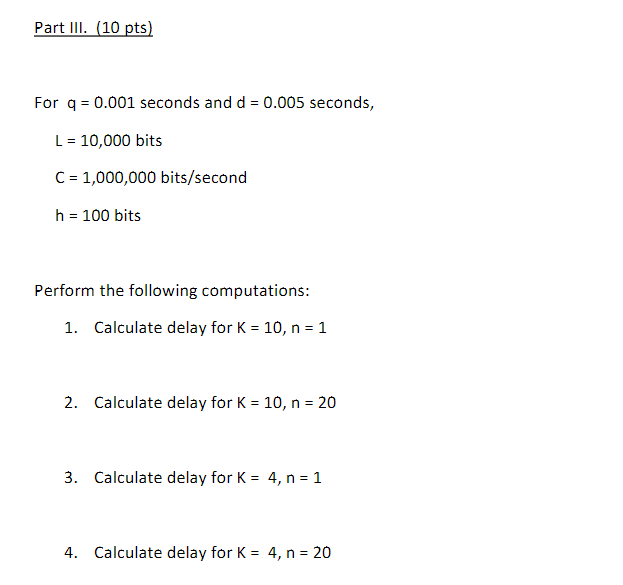
Problem 4 Consider a path from host A, through intermediate nodes 1, 2, ...,K, to host B. Suppose the links between two neighboring nodes have the same capacity and propagation delay: R link capacity in bits/second d propagation delay in seconds Part I. (10 pts) Consider packets, each of which has h header bits and L information bits. The total delay of a packet from host A to host B is defined to be the duration from when the last bit of the packet leaves host A to when the last bit of the packet arrives at host B. Suppose the delay also includes a processing time of p seconds in each of intermediate nodes 1, 2, ..., K. And the processing time includes waiting time in queue. Derive the formula for total delay of a packet from host A to host B. Part II. (10 pts) Now, suppose that each packet is segmented into n cells, each of which has L information bits and h header bits. Each cell still requires a processing time of q seconds in an intermediate node. Suppose that the n cells of a packet are transmitted from one node to the next with no gap between consecutive cells, i.e., transmission of the last bit of a cell is immediately followed by transmission of the first bit of the next cell. (A node has multiple processors and can process the output of one cell and the input of another cell concurrently.) Segmenting packets into cells has the advantage of pipelining, namely: as soon as a cell is completely received by node i, node i can process and transmit the cell to node i+1 without waiting for the rest of the packet. This observation is to be illustrated by the following analysis. Derive the formula for the total delay of a packet that has been segmented into n cells, as a function of n, that is defined to be from when the last bit of the packet's last cell leaves host A until the last bit of the last cell arrives at host B. Part III. (10 pts) For q = 0.001 seconds and d = 0.005 seconds, L = 10,000 bits C = 1,000,000 bits/second h = 100 bits = Perform the following computations: 1. Calculate delay for k = 10, n = 1 2. Calculate delay for K = 10, n = 20 3. Calculate delay for K = 4, n = 1 4. Calculate delay for K = 4, n = 20
Step by Step Solution
There are 3 Steps involved in it

Get step-by-step solutions from verified subject matter experts
 Study Help