



Question: Consider a closed and finite bulk environment with a volume of V, which contains an adsorbate species of concentration Cb0. At time t=0+, a single
Consider a closed and finite bulk environment with a volume of V, which contains an adsorbate species of concentration Cb0. At time t=0+, a single medium sized porous particle with a mass of m and density of , is exposed to this environment and the diffusion and adsorption processes are started. The following assumptions are made in the theoretical analysis. (1) Particle is medium sized sphere which consists of many sphere microparticles separated by network of macropores.. (2) Both pore and surface diffusions occur along the particle coordinate. (3) The adsorbed species is assumed to diffuse in two directions, one is the direction along the particle coordinate (r, surface diffusion), and the other is the direction along the microparticle (r, micropore diffusion) which is in perpendicular to the particle coordinate. (4) The adsorbed species are in local equilibrium with those in the gas phase inside the particle. (5) The physical properties of the particle are constant. The macropore porosity is . (6) The film mass transfer coefficient is km, pore diffusivity is Dp, surface diffusivity is Ds abd nicropore diffusivity is D. (7) The system is isothermal. Use the mass balance to derive a mathematical model to cover all the macropore, surface and micropore diffusion (MSMD) mechanisms, with all boundary and initial conditions. A conceptual diagram of the MSMD model is shown in following figure.
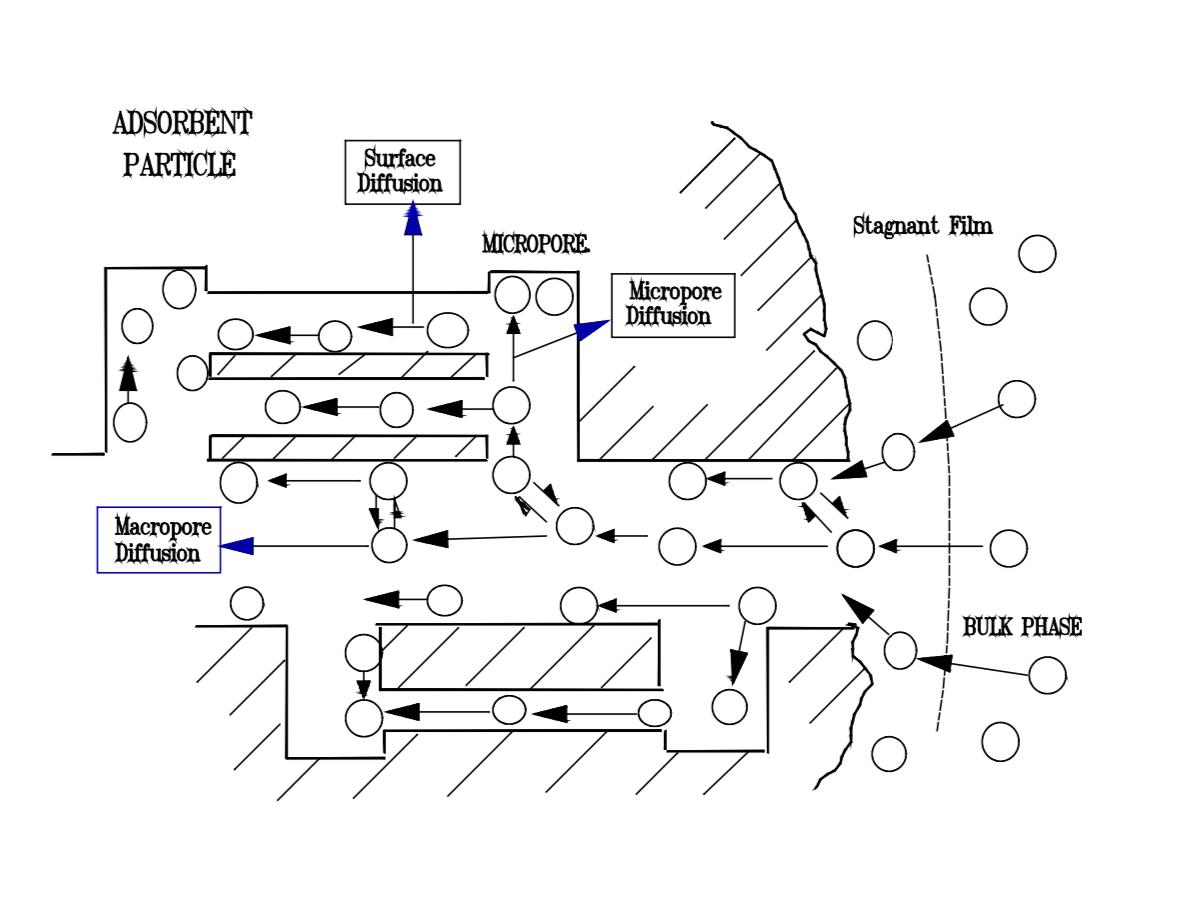
ADSORBENT PARTICLE Surface Diffusion Stagnant Film MICROPORE Micropore Diffusion Macropore Diffusion BULK PHASE ADSORBENT PARTICLE Surface Diffusion Stagnant Film MICROPORE Micropore Diffusion Macropore Diffusion BULK PHASE
Step by Step Solution
There are 3 Steps involved in it

Get step-by-step solutions from verified subject matter experts