







Question: Consider a combinational logic circuit which gets two 2-bit unsigned integers A=AAy, and B=BB, as inputs, and produce a single bit F as the output.
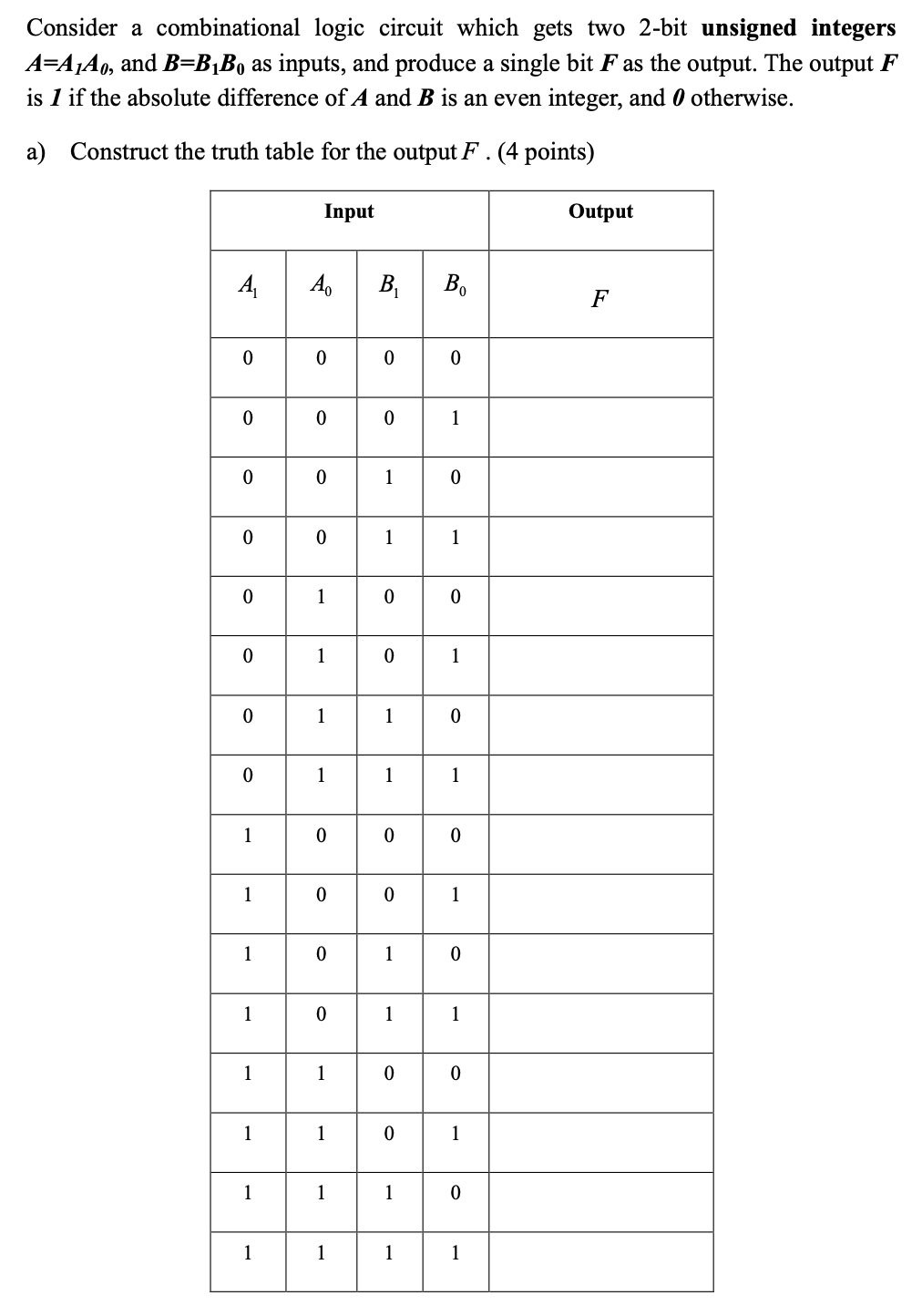
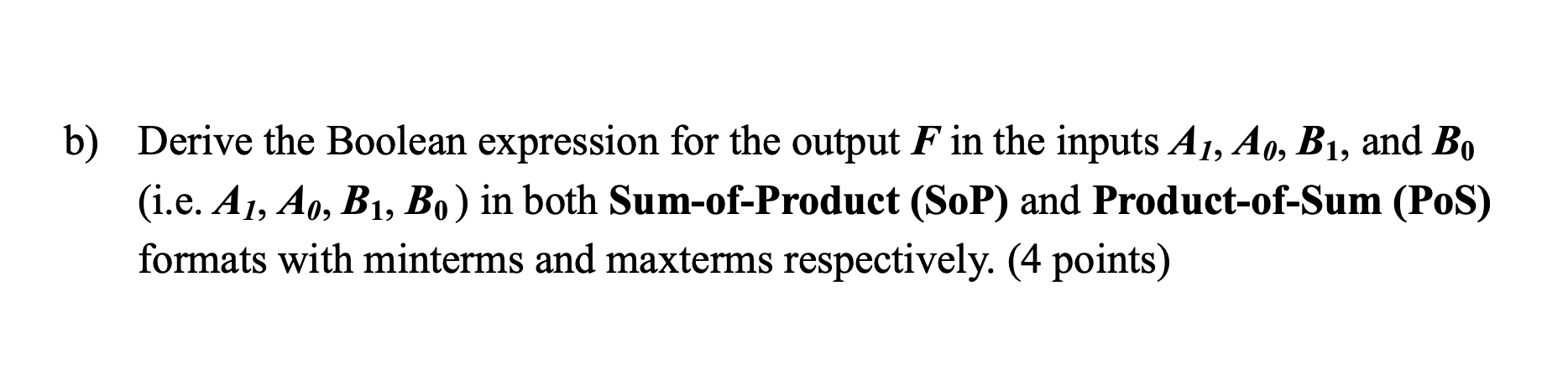
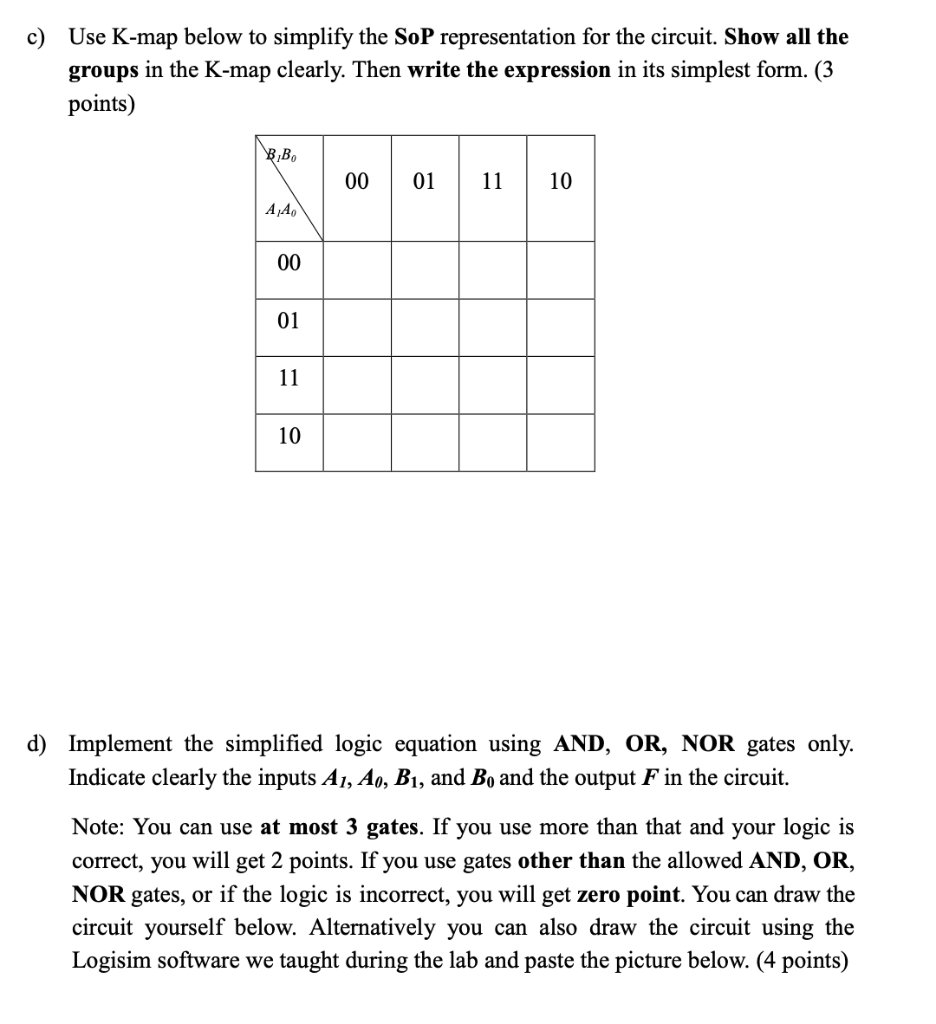
Consider a combinational logic circuit which gets two 2-bit unsigned integers A=AAy, and B=BB, as inputs, and produce a single bit F as the output. The output F is 1 if the absolute difference of A and B is an even integer, and 0 otherwise. a) Construct the truth table for the output F.(4 points) Input Output A 4. B B. F 0 0 0 0 0 0 1 0 | 1 0 0 1 1 0 1 0 0 0 1 0 1 0 1 1 0 0 1 1 1 1 0 0 0 1 0 | 1 0 1 0 1 0 1 0 1 1 1 0 0 1 1 0 1 1 1 1 0 1 1 1 1 b) Derive the Boolean expression for the output F in the inputs A1, A5, B1, and Bo (i.e. A1, A, B1, Bo) in both Sum-of-Product (SoP) and Product-of-Sum (PoS) formats with minterms and maxterms respectively. (4 points) c) Use K-map below to simplify the SoP representation for the circuit. Show all the groups in the K-map clearly. Then write the expression in its simplest form. (3 points) BB 00 01 11 10 A A 00 01 11 10 d) Implement the simplified logic equation using AND, OR, NOR gates only. Indicate clearly the inputs A1, A1, B1, and Bo and the output F in the circuit. Note: You can use at most 3 gates. If you use more than that and your logic is correct, you will get 2 points. If you use gates other than the allowed AND, OR, NOR gates, or if the logic is incorrect, you will get zero point. You can draw the circuit yourself below. Alternatively you can also draw the circuit using the Logisim software we taught during the lab and paste the picture below. (4 points)
Step by Step Solution
There are 3 Steps involved in it

Get step-by-step solutions from verified subject matter experts
 Study Help