







Question: Consider a complex function F(s)=(1)/(s+1) of a complex variable s . (a) Assume s=-sigma +jomega where sigma and omega are real numbers. Obtain the magnitude
Consider a complex function
F(s)=(1)/(s+1)of a complex variable
s.\ (a) Assume
s=-\\\\sigma +j\\\\omega where
\\\\sigma and
\\\\omega are real numbers. Obtain the magnitude and phase of
F(s)in terms of
\\\\sigma and
\\\\omega .\ (b) Now set
\\\\sigma =0, so that
s=j\\\\omega . Obtain real and imaginary parts of
F(s)in terms
\\\\omega .\ (c) We want to see how
F(s)varies as
s=j\\\\omega varies between
-100jand
100j(that is when
\\\\omega increases from -100 to 100.) Write a short MATLAB program to plot the variations of complex function
F(s)in the complex plane (Hint: Plot the imaginary part of
F(s)versus its real part as
svaries from
-100jto
100j.)
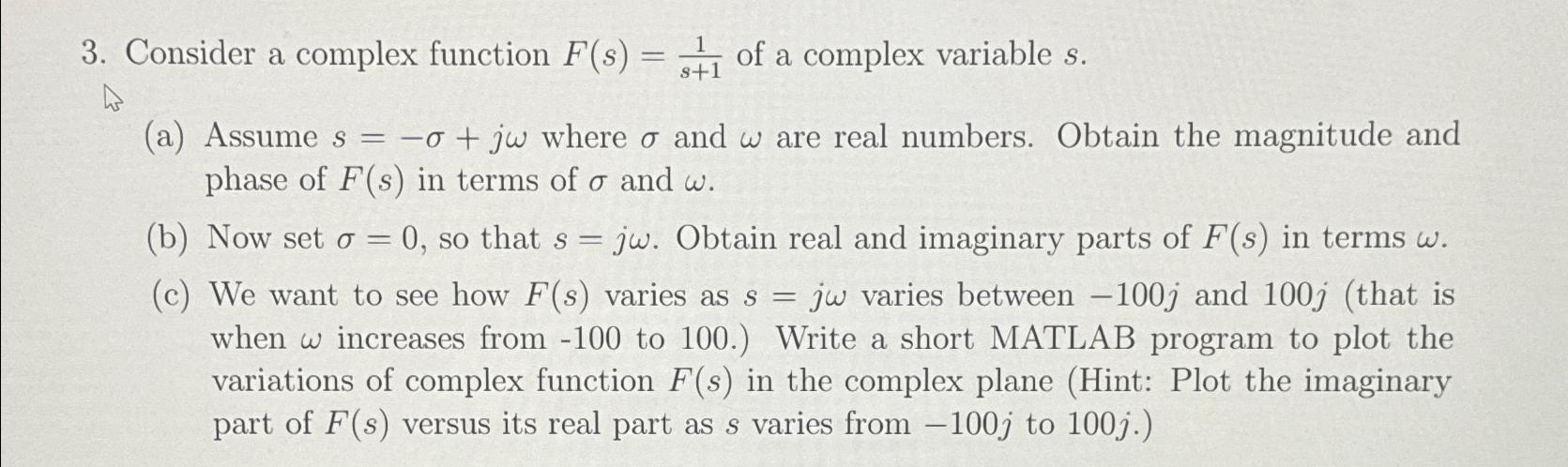
3. Consider a complex function F(s)=s+11 of a complex variable s. (a) Assume s=+j where and are real numbers. Obtain the magnitude and phase of F(s) in terms of and . (b) Now set =0, so that s=j. Obtain real and imaginary parts of F(s) in terms . (c) We want to see how F(s) varies as s=j varies between 100j and 100j (that is when increases from -100 to 100.) Write a short MATLAB program to plot the variations of complex function F(s) in the complex plane (Hint: Plot the imaginary part of F(s) versus its real part as s varies from 100j to 100j.)
Step by Step Solution
There are 3 Steps involved in it

Get step-by-step solutions from verified subject matter experts
 Study Help