





Question: Consider a composite solid of materials A and B, shown in the Figure 1. An electrical resistance heater embedded in solid B generates heat at
 Consider a composite solid of materials A and B, shown in

the Figure 1. An electrical resistance heater embedded in solid B generates

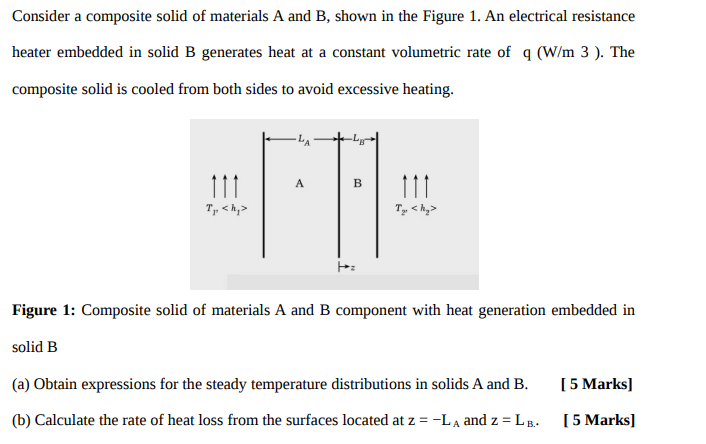
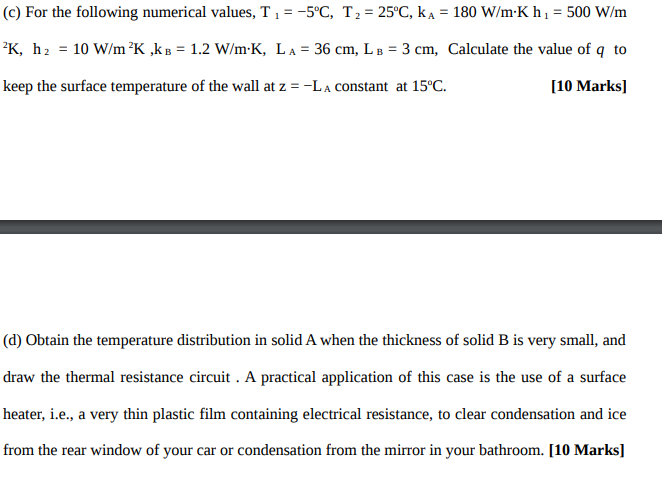
Consider a composite solid of materials A and B, shown in the Figure 1. An electrical resistance heater embedded in solid B generates heat at a constant volumetric rate of 2 (W/m 3 ). The composite solid is cooled from both sides to avoid excessive heating. 111 A B 111 T, T Figure 1: Composite solid of materials A and B component with heat generation embedded in solid B (a) Obtain expressions for the steady temperature distributions in solids A and B. [ 5 Marks) (6) Calculate the rate of heat loss from the surfaces located at z=-L A and z=LB.. [ 5 Marks) (C) For the following numerical values, T, = -5C, T, = 25C, KA = 180 W/m-K h = 500 W/m 2K, h 2 = 10 W/mK ,kb = 1.2 W/m-K, LA = 36 cm, L B = 3 cm, Calculate the value of q to keep the surface temperature of the wall at z = -L A constant at 15C. [10 Marks) (d) Obtain the temperature distribution in solid A when the thickness of solid B is very small, and draw the thermal resistance circuit . A practical application of this case is the use of a surface heater, i.e., a very thin plastic film containing electrical resistance, to clear condensation and ice from the rear window of your car or condensation from the mirror in your bathroom. [10 Marks]

Step by Step Solution

There are 3 Steps involved in it

1 Expert Approved Answer
Step: 1 Unlock blur-text-image
Question Has Been Solved by an Expert!

Get step-by-step solutions from verified subject matter experts

Step: 2 Unlock
Step: 3 Unlock

Students Have Also Explored These Related Chemical Engineering Questions!