







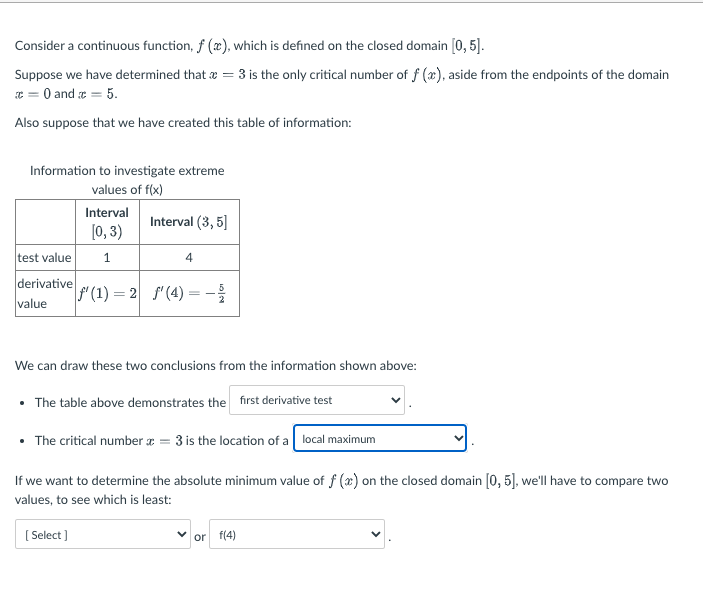
Question: Consider a continuous function, f (@), which is defined on the closed domain [0, 5]. Suppose we have determined that @ = 3 is the
![closed domain [0, 5]. Suppose we have determined that @ = 3](https://s3.amazonaws.com/si.experts.images/answers/2024/06/6665e1029f468_7706665e10285040.jpg)
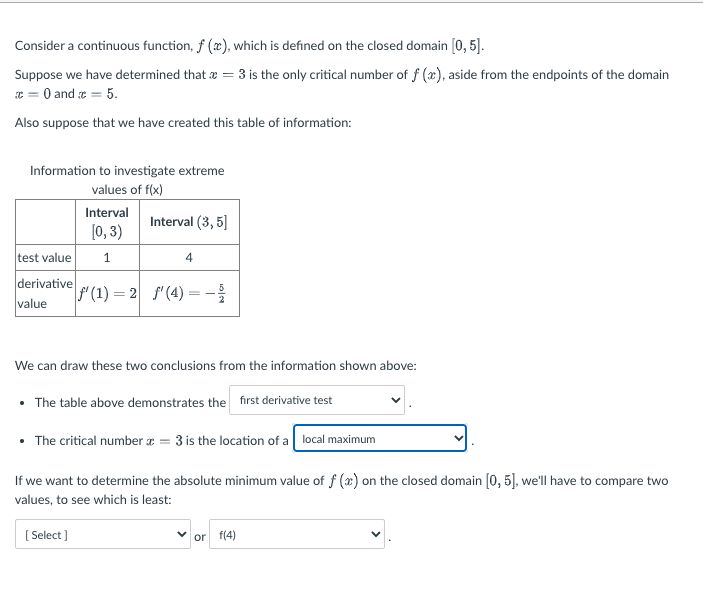
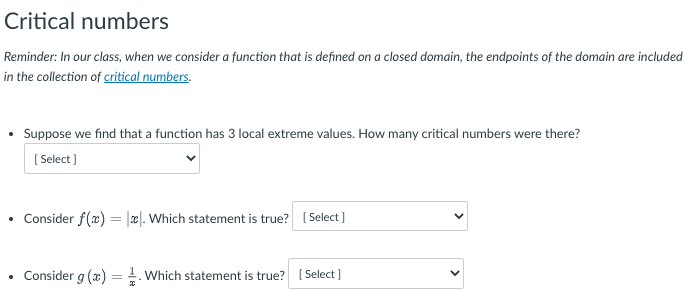
Consider a continuous function, f (@), which is defined on the closed domain [0, 5]. Suppose we have determined that @ = 3 is the only critical number of f (@), aside from the endpoints of the domain c = 0 and * = 5. Also suppose that we have created this table of information: Information to investigate extreme values of f(x) Interval [0, 3) Interval (3, 5] test value 1 4 derivative f' (1) = 2 f'(4) = - value We can draw these two conclusions from the information shown above: . The table above demonstrates the first derivative test . The critical number : = 3 is the location of a | local maximum If we want to determine the absolute minimum value of f (@) on the closed domain [0, 5], we'll have to compare two values, to see which is least: [ Select ] or f(4)Critical numbers Reminder: In our class, when we consider a function that is defined on a closed domain, the endpoints of the domain are included in the collection of critical numbers. . Suppose we find that a function has 3 local extreme values. How many critical numbers were there? [ Select ] . Consider f(@) = |x|. Which statement is true? [ Select ] . Consider g () = _. Which statement is true? [ Select ]
Step by Step Solution
There are 3 Steps involved in it

Get step-by-step solutions from verified subject matter experts
 Study Help