







Question: Consider a CSTR with a single inlet and single (overflow) outlet stream. The inlet stream is made up compound A and some inert carrier
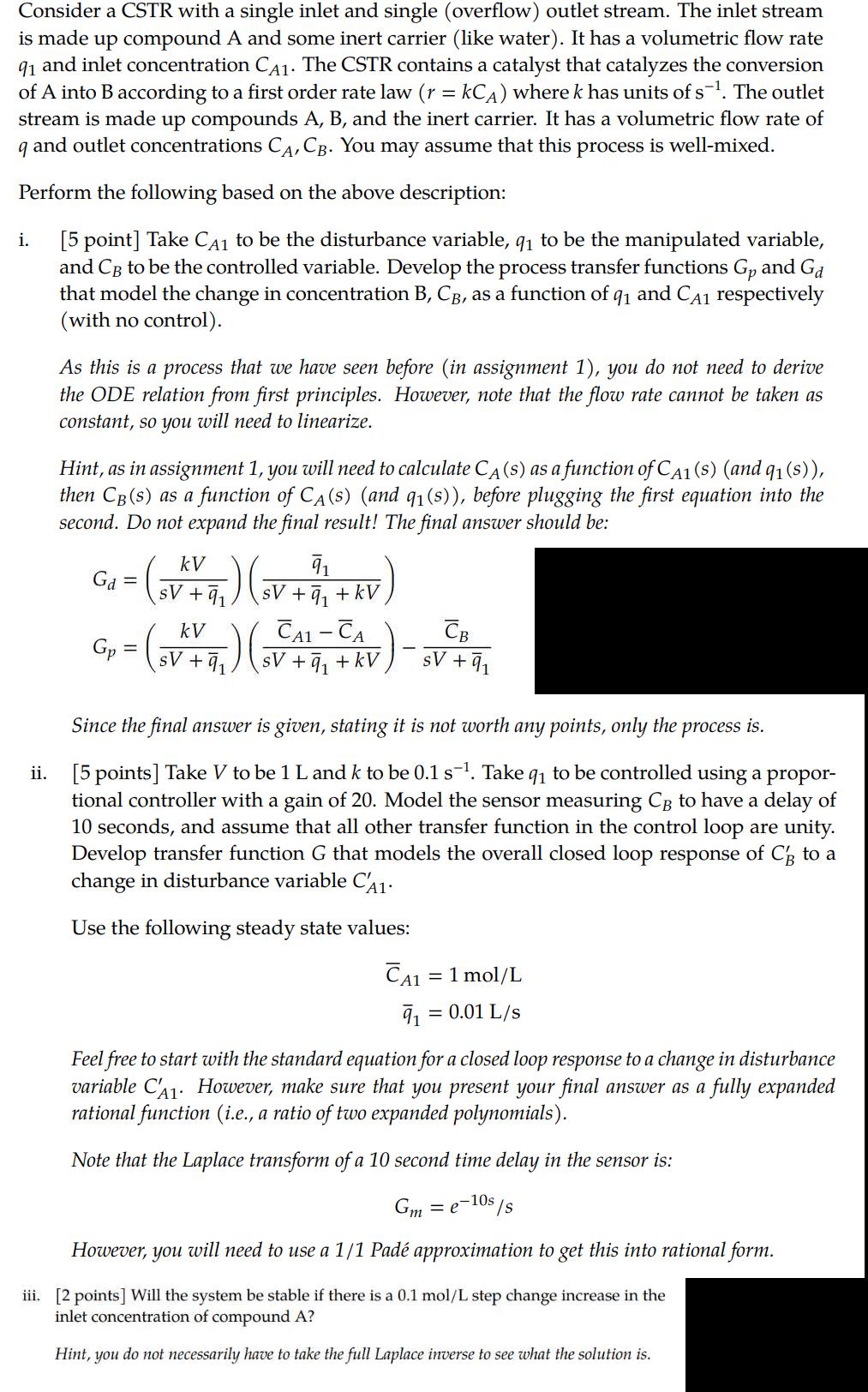
Consider a CSTR with a single inlet and single (overflow) outlet stream. The inlet stream is made up compound A and some inert carrier (like water). It has a volumetric flow rate 91 and inlet concentration CA1. The CSTR contains a catalyst that catalyzes the conversion of A into B according to a first order rate law (r = kCA) where k has units of s. The outlet stream is made up compounds A, B, and the inert carrier. It has a volumetric flow rate of and outlet concentrations CA, CB. You may assume that this process is well-mixed. 9 Perform the following based on the above description: i. [5 point] Take CA1 to be the disturbance variable, 91 to be the manipulated variable, and CB to be the controlled variable. Develop the process transfer functions Gp and Gd that model the change in concentration B, CB, as a function of 91 and CA1 respectively (with no control). As this is a process that we have seen before (in assignment 1), you do not need to derive the ODE relation from first principles. However, note that the flow rate cannot be taken as constant, so you will need to linearize. Hint, as in assignment 1, you will need to calculate CA (s) as a function of CA1 (s) (and q(s)), then CB(s) as a function of CA (s) (and q(s)), before plugging the first equation into the second. Do not expand the final result! The final answer should be: Gd = Gp = kV (3 (V+1) (v +91 + kV) kV SV +91 SV CA1 - CA SV + + kV SV +91 Since the final answer is given, stating it is not worth any points, only the process is. ii. [5 points] Take V to be 1 L and k to be 0.1 s-1. Take q to be controlled using a propor- tional controller with a gain of 20. Model the sensor measuring CB to have a delay of 10 seconds, and assume that all other transfer function in the control loop are unity. Develop transfer function G that models the overall closed loop response of C' to a change in disturbance variable CA1 Use the following steady state values: CA1 = 1 mol/L = 0.01 L/s Feel free to start with the standard equation for a closed loop response to a change in disturbance variable C'A1 However, make sure that you present your final answer as a fully expanded rational function (i.e., a ratio of two expanded polynomials). Note that the Laplace transform of a 10 second time delay in the sensor is: Gm = e-10s -10s/S However, you will need to use a 1/1 Pad approximation to get this into rational form. iii. [2 points] Will the system be stable if there is a 0.1 mol/L step change increase in the inlet concentration of compound A? Hint, you do not necessarily have to take the full Laplace inverse to see what the solution is.
Step by Step Solution
There are 3 Steps involved in it

Get step-by-step solutions from verified subject matter experts
 Study Help