







Question: , Consider a digraph D=(N,A) where N={0,1,,10}. The customer demand at nodes i{1,3,5,7,9} is 9 and i{2,4,6,8,10} is 2 . The truck has a capacity
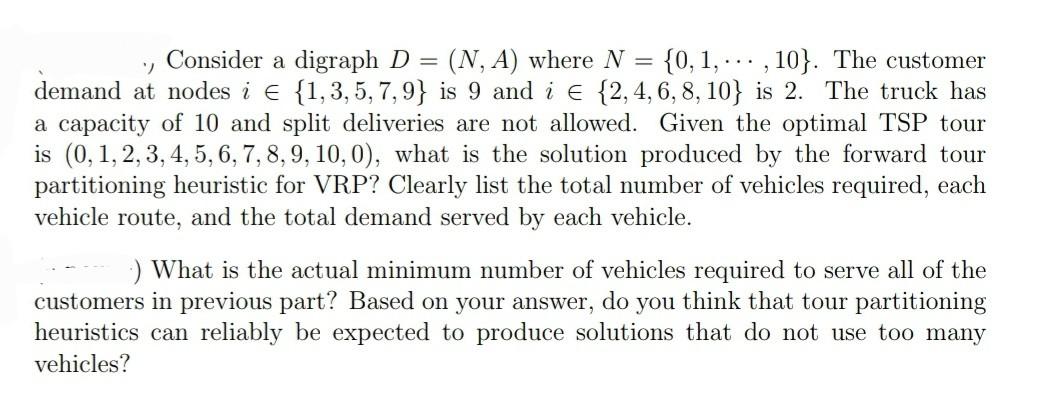
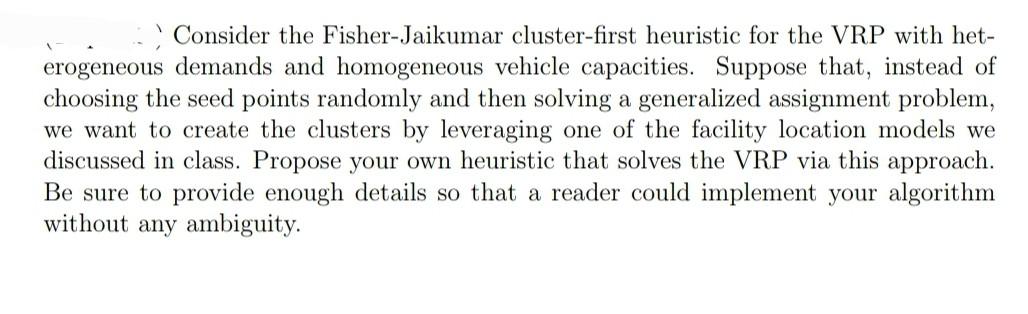
, Consider a digraph D=(N,A) where N={0,1,,10}. The customer demand at nodes i{1,3,5,7,9} is 9 and i{2,4,6,8,10} is 2 . The truck has a capacity of 10 and split deliveries are not allowed. Given the optimal TSP tour is (0,1,2,3,4,5,6,7,8,9,10,0), what is the solution produced by the forward tour partitioning heuristic for VRP? Clearly list the total number of vehicles required, each vehicle route, and the total demand served by each vehicle. ) What is the actual minimum number of vehicles required to serve all of the customers in previous part? Based on your answer, do you think that tour partitioning heuristics can reliably be expected to produce solutions that do not use too many vehicles? ,- . ' ' Consider the Fisher-Jaikumar cluster-first heuristic for the VRP with het-erogeneous demands and homogeneous vehicle capacities. Suppose that, instead of choosing the seed points randomly and then solving a generalized assignment problem, we want to create the clusters by leveraging one of the facility location models we discussed in class. Propose your own heuristic that solves the VRP via this approach. Be sure to provide enough details so that a reader could implement your algorithm without any ambiguity
Step by Step Solution
There are 3 Steps involved in it

Get step-by-step solutions from verified subject matter experts
 Study Help