







Question: Consider a directed acyclic graph (DAG) with N nodes, where each node represents a task and the edges represent dependencies between tasks. Each task has

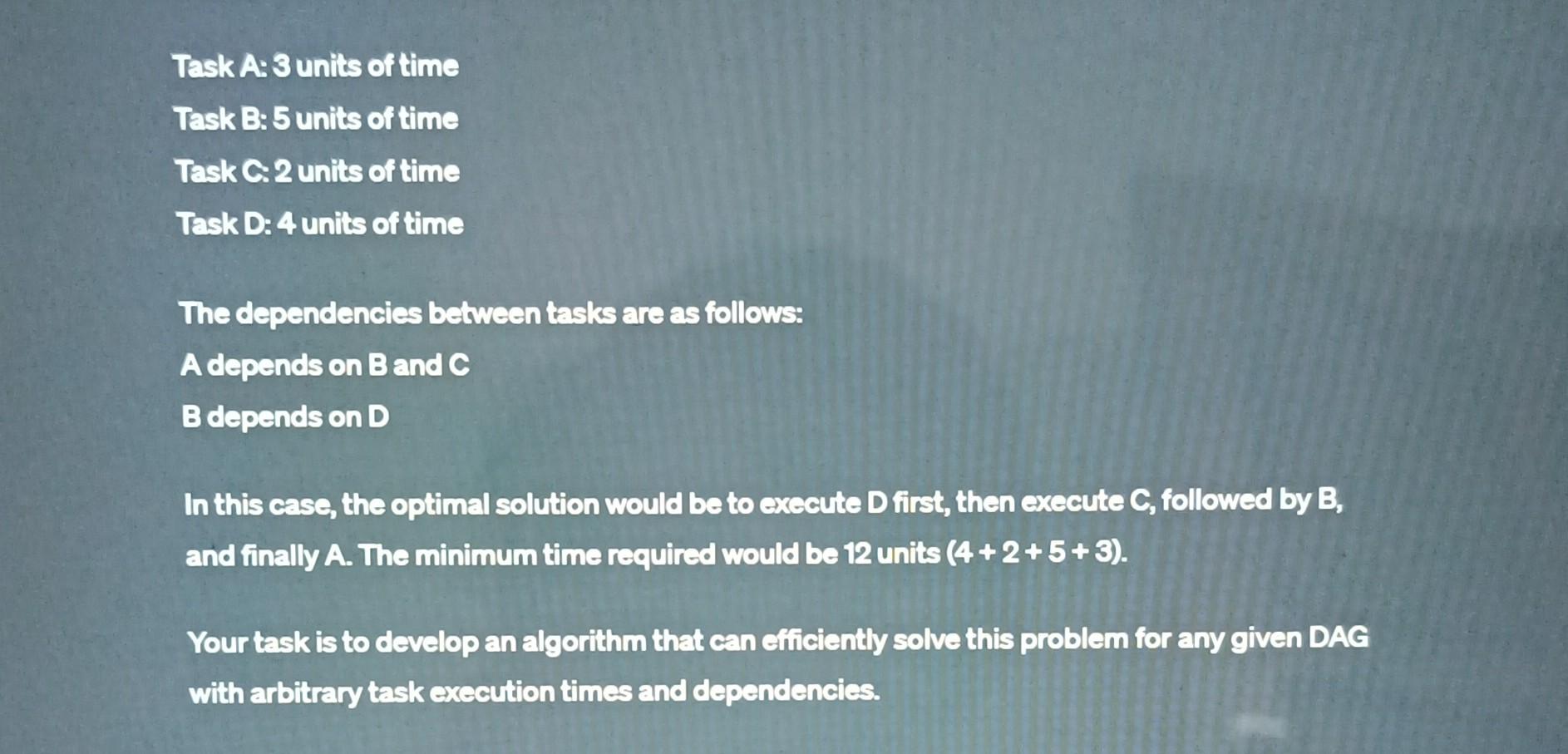
Consider a directed acyclic graph (DAG) with N nodes, where each node represents a task and the edges represent dependencies between tasks. Each task has a certain amount of time required for its execution. Your task is to determine the minimum amount of time required to complete all the tasks, considering that you can parallelize the execution of independent tasks. To illustrate, let's assume we have the following DAC with tasks and their execution times: Task A: 3 units of time Task B: 5 units of time Task C: 2 units of time Task D: 4 units of time Task A:3 units of time Task B: 5 units of time Task C.2 units of time Task D: 4 units of time The dependencies between tasks are as follows: A depends on B and C B depends on D In this case, the optimal solution would be to execute D first, then execute C, followed by B, and finally A. The minimum time required would be 12 units (4+2+5+3). Your task is to develop an algorithm that can efficiently solve this problem for any given DAG with arbitrary task execution times and dependencies
Step by Step Solution
There are 3 Steps involved in it

Get step-by-step solutions from verified subject matter experts
 Study Help