







Question: Consider a directed graph G = (N, E). Breadth-first search and depth-first search both have a runtime complexity of ~|N| + |E| if we
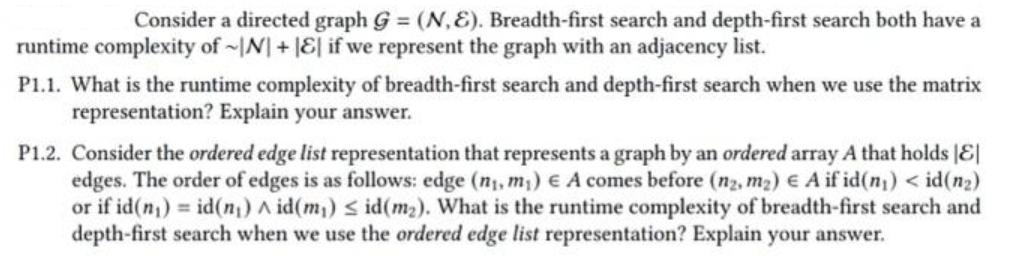
Consider a directed graph G = (N, E). Breadth-first search and depth-first search both have a runtime complexity of ~|N| + |E| if we represent the graph with an adjacency list. P1.1. What is the runtime complexity of breadth-first search and depth-first search when we use the matrix representation? Explain your answer. P1.2. Consider the ordered edge list representation that represents a graph by an ordered array A that holds |E| edges. The order of edges is as follows: edge (n, m) A comes before (n, m) A if id(ny) < id(n) or if id(n)= id(n) Aid(m) id(m). What is the runtime complexity of breadth-first search and depth-first search when we use the ordered edge list representation? Explain your answer.
Step by Step Solution
3.33 Rating (147 Votes )
There are 3 Steps involved in it
In a directed graph G N E lets analyze the runtime complexity of breadthfirst search BFS and depthfirst search DFS when using different representations 1 Adjacency Matrix Representation ... View full answer

Get step-by-step solutions from verified subject matter experts
 Study Help