







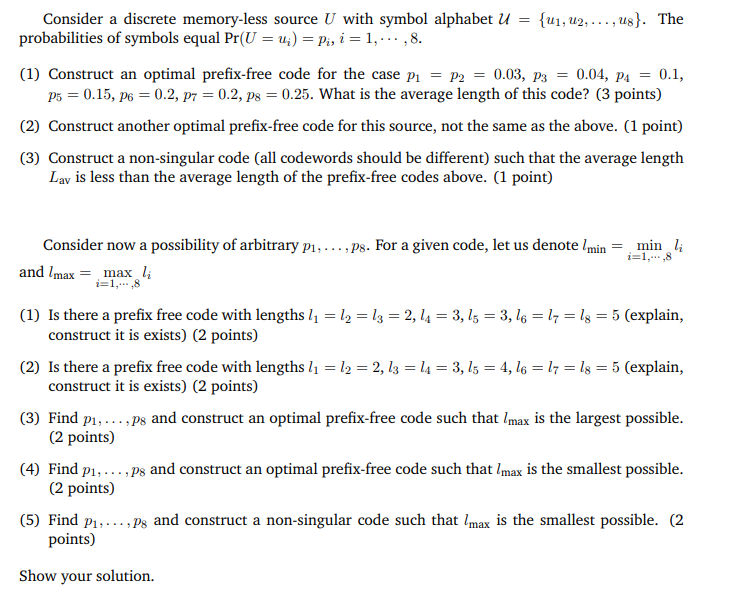
Question: Consider a discrete memory - less source U with symbol alphabet U = { u 1 , u 2 , dots, u 8 } .
Consider a discrete memoryless source with symbol alphabet dots, The
probabilities of symbols equal cdots,
Construct an optimal prefixfree code for the case
What is the average length of this code? points
Construct another optimal prefixfree code for this source, not the same as the above. point
Construct a nonsingular code all codewords should be different such that the average length
is less than the average length of the prefixfree codes above. point
Consider now a possibility of arbitrary dots, For a given code, let us denote cdots,
and cdots,
Is there a prefix free code with lengths explain
construct it is exists points
Is there a prefix free code with lengths explain
construct it is exists points
Find dots, and construct an optimal prefixfree code such that is the largest possible.
points
Find dots, and construct an optimal prefixfree code such that is the smallest possible.
points
Find dots, and construct a nonsingular code such that is the smallest possible.
points
Show your solution.
Step by Step Solution
There are 3 Steps involved in it
1 Expert Approved Answer
Step: 1 Unlock

Question Has Been Solved by an Expert!
Get step-by-step solutions from verified subject matter experts
Step: 2 Unlock
Step: 3 Unlock
 Study Help