







Question: Consider a dual-processor router in which two processors, processor 1 and processor 2, are used to process the incoming packets. Each processor has its own
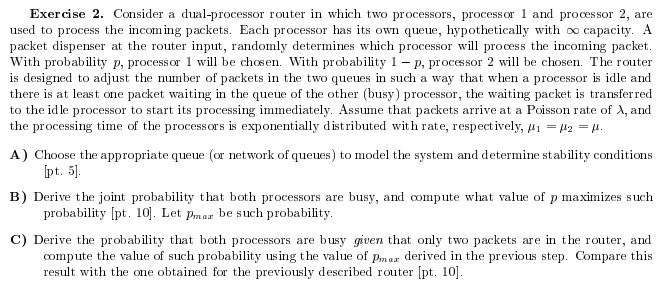
Consider a dual-processor router in which two processors, processor 1 and processor 2, are used to process the incoming packets. Each processor has its own queue, hypothetically with infinity capacity. A packet dispenser at the router input, randomly determines which processor will process the incoming packet With probability p, processor 1 will be chosen. With probability 1 - p, processor 2 will be chosen. The router is designed to adjust the number of packets in the two queues in such a way that when a processor is idle and there is at least one packet waiting in the queue of the other (busy) processor, the waiting packet is transferred to the idle processor to start its processing immediately. Assume that packets arrive at a Poisson rate of lambda, and the processing time of the processors is exponentially distributed with rate, respectively, mu_1 = mu_2 = mu. A) Choose the appropriate queue (or network of queues) to model the system and determine stability conditions. B) Derive the joint probability that both processors are busy, and compute what value of p maximizes such probability. Let p_max be such probability. C) Derive the probability that both processors are busy given that only two packets are in the router and compute the value of such probability using the value of p_max derived in the previous step. Compare this result with the one obtained for the previously described router. Consider a dual-processor router in which two processors, processor 1 and processor 2, are used to process the incoming packets. Each processor has its own queue, hypothetically with infinity capacity. A packet dispenser at the router input, randomly determines which processor will process the incoming packet With probability p, processor 1 will be chosen. With probability 1 - p, processor 2 will be chosen. The router is designed to adjust the number of packets in the two queues in such a way that when a processor is idle and there is at least one packet waiting in the queue of the other (busy) processor, the waiting packet is transferred to the idle processor to start its processing immediately. Assume that packets arrive at a Poisson rate of lambda, and the processing time of the processors is exponentially distributed with rate, respectively, mu_1 = mu_2 = mu. A) Choose the appropriate queue (or network of queues) to model the system and determine stability conditions. B) Derive the joint probability that both processors are busy, and compute what value of p maximizes such probability. Let p_max be such probability. C) Derive the probability that both processors are busy given that only two packets are in the router and compute the value of such probability using the value of p_max derived in the previous step. Compare this result with the one obtained for the previously described router
Step by Step Solution
There are 3 Steps involved in it

Get step-by-step solutions from verified subject matter experts
 Study Help