







Question: Consider a floating point number representation that is 16 bit wide. The leftmost bit is the sign bit, and the next 5 bits from the
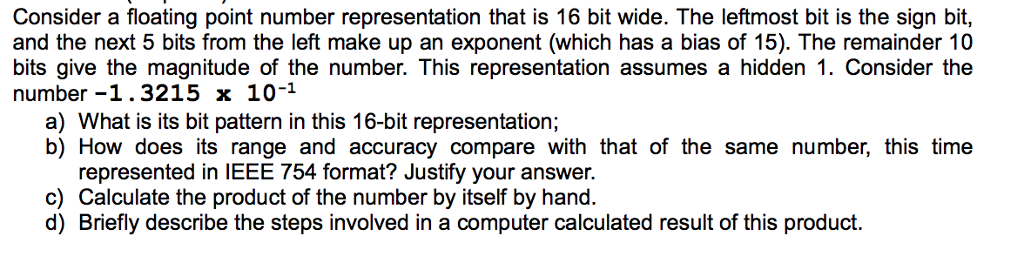
Consider a floating point number representation that is 16 bit wide. The leftmost bit is the sign bit, and the next 5 bits from the left make up an exponent (which has a bias of 15). The remainder 10 bits give the magnitude of the number. This representation assumes a hidden 1. Consider the number -1.3215 x 10⁻¹ a) What is its bit pattern in this 16-bit representation; b) How does its range and accuracy compare with that of the same number, this time represented in IEEE 754 format? Justify your answer. c) Calculate the product of the number by itself by hand. d) Briefly describe the steps involved in a computer calculated result of this product. Consider a floating point number representation that is 16 bit wide. The leftmost bit is the sign bit, and the next 5 bits from the left make up an exponent (which has a bias of 15). The remainder 10 bits give the magnitude of the number. This representation assumes a hidden 1. Consider the number -1.3215 x 10⁻¹ a) What is its bit pattern in this 16-bit representation; b) How does its range and accuracy compare with that of the same number, this time represented in IEEE 754 format? Justify your answer. c) Calculate the product of the number by itself by hand. d) Briefly describe the steps involved in a computer calculated result of this product
Step by Step Solution
There are 3 Steps involved in it

Get step-by-step solutions from verified subject matter experts
 Study Help