







Question: Consider a function $z=f(x, y)$, where $X$ and $y$ are independent random variables. By expanding $f(x, y) $ about $(x, y)=left(mu_{x}, mu_{y} ight) $, where
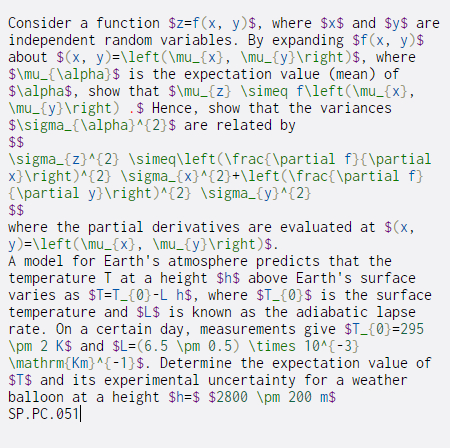
Consider a function $z=f(x, y)$, where $X$ and $y$ are independent random variables. By expanding $f(x, y) $ about $(x, y)=\left(\mu_{x}, \mu_{y} ight) $, where $\mu_{\alpha}$ is the expectation value (mean) of $\alpha$, show that $\mu_{z} \simeq f\left(\mu_{x}, \mu_{y} ight) . Hence, show that the variances $\sigma_{\alpha}^{2}$ are related by $$ \sigma_{z}^{2} \simeq\left(\frac{\partial f}{\partial x} ight)^{2} \sigma_{x}^{2}+\left(\frac{ \partial f} {\partial y} ight)^{2} \sigma_{y}^{2} $$ where the partial derivatives are evaluated at $(x, y)=\left(\mu_{x}, \mu_{y} ight)$. A model for Earth's atmosphere predicts that the temperature I at a height $h$ above Earth's surface varies as $T=T_{0}-L h$, where $T_{0}$ is the surface temperature and $L$ is known as the adiabatic lapse rate. On a certain day, measurements give $T_{0}=295 \pm 2 K$ and $L=(6.5 \pm 0.5) \times 10^{-3} \mathrm{Km}^{-1}$. Determine the expectation value of $T$ and its experimental uncertainty for a weather balloon at a height $h=$ $2800 \pm 200 m$ SP.PC.0511
Step by Step Solution
There are 3 Steps involved in it

Get step-by-step solutions from verified subject matter experts
 Study Help