







Question: Consider a group project you need to do with another classmate. Both of you have to decide individually how much effort to put into
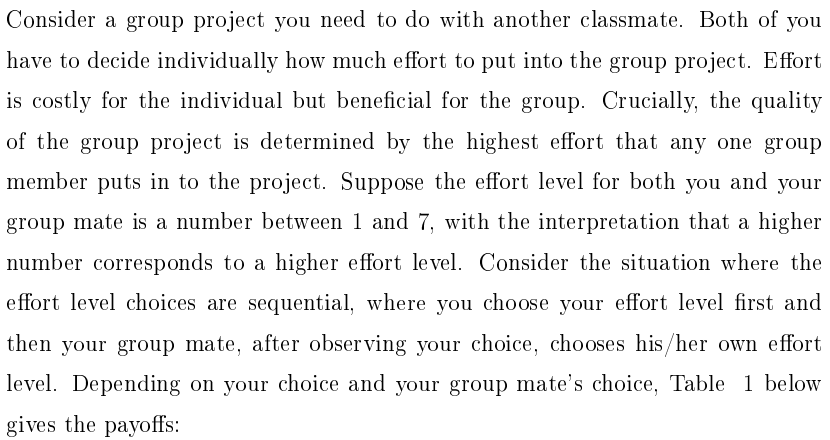
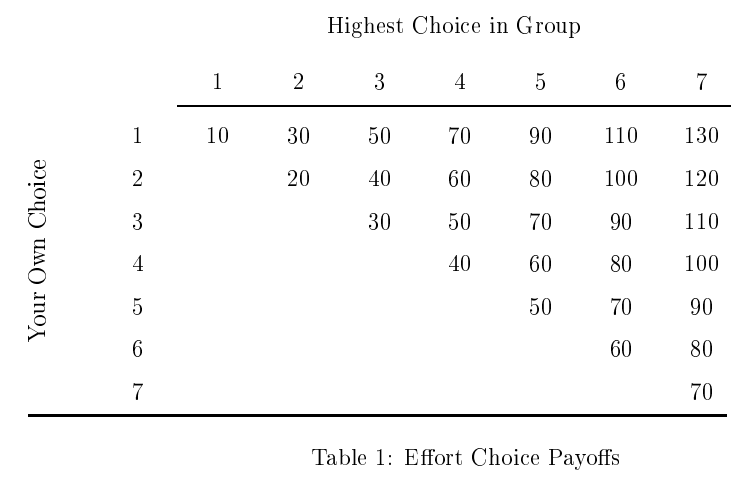

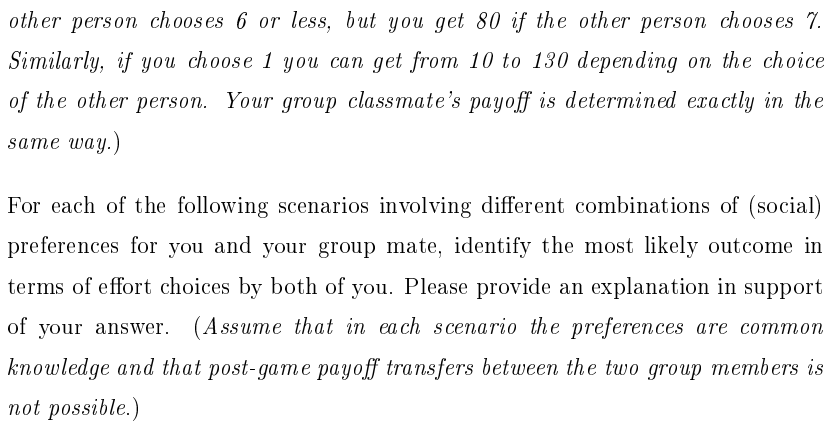
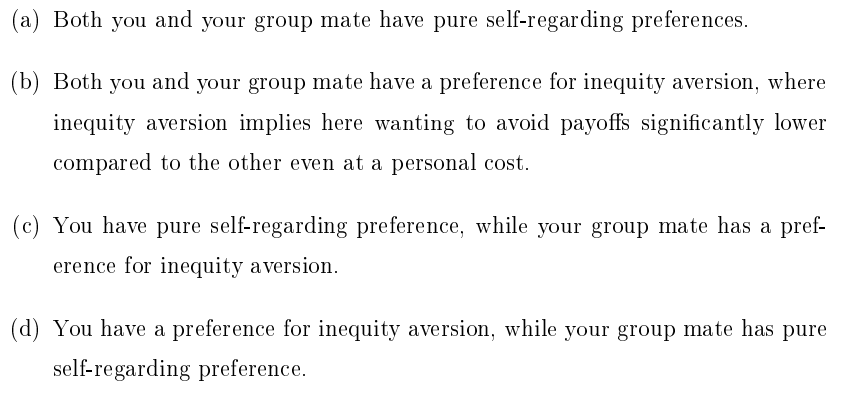
Consider a group project you need to do with another classmate. Both of you have to decide individually how much effort to put into the group project. Effort is costly for the individual but beneficial for the group. Crucially, the quality of the group project is determined by the highest effort that any one group member puts in to the project. Suppose the effort level for both you and your group mate is a number between 1 and 7, with the interpretation that a higher number corresponds to a higher effort level. Consider the situation where the effort level choices are sequential, where you choose your effort level first and then your group mate, after observing your choice, chooses his/her own effort level. Depending on your choice and your group mate's choice, Table 1 below. gives the payoffs: Your Own Choice Highest Choice in Group 1 2 3 4 5 6 7 1 10 30 50 2 3 20 40 760 70 90 110 130 60 80 100 120 30 50 70 90 110 4 5 6 7 40 60 80 100 50 70 90 60 80 70 Table 1: Effort Choice Payoffs (For example, if you choose an effort of 7 you are guaranteed a payoff of 70 irrespective of your group classmate's choice. If you choose 6, you get 60 if the other person chooses 6 or less, but you get 80 if the other person chooses 7. Similarly, if you choose 1 you can get from 10 to 130 depending on the choice of the other person. Your group classmate's payoff is determined exactly in the same way.) For each of the following scenarios involving different combinations of (social) preferences for you and your group mate, identify the most likely outcome in terms of effort choices by both of you. Please provide an explanation in support of your answer. (Assume that in each scenario the preferences are common knowledge and that post-game payoff transfers between the two group members is not possible.) (a) Both you and your group mate have pure self-regarding preferences. (b) Both you and your group mate have a preference for inequity aversion, where inequity aversion implies here wanting to avoid payoffs significantly lower compared to the other even at a personal cost. (c) You have pure self-regarding preference, while your group mate has a pref- erence for inequity aversion. (d) You have a preference for inequity aversion, while your group mate has pure self-regarding preference.
Step by Step Solution
There are 3 Steps involved in it

Get step-by-step solutions from verified subject matter experts
 Study Help